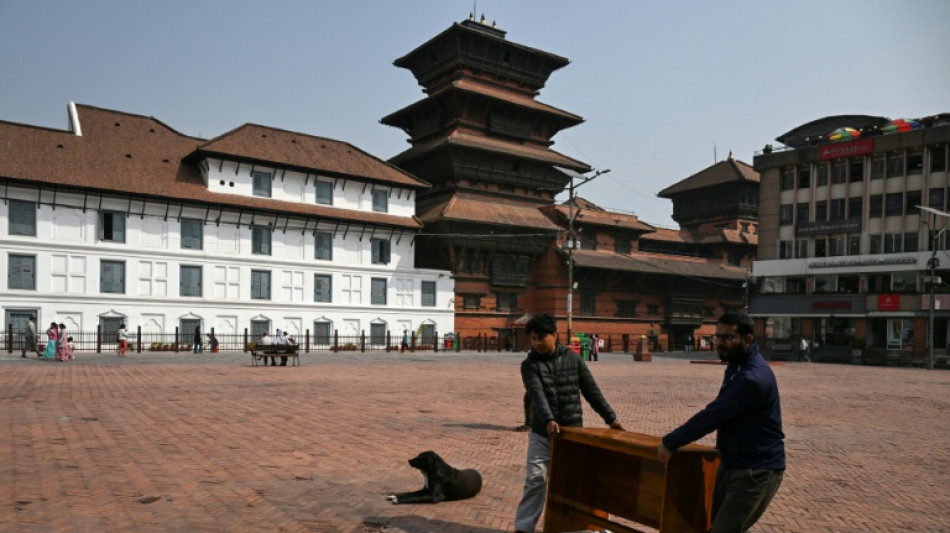
Nepal's Gen Z pins hopes on post-uprising elections / Photo: TAUSEEF MUSTAFA - AFP

 Brigitte Bardot widower slams sale of star's belongings

 Indonesia accepts Malaysia's help to tackle wildfires
 Nvidia, OpenAI CEOs to attend Xi dinner at White House

 Cuba hit with seventh major blackout of the year

 Nigeria miners struggled to breathe in cell before 37 died: survivors

 Warren Buffett steps down as Berkshire Hathaway chairman

 Isolated Syrian-Druze city blames Damascus for shortages

 Kerry James Marshall: American 'blackness' painter celebrated in Europe

 Infantino 'must go', says German FA vice-president

 Japan's busiest rail station tests robot bins

 Backpackers fret over Australian visa crackdown

 Bank of Japan hikes rates to 31-year high to battle inflation

 AI doomsday warnings unlikely to slow IPOs but questions linger

 In Brazil's Amazon, the hunt for oil fuels hopes and fears

 Baby orangutans in India expose 'frightening' scale of trafficking

 Oversight Board blasts 'inadequate' Meta safeguards for AI deepfakes

 Harry makes first public appearance since return to UK

 Princess Diana's brother makes new explosive claims against Charles

 Trump admin overhauls key protection for endangered species

 Mbappe draws political fire over Ceuta t-shirt controversy

 Third malaria death in Germany from outbreak tied to Frankfurt airport

 AtlasClear Holdings Reports Preliminary Fiscal 2026 Revenue of Approximately $20.1 Million, Up 85%; Revenue Plus Interest Income of Approximately $21.9 Million

 'Another arrow to the quiver': World Bank posts record private capital mobilization

 Ireland to boycott Eurovision 2027 over Gaza

 India's Tata Sons reappoints N. Chandrasekaran as chairman

Six months after joining anti-corruption protests that rocked Nepal, 23-year-old Amrita Ban will vote in Thursday's election, hoping the new government will realise the movement's demands.
Last September's violence, in which at least 77 people were killed, parliament set on fire and the government ousted, still shadows her today.
"It took months to sleep properly again," she told AFP. "As soon as I closed my eyes, I would hear gunshots, like it was happening right now."
The demonstrations were initially sparked by anger over a brief government ban on social media but were driven by deeper frustration over economic hardship, corruption and entrenched political practices.
At least 19 people were killed in a security crackdown on the first day of protests, before the unrest spread across the country.
"The candidates I support are those whom I believe will carry forward the spirit of our movement," said Ban, who worked to encourage young people to vote.
Nearly 19 million people have registered to vote in the parliamentary polls, including about 800,000 for the first time.
- 'Political awakening' -
Young Nepalis largely led the protests, rallying under the loose banner of Gen Z.
They do not have a party of their own, but exert pressure and wield significant influence, especially online.
"We are not in the election race, but we will still be active in raising our voices from outside, the streets are with us," said Yujan Rajbhandari, aged 24.
"The movement still continues."
Former protesters have backed a surge of new candidates calling for change, and invoking the Gen Z movement.
"They cannot forget us if they win," 22-year-old Astha Basnet told AFP.
"There has been a political awakening among younger people," she added, saying people were "very curious" about the parties, policies and candidates.
"There is an excitement -- and also a sense of responsibility -- among the voters of our generation."
Still, some activists warn against equating popularity with competence, or ignoring experience simply because someone is new.
"There is a danger to our democracy if we choose populism over capability," said Riyab Baniya, aged 21.
"Right now, those whose voices are louder are getting popular, but we have to be critical -- we have to support people who will take our mandate forward."
- 'Tired of old leaders' -
Many who drove the movement remain outside mainstream politics -- raising concerns about whether their demands will be fully represented.
"We raised our voices against bad governance and corruption," said Janak Pokharel, 28.
"But the parties and leaders need to have a roadmap on how to address these issues and older existing problems."
More than 3,400 candidates are running for 165 seats in direct elections to the 275-member House of Representatives, the lower chamber of parliament, with 110 more chosen via party lists.
Nearly a third of them are under the age of 40, some of whom came to prominence through the protests.
"We are not looking just for new faces, we need a change in the culture -- society was tired of the old leaders," Ban added.
"It is a testing period for forces of alternative politics."
P.Kolisnyk--CPN