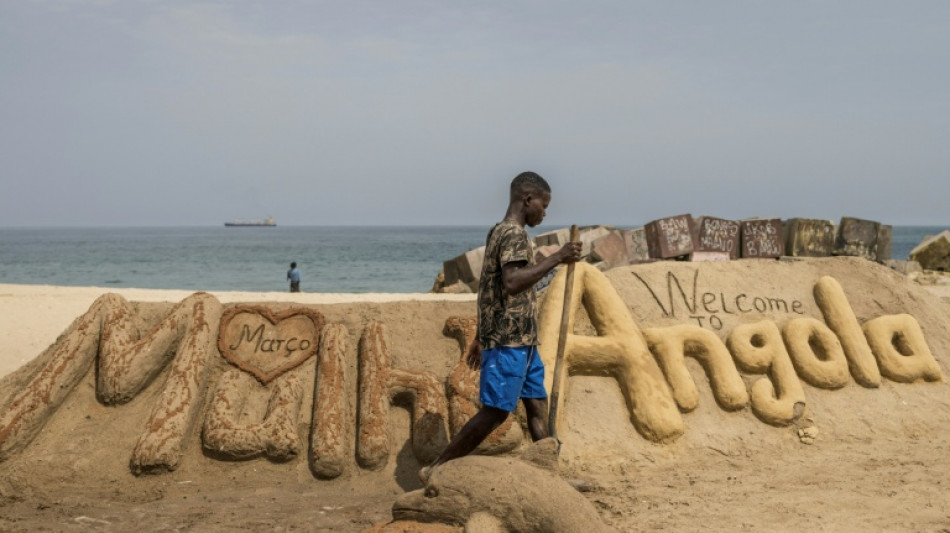
Hidden gem: Angola opens up to tourists in a pivot from oil / Photo: MARCO LONGARI - AFP/File

 Trump's photo of Xi greeting carries signs of AI

 First US trial against TikTok to open Monday

 French literary prize removes novel from longlist after AI claims

 Trump accuser E. Jean Carroll finally has her damages

 Heavy fighting, internet disruption as Ethiopia conflict rages
 Asian markets mixed after oil gains

 UN approves resolution on dealing with rising sea levels
 Global stocks mostly fall as oil prices and bond yields rise

 Starbucks to close 250 more cafes in North America
 Stocks fall as oil prices rise and bonds back under pressure
 Top ECB official to resign to take up IMF role

 Eviction of pensioner puts Spain housing crisis in spotlight
 Average EU diesel price hits record 2.23 euros a litre: AFP analysis

 Whitetip Investments Marks 10 Years of Regulation, Transparency & Responsible Trading

 Stocks fall, oil prices rise as global bonds under pressure
 Hungary detects invasive spotted lanternfly for first time in EU

 Forex Expo Dubai 2026 Breaks Guinness World Record Again With 23,816 Attendees

 Asian markets fall on US-China jitters as leaders meet
 As Moscow steps up attacks, Kyiv residents brace for harsh winter

 Markets mixed as China's Xi arrives for US talks
 Archaeological 'breakthrough' could confirm origins of Paris

 Australian PM says OpenAI hacked government health website

 Rio breaks record for rainiest September amid powerful El Nino
 Mandela Digital Extends Early Access Programme to 11 February 2027 Following Strong Response

 McDonald's to boost franchisees as inflation weighs on consumers
When Feliesiano Muteca started surfing a decade ago, he had the waves at Cabo Ledo on Angola's long Atlantic coastline pretty much to himself.
Now, the unspoilt and sandy beach about 125 kilometres (75 miles) south of the capital Luanda has become a prized destination for international surfers, with a reputation as a hidden gem.
The Portuguese-speaking southern African nation is still scarred by a long post-independence civil war that stalled its development, although parts of Luanda flash with oil money.
Wary of its dependence on oil and already burned by the market's volatility, Angola is embarking on a drive to lure back foreign tourists by easing access for travellers and boosting its attractions.
These include Cabo Ledo, where Muteca is a qualified surfing instructor with the sport's accredited body.
"There are two of us, and we give surf lessons," said Muteca, who started out when he was about 10 years old by borrowing boards from other surfers.
"Otherwise, we're there to help out on the beach," he said, pointing to thatched cabanas being assembled on the sand.
Further along, a small lodge has set up a beachside bar and cafe, with cabins on the hillside overlooking the Atlantic.
It is filled with a group of Germans enjoying the shade between waves. The same company, Carpe Diem, has a larger resort just up the coast.
Nearby tourist sites like the dramatic seaside Miradouro da Lua cliffs once had little more than a dusty road to a lookout point.
Now there’s a smoothie hut and a cocktail bar, with a branded wooden frame showing the best angles for photos and selfies.
- Cruises and cuisine -
After five decades of war that ended in 2002, the vast country had a Stalinist government suspicious of the outside world.
Oil fuelled a post-war boom but an oil crash sent the kwanza currency tumbling. In 2014, it traded at around 100 to the US dollar. It is now trading around 900 to one dollar.
The oil boom days sent tourism to a high of nearly $1.6 billion in 2014, with the yacht crowd filling Luanda Bay and splashing huge sums on lavish beach parties.
That plunged to just $14.8 million last year, according to the National Bank.
It led the government to adopt a new tourism strategy.
Since last year, dozens of countries have visa-free entry. An airport where soldiers once patrolled with AK-47s is now staffed with smiling young travel ambassadors wearing denim overalls with bibs that read: "Can I help you?".
The yacht club remains busy but Luanda has also become a stop for cruise liners.
Local tour companies are opening to guide visitors through the less developed interior.
And high-end international companies are adding Angola to their itineraries.
Luanda-born writer Claudio Silva in June co-hosted a week-long journey for foodies, travelling with a top Angolan chef to visit new wineries and explore pre-colonial cuisine and heritage farming.
"Deep-dive gastronomic tours like the one we’re doing with Roads and Kingdoms are an opportunity for us to tell our own stories, through food and culture, in urban and rural settings, where our journey is guided by the experiences of the people who live here," he said.
South African luxury train operator Rovos Rail has also added the Angolan port city of Lobito to its routes, creating overland treks that can run across the continent from the Indian Ocean to the Atlantic.
Those journeys pass through inland areas largely unseen by outsiders for decades. That means accommodation can be basic or require camping.
The once-rich wildlife population was decimated by the years of war but government-sponsored repopulation efforts are under way, said Pedro Monterroso of African Parks, a non-profit conservation group.
Local rangers and communities are also being trained to become involved in the safari sector, said Monterroso, whose organisation has been hired by Angola to run Iona National Park along the Namibian border in the ancient Namib desert.
"The vision is they want to be Namibia or Botswana in 10 or 15 years," Monterroso said, referring to Angola's neighbours that draw tens of thousands of foreign tourists every year to their unspoiled natural riches.
U.Ndiaye--CPN