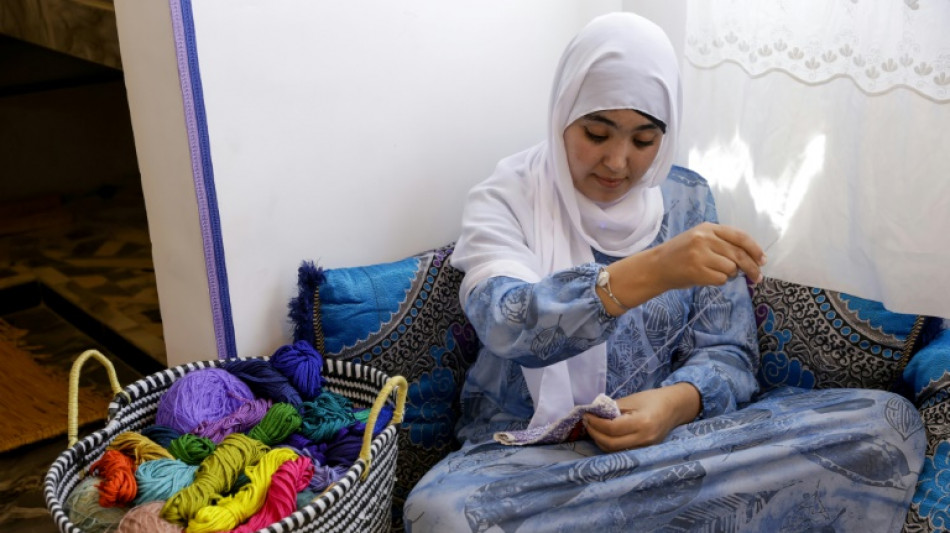
Moroccan women embroider 'art with purpose' / Photo: Abdel Majid BZIOUAT - AFP

 TikTok agrees to teen limits in US settlement following Meta

 Venezuela's oil cradle pins hopes on US energy deals
 Lula bans sports betting days ahead of Brazil's election

 Spotting AI writing: how reliable are the detectors?

 US court refuses to overturn Pentagon ban on Anthropic

 South Lebanon children return to school destroyed by Israel strike

 European stock markets climb as oil prices drop

 Asian markets mixed after recent oil surge
 Cash for nature protection: hotelier's offer to Principe islanders

 India rape cases turn focus back onto women's safety

 Rich nations should foot climate bill, says Nepal minister

 Italy bans burqas in schools, caps numbers of foreign students per class

 Napoli hoping to build new stadium, says owner

 What happens if the US bans diesel exports
 Oscar-winner Cotillard fears being moved by AI actor

 Stocks fall, oil prices rise as global bonds back under pressure

 Streamex Converts Interest Into Capital as GLDY Investment Strategy Secures $1M+ Institutional Allocation

 STARTRADER Named Best Fintech Forex Broker at Forex Expo Dubai 2026

 German think tanks urge Merz to stick with reforms after election defeats

 France's top-selling newspaper to slash jobs

 BaazEX Enters the Asian Trading Market With a New Approach to Online Forex Trading.

 Sao Tome voters want to stop exodus of 'neglected' youth

 Mexican cartels target Australia with their African meth

 Rapper-turned-PM faces first big test after Nepal disaster

 Meta launches camera-free AI glasses amid privacy pushback

In a small village on the coast of southern Morocco, women gather in a house to create collaborative works of textile art, and also earn a living.
Several hunch over large canvasses, embroidering their latest piece at the women-only workshop, in the village of 400 people. Some of their works have been shown internationally.
"This project has changed my life," said Hanane Ichbikili, a 28-year-old former nursing student turned project creative director.
"And yet I had never held an embroidery needle before," she told AFP.
Just 19 percent of Moroccan women hold steady jobs, according to official figures, and in rural areas they are particularly affected by poverty, unpaid labour and a lack of opportunity.
An artist with roots in both Morocco and France has tried to make a difference.
Margaux Derhy founded the workshop in 2022 in her father's native village of Sidi R'bat, around 70 kilometres (45 miles) south of Agadir, to fulfil her "dream to make art with purpose".
The project uses textiles and old photographs to explore her family heritage before they left the country in the 1960s, turning sepia-toned portraits and scenes into large silk-and-linen canvases.
The North African country was a protectorate of France before gaining its independence in 1956.
- Creative process -
The project is more than just personal for Derhy -- it also provides local women in the small fishing village employment.
"I wanted to be engaged on the ground," said Derhy, adding that she hired 10 local women to work full-time for a monthly salary exceeding Morocco's private-sector minimum wage of 3,045 dirhams ($330).
The women's hands glide over frames that were once used by Paris's prestigious Maison Lesage, the world-famous embroidery house that has worked with some of the greatest names in fashion.
The creative process is collaborative, with Derhy drawing an outline and the team then gathering to choose the threads and colour palette for each section.
A canvas can take up to five months to complete.
The finished works, priced at up to $5,620, have been shown in exhibitions in Marrakesh, Paris and Brussels. Future exhibits are planned for Casablanca's L'Atelier 21 and Tabari Artspace Gallery in Dubai.
The workshop has also helped to challenge perceived ideas about women in the village.
"At first, some of the women had to hide to come because it was frowned upon," said Khadija Ahuilat, 26, who oversees operations.
- 'A blessing' -
She said some people thought the project "was nonsense, and a woman should stay at home".
"But we managed to change that. I'm very proud to have contributed to this change, even if on a small scale."
Her mother, Aicha Jout, 50, a widow who once gathered mussels and raised livestock to support her family, is now one of the embroiderers.
"It changes a lot for me to be here," she said.
"I love the idea of embroidering on pictures, but also of passing on the craft to other women."
Jout learned to embroider at the age of 12, and has trained the rest of her mostly single or widowed colleagues.
"There aren't really a lot of job opportunities here, so when the chance came I didn't hesitate for a second," said Haddia Nachit, 59, one of the workshop's most efficient embroiders.
Her nickname among the women is "TGV" -- after France's high-speed train.
Seated next to Nachit, Fadma Lachgar, also 59, said the work allowed her to help her family.
"Resuming embroidery at my age, after 20 years of stopping, is a blessing," she said.
L.K.Baumgartner--CPN