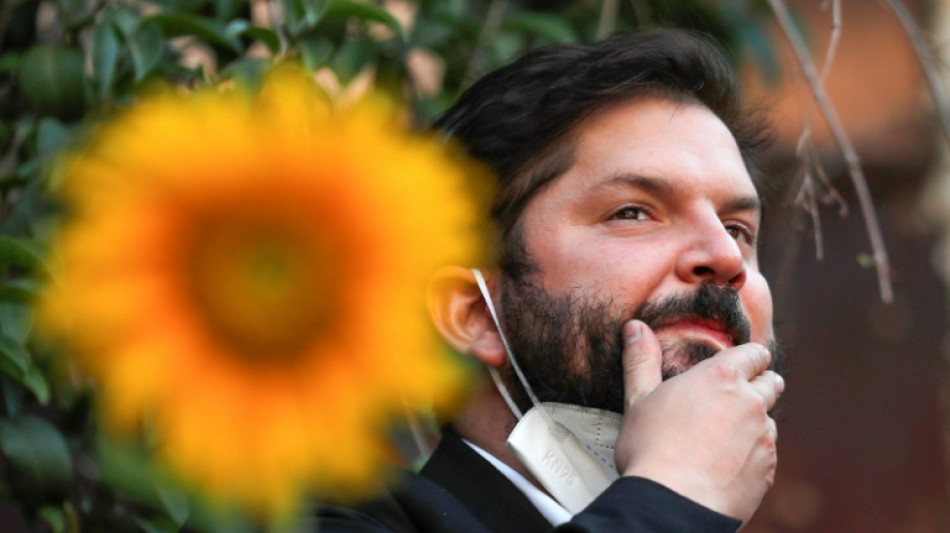
Reserve Bank chief will be Chile's new finance minister

 Lights out in Laos as electricity exports surge

 Steven Strogatz weighs AI mathematics advances and their consequences for researchers

 Anthropic boss calls for AI slowdown, Altman and Musk agree

 French IT giant Capgemini sells subsidiary after row over ICE links

 Quebec Brokerage Qubit Insurance Announces New Data on Coverage Shortfalls as Rebuilding Costs Rise

 Lady Gaga welcomes first child with fiance: US media

 Bhutan business bets on hazelnuts for farming future

 'Widow's Bay' and 'The Pitt' are favorites for Emmys night

 Coastal erosion forces cancellation of California music festival

 Argentina's Dirty War rears its head in Venice film

 UK lawmakers throw out bill to legalise assisted dying

 US inflation steady in August, fueling Fed rate hike expectations

 New York marks 25th anniversary of 9/11 attacks

 Nepal flood reconstruction bill to be $4.78 bn: foreign ministry

 JUMO and Standard Bank launch Social Finance Framework to scale inclusive finance in Africa

 Doomsday tech: could AI really kill us all?

 French comedy show 'Call my agent' makes film comeback

 It's all coming back: Celine Dion fans gear up for Paris return

 Researchers eye AI revolution in natural disaster forecasts

 US braces for inflation report that may push Fed to hike rates

 Musk threatens legal action over documentary

 Latin America fact-check group asks Meta not to replace verification practice

 AI Risks to Enter 60–80% of Liability and Cyber Insurance Underwriting by 2028, ScienceSoft Predicts

 Tribal Launches Campfire, Letting Business and Technical Teams Build on Salesforce Together

 Stocks fall as fresh oil surge fans inflation fears

Chile's leftist president-elect Gabriel Boric, whose victory at the polls last month unsettled the markets, on Friday named the country's Central Bank governor as his finance minister in a young, diverse and woman-majority cabinet.
Mario Marcel, an independent politician and former member of the Socialist Party, with which he maintains strong ties, announced his resignation as Reserve Bank chief overnight.
The 62-year-old had held various roles under center-left governments from 1990 to 2008.
He was appointed Reserve Bank governor by Socialist former president Michelle Bachelet for a five-year term that started in late 2016 and continued under her center-right successor Sebastian Pinera.
Marcel was the favorite of the markets, which view his appointment as a sign of moderation in the economic reforms Boric had vowed to implement.
Boric, painted by his detractors as a "communist," succeeded in mobilizing record turnout in the December 19 vote, and garnered nearly 56 percent of votes cast, compared to 44 percent for ultra-conservative Jose Antonio Kast.
In an alliance with Chile's Communist Party, Boric campaigned on promises of creating a "welfare state," increasing taxes and social spending.
Kast, in turn, had pledged to protect the neo-liberal economic model left behind by Pinochet -- credited with Chile's relative wealth but blamed for a yawning gap between rich and poor.
Investors reacted nervously to Boric's victory, with the SP IPSA index closed 6.18 percent down the day after the election, while the Chilean peso ceded 3.4 percent to the US dollar to reach an historic rate of 876.
- 'Diverse backgrounds and training' -
Boric had vowed in his first official address to "expand social rights" in Chile, but to do so with "fiscal responsibility."
"We will do it protecting our macro-economy," he said.
As interior minister, Boric chose Izkia Siches, 35, a surgeon who in 2017 became the first president of the Medical College, a professional association of physicians.
Boric's 24-member cabinet contains 14 women.
It includes former student leaders and lawmakers Giorgio Jackson and Camila Vallejo, who together with Boric led protests in 2011 for free schooling.
Maya Fernandez -- the granddaughter of Marxist former president Salvador Allende who died in the 1973 coup d'etat led by Augusto Pinochet -- will be defense minister.
The new foreign minister will be 53-year-old lawyer Antonia Urrejola, who last year became the president of the Inter-American Commission on Human Rights.
"We are accompanied in this team of ministers by people of diverse backgrounds and training, a diverse cabinet," said Boric as he unveiled his new team.
The cabinet has a wide representation of regions, generations and political leanings, he added.
The average age of the team is 49, with the youngest, at 32, new Women's Affairs Minister Antonia Orellana. Seven of the cabinet members are in their 30s.
Boric, elected at 35, will be Chile's youngest-ever president, and one of the youngest in world history.
He will be sworn in on March 11.
U.Ndiaye--CPN