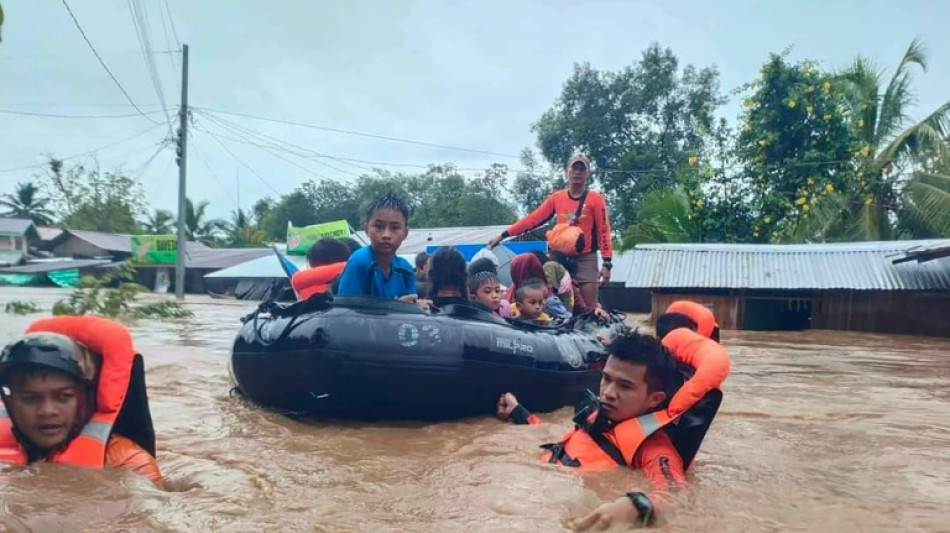
At least 42 killed as storm lashes southern Philippines / Photo: Handout - Philippine Coast Guard (PCG)/AFP

 Lights out in Laos as electricity exports surge

 Steven Strogatz weighs AI mathematics advances and their consequences for researchers

 Anthropic boss calls for AI slowdown, Altman and Musk agree

 French IT giant Capgemini sells subsidiary after row over ICE links

 Quebec Brokerage Qubit Insurance Announces New Data on Coverage Shortfalls as Rebuilding Costs Rise

 Lady Gaga welcomes first child with fiance: US media

 Bhutan business bets on hazelnuts for farming future

 'Widow's Bay' and 'The Pitt' are favorites for Emmys night

 Coastal erosion forces cancellation of California music festival

 Argentina's Dirty War rears its head in Venice film

 UK lawmakers throw out bill to legalise assisted dying

 US inflation steady in August, fueling Fed rate hike expectations

 New York marks 25th anniversary of 9/11 attacks

 Nepal flood reconstruction bill to be $4.78 bn: foreign ministry

 JUMO and Standard Bank launch Social Finance Framework to scale inclusive finance in Africa

 Doomsday tech: could AI really kill us all?

 French comedy show 'Call my agent' makes film comeback

 It's all coming back: Celine Dion fans gear up for Paris return

 Researchers eye AI revolution in natural disaster forecasts

 US braces for inflation report that may push Fed to hike rates

 Musk threatens legal action over documentary

 Latin America fact-check group asks Meta not to replace verification practice

 AI Risks to Enter 60–80% of Liability and Cyber Insurance Underwriting by 2028, ScienceSoft Predicts

 Tribal Launches Campfire, Letting Business and Technical Teams Build on Salesforce Together

 Stocks fall as fresh oil surge fans inflation fears

Landslides and flooding killed at least 42 people as heavy rain from an approaching storm lashed the southern Philippines, a disaster official said Friday.
The storm unleashed flash floods carrying uprooted trees, rocks and mud overnight in nine mostly rural towns around Cotabato, a city of 300,000 people on Mindanao island.
Many residents were caught by surprise as floodwaters rose rapidly before dawn, Naguib Sinarimbo, the spokesman and civil defence chief for the regional government, told AFP.
Sinarimbo said 27 died in the town of Datu Odin Sinsuat, including 11 from a mountain village buried in mud, while 10 died in Datu Blah Sinsuat town and five were killed in Upi town.
Teams in rubber boats had rescued residents from rooftops in some towns, Sinarimbo said, adding that 16 people were missing in the region.
In recent years, flash floods with mud and debris from largely deforested mountainsides have been among the deadliest hazards posed by typhoons on Philippine communities.
Mindanao is rarely hit by the 20 or so typhoons that strike the Philippines each year and kill hundreds of people. But those that do tend to be deadlier than those that hit Luzon, the main island.
A long mountain range walls off most of Luzon from the Pacific, where most storms are spawned, helping to absorb the blow, the state weather service said.
Local filmmaker Remar Pablo told AFP he was shooting a beauty pageant in Upi when the floodwaters suddenly came in after midnight and forced audience members to flee.
A row of cars sat half-submerged on the street outside, his clips showed.
"We were stranded inside," said Pablo, who eventually waded through the water to get home.
Rescuers carried a baby in a plastic tub as they navigated chest-deep water, a photo posted by the provincial police showed.
- 'It was a shock' -
Floodwaters have receded in several areas, but Cotabato remained almost entirely waterlogged.
Sinarimbo said there could be more flooding over the next few hours because of heavy rain over mountains surrounding the Cotabato river basin.
"Our focus at this time is rescue as well as setting up community kitchens for the survivors," he said.
The army deployed its trucks to collect stranded residents in Cotabato and nearby towns, provincial civil defence chief Nasrullah Imam said.
"It was a shock to see municipalities which had never flooded getting hit this time," Imam said, adding that some families were swept away when the waters hit their homes.
The heavy rainfall began late Thursday in the impoverished region, which is under Muslim self-rule after decades of separatist armed rebellion.
The state weather office in Manila said the downpours were partly caused by Tropical Storm Nalgae, which it expects to strengthen at landfall overnight Friday.
Nalgae was heading northwest with maximum winds of 85 kilometres (53 miles) an hour and could hit Samar island late Friday or the Bicol peninsula on the southern tip of Luzon early Saturday.
Nearly 5,000 people were evacuated from flood- and landslide-prone communities in these areas, the civil defence office said.
The coast guard also suspended ferry services in much of the archipelago nation where tens of thousands of people board boats each day.
Scientists have warned that storms, which also kill livestock and destroy farms, houses, roads and bridges, are becoming more powerful as the world gets warmer because of climate change.
strs-cgm/dva
M.García--CPN