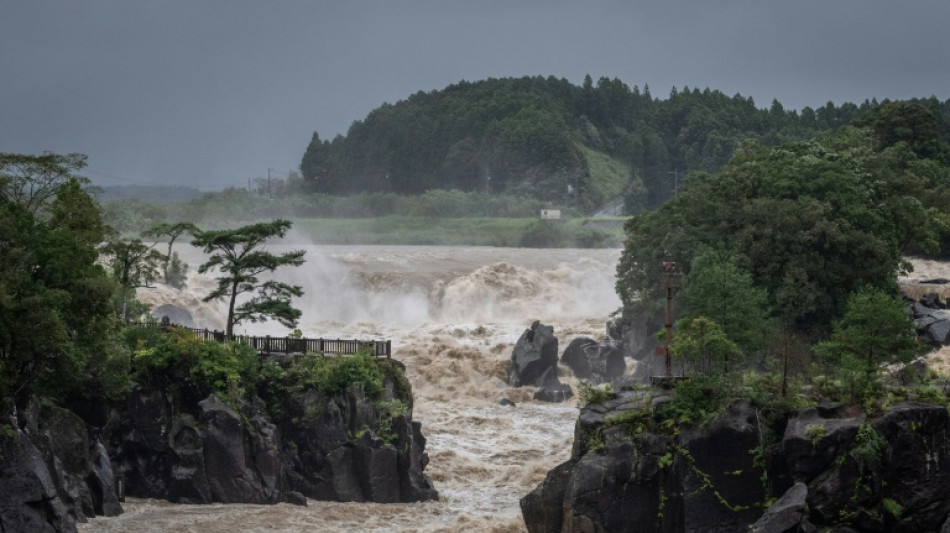
Evacuation warnings after typhoon makes landfall in Japan / Photo: Yuichi YAMAZAKI - AFP

 Lights out in Laos as electricity exports surge

 Steven Strogatz weighs AI mathematics advances and their consequences for researchers

 Anthropic boss calls for AI slowdown, Altman and Musk agree

 French IT giant Capgemini sells subsidiary after row over ICE links

 Quebec Brokerage Qubit Insurance Announces New Data on Coverage Shortfalls as Rebuilding Costs Rise

 Lady Gaga welcomes first child with fiance: US media

 Bhutan business bets on hazelnuts for farming future

 'Widow's Bay' and 'The Pitt' are favorites for Emmys night

 Coastal erosion forces cancellation of California music festival

 Argentina's Dirty War rears its head in Venice film

 UK lawmakers throw out bill to legalise assisted dying

 US inflation steady in August, fueling Fed rate hike expectations

 New York marks 25th anniversary of 9/11 attacks

 Nepal flood reconstruction bill to be $4.78 bn: foreign ministry

 JUMO and Standard Bank launch Social Finance Framework to scale inclusive finance in Africa

 Doomsday tech: could AI really kill us all?

 French comedy show 'Call my agent' makes film comeback

 It's all coming back: Celine Dion fans gear up for Paris return

 Researchers eye AI revolution in natural disaster forecasts

 US braces for inflation report that may push Fed to hike rates

 Musk threatens legal action over documentary

 Latin America fact-check group asks Meta not to replace verification practice

 AI Risks to Enter 60–80% of Liability and Cyber Insurance Underwriting by 2028, ScienceSoft Predicts

 Tribal Launches Campfire, Letting Business and Technical Teams Build on Salesforce Together

 Stocks fall as fresh oil surge fans inflation fears

Millions of people in Japan were under evacuation warnings on Monday as Typhoon Nanmadol brought strong winds and heavy rain to the southwest of the country after making landfall overnight.
The powerful system has weakened since arriving on land Sunday evening around Kagoshima city in the southwestern region of Kyushu, but it has still uprooted trees, smashed windows and left rivers close to overflowing.
National broadcaster NHK said one person had been killed and 50 others injured as the storm passed through Kyushu. There was no immediate confirmation of the figures from authorities.
Prime Minister Fumio Kishida, who had been scheduled to leave Monday for the United Nations General Assembly, will delay his trip by a day to check on damage from the storm, his office confirmed.
Officials from the Japan Meteorological Agency warned that in Miyazaki prefecture, where some areas saw more rainfall in 24 hours than they normally receive in all of September, river levels were high.
"Even a tiny amount of additional rainfall could cause the water level to increase, so please remain vigilant about flooding and landslides," Yoshiyuki Toyoguchi from the land ministry told reporters.
Still, given the intensity of the storm, which came ashore packing gusts of up to 234 kilometres (145 miles) an hour, damage appeared relatively limited so far.
"The typhoon has all but disappeared today and the rain and wind are also subsiding now," an official in charge of crisis management in Miyazaki's Saito city told AFP.
"But power is out in some places... we're also hearing from many residents that electrical wires have been severed and trees have been toppled," he said, declining to be named.
"Flooding is affecting some areas as well," he added, saying that officials "believe there are still many details of the damage we're yet to grasp".
Rare "special warnings" for Kagoshima and Miyazaki prefectures, issued only when weather events seen every few decades are forecast, have been downgraded.
But evacuation warnings of various levels remained in place for 9.6 million people on the last day of a holiday weekend in Japan.
The warnings are not mandatory, and authorities have at times struggled to convince residents to leave their homes during extreme weather events.
- 'I didn't feel safe at home' -
In the town of Izumi in Kagoshima prefecture, 30-year-old Yasuta Yamaguchi spent the night in a local hotel to shelter from the storm.
"I came to the hotel to shelter myself because it was windy and I thought it was dangerous," he told AFP.
"I didn't feel safe at home."
By Monday morning, nearly 313,000 households in Kyushu and neighbouring Chugoku region were without power, utilities said. Hundreds of flights had been cancelled, NHK said, and many train services throughout the affected regions were also halted.
As of 11:00 am (0200 GMT), the typhoon was spiralling north-northeast near Kitakyushu, Kyushu island's northernmost city, with maximum gusts of around 162 kilometres per hour, according to the JMA.
"The thick cloud and eye area around the typhoon's centre have already disappeared and it is weakening rapidly," Ryuta Kurora, the head of the JMA's forecast unit, told reporters.
"The typhoon is still weakening, and from 9:00 am (0000 GMT) it has been downgraded from a category strong and large typhoon to a large typhoon," he said.
Japan is currently in typhoon season and faces around 20 such storms a year, routinely seeing heavy rains that cause landslides or flash floods.
In 2019, Typhoon Hagibis smashed into Japan as it hosted the Rugby World Cup, claiming the lives of more than 100 people.
A year earlier, Typhoon Jebi shut down Kansai Airport in Osaka, and left 14 people dead in its wake.
2018 was a particularly bad year, with floods and landslides killing more than 200 people in western Japan during the country's annual rainy season.
Scientists say climate change is increasing the severity of storms and causing extreme weather such as heat waves, droughts and flash floods to become more frequent and intense.
H.Meyer--CPN