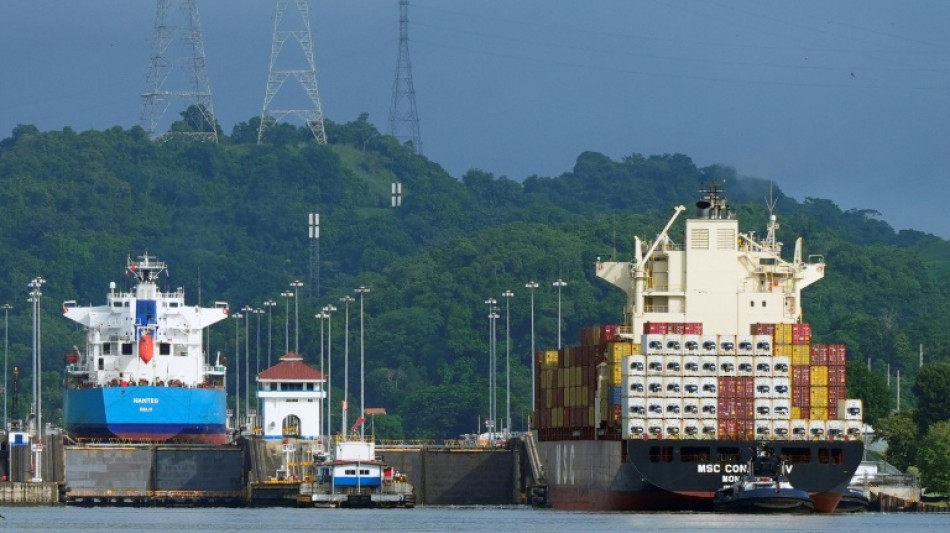
Panama Canal considering more cuts in transits due to El Nino / Photo: ARNULFO FRANCO - AFP/File

 S.African activists push back on data centre rush

 Billionaire Ambani's Jio to debut after record India IPO

 UK set for cautious budget as borrowing costs climb

 US Fed expected to hold rates steady ahead of key midterm elections

 AI chip giant SK hynix says quarterly operating profit soars 630%

 Charles tackles thorny legacy of slavery on Caribbean trip

 UN nuclear watchdog chief urges Iran to grant access

 Boeing releases cautious growth plan as shares fall sharply
 Tech firms gain on Anthropic IPO optimism; HSBC slumps in London
 Tech firms track Wall St rally on mixed day for stock markets

 HSBC profit jumps on higher rates, lower costs

 Reparations calls follow Charles on tough Caribbean trip

 China brands drop Mbappe for 'offending national sentiments'

 Critical coal inventories affect nearly half of India’s domestic power plants

 Gold ETF flows turn negative after 13 weeks as bullion loses 4%
The number of ships sailing through the Panama Canal could be cut further due to drought caused by the El Nino weather pattern, the new administrator of the waterway told AFP on Monday.
Panama has declared a nationwide emergency over El Nino, a phenomenon developing over the Pacific Ocean that is affecting worldwide weather patterns and pushing up global temperatures.
This year's El Nino is expected to be the strongest since record-keeping began four decades ago.
Panama's restrictions come even as use of the canal has risen: shippers are seeking an alternative to the Strait of Hormuz, which Iran has blocked in retaliation for the war launched by the United States and Israel.
The interoceanic Panama Canal -- which handles five percent of global maritime trade -- has already reduced the maximum number of ships allowed through daily, from 36 last month to 32 by mid-September.
It operates using rainwater that collects in two reservoirs, whose levels have dropped due to the onset of El Nino.
Without water, the locks that lift and lower ships at the start and end of their crossing cannot function.
Ilya Espino de Marotta, who took over as head of the Panama Canal Authority on Monday, told AFP that further measures may be implemented if the drought does not subside.
"We do not rule out the possibility that in February or March we may have to lower the limit -- probably not to 24 slots per day, but it could be reduced to 29 or something similar," she said.
- 200 mn liters per ship -
Each ship requires about 200 million liters of water, which is then discharged into the sea.
In 2023, El Nino forced a reduction in daily transits from 38 to 22 due to the dramatic reduction in reservoir levels.
Espino de Marotta, the first woman ever to head the US-built canal authority, stated, however, that she does not expect restrictions to reach the levels seen that year.
Apart from reducing the number of vessels, canal authorities have also reduced their maximum draft, from 15.2 meters to 14.6 meters (50 feet to 48 feet).
The draft is the vertical distance between the waterline and the lowest point of a ship's hull. It is a measure of how much water is needed for a ship to float safely without running aground.
Experts have warned that long-term restrictions on canal crossings could lead to higher shipping costs and longer waiting times for deliveries.
The United States and China are the main users of the canal, which is the fastest maritime route between the east coast of the United States and China.
The canal connecting the Atlantic and Pacific handles around 40 percent of US container traffic.
The Iran war has pushed up traffic through the channel.
With shipping at a standstill in the Strait of Hormuz, a conduit for a fifth of the world's oil and gas, the Panama Canal has become a fallback route for energy shipments.
H.Cho--CPN