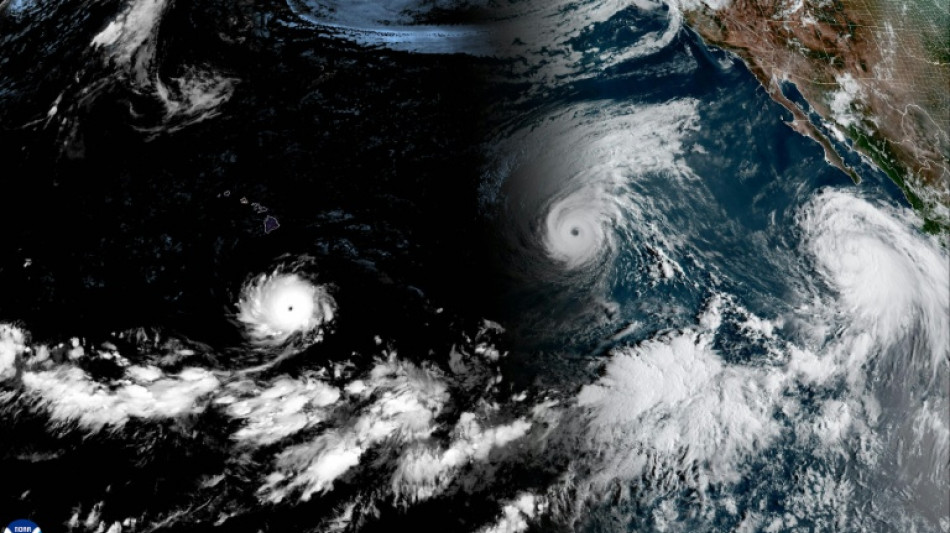
Rare trio of Pacific hurricanes fueled by historic El Nino / Photo: Handout - NOAA/AFP

 Tesla launches self-driving 'Cybercab' in Texas

 Colombian judge bans strikes on guerrillas if minors are present
 Volkswagen says cutting 100,000 jobs by end of decade

 How El Nino is choking the Panama Canal

 Hugging Face, the French start-up that became AI's warehouse

 War criminal Mladic's body returns to Serbia with military honours

 Violence erupts at S.Africa anti-migrant protest

 Spacecraft bound for Mercury begins 'tricky' arrival

 Tazapay Now Live on the Borderless.xyz Network For Seamless Money Movement to Asia Pacific and Latin America

 DWF Labs Expands Global Regulatory Footprint with BVI Virtual Asset Service Provider Approval
 Lost tool disrupted Airbus jet deliveries for months

 France sells bonds at highest rate since 2008 amid deficit worries

 Heavy rain puts a dampener on Taiwan 'extreme heat' drill
 German growth prospects brighten as economy defies Mideast turmoil

 US govt sides with OpenAI in New York Times copyright lawsuit

 China’s Oil Use Drops 9 Percent as Transport Electrification Accelerates

 Philadelphia Roundup: Museum Closure, Phishing Warning and Gun Violence Data
 Spacecraft bound for Mercury faces 'tricky' arrival
 American jazz singer Cassandra Wilson dies at 70
 Families descend on Nepal in search of missing tourists

 Nepal seeks climate justice after Himalayan disaster

 Thailand's 'Jurassic Park' shines light on dinosaur evolution

 Formerra Receives 2026 Eaton Supplier Excellence Award

 US energy firms dominate Venezuela deals worth billions

 Rare train of Pacific cyclones fueled by historic El Nino

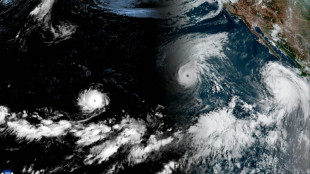
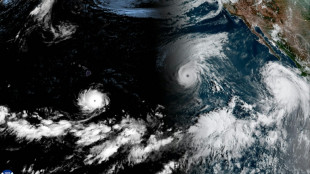
A rare trio of hurricanes were churning through the Pacific Ocean on Thursday, which scientists attributed to waters warmed by a historically strong El Nino phenomenon.
Tropical Storm Marie strengthened into a hurricane late Wednesday off the coast of Baja California, lining up behind Hurricanes Karina and Lowell -- both rated Category 4 -- which were making their way westward across the Pacific.
Three hurricanes are "definitely rare to see," Julia Cole, a climate scientist at the University of Michigan, told AFP.
"El Nino warming sets the stage for these storms, which are fueled in large part by warm waters -- when the tropical Pacific is warmer than normal we see an increase in strong storms," Cole said.
Lowell was about 440 miles (710 kilometers) south of Hilo, Hawaii and "is expected to remain a major hurricane for the next several days" as it moves west, according to the National Hurricane Center (NHC).
"Swells from Lowell are likely to cause life-threatening surf and rip current conditions in portions of the Hawaiian Islands during the next several days," the NHC said, adding that its long-range track and intensity forecasts were "more uncertain than usual."
Hawaii is still recovering from the impacts of Hurricane Lala, which brushed past the southern part of the Big Island last month, bringing destructive winds and severe flash floods.
The NHC said late Wednesday that Karina weakened slightly as it moved northwest, but is likely to remain a hurricane for the next couple of days.
Lowell and Karina are trailed to the east by Marie, which was 375 miles southwest of the southern tip of Baja California and expected to strengthen through Friday, according to the NHC.
Warm waters provide fuel for storms, and El Nino's effect on the atmosphere leaves little vertical wind shear over the Pacific, creating favorable conditions for hurricanes to intensify.
"The climate system has significantly warmed over the last 20 years or so," said Benjamin Kirtman, an atmospheric scientist at the University of Miami.
The sea surface temperature anomaly -- how much warmer the ocean is compared to average -- is already near record high, Kirtman added.
"There's no other way to put it -- it is juicy out there right now," he told AFP.
A similar trend took place in 2015, another intense El Nino year, when Hurricane Kilo, Ignacio, Jimena and Tropical Depression 14E crossed the Pacific at once.
- Impacts felt worldwide -
This year's El Nino has a 69 percent chance of becoming the strongest on record, according to the National Oceanic and Atmospheric Administration, and is already unleashing extreme weather across the globe even though it is not expected to peak until October-December.
Peru, the world's largest catcher of anchovy, is facing a devastating blow from warming seas that have gutted production, according to industry officials. In Sudan, El Nino is blamed for delaying crucial rains that have led water levels in the Nile to drop precipitously.
El Nino is the warming phase of a natural cycle in the tropical Pacific known as the El Nino-Southern Oscillation (ENSO), and comes along every two to seven years.
It sets in when east-to-west trade winds ease, allowing warm water which normally piles up in the western Pacific Ocean to slide back east and rise to the surface.
When those warmer-than-average surface temperatures last for a few months, they cause more storms and clouds over the region, which in turn cause ripple effects through the entire global atmosphere: hotter and drier conditions in some places, cooler and wetter in others.
Climate change increases El Nino's impacts. A warmer atmosphere holds more moisture, so El Nino-linked rains can turn more extreme. It also dries out soils, deepening drought where El Nino brings drought.
A.Zimmermann--CPN