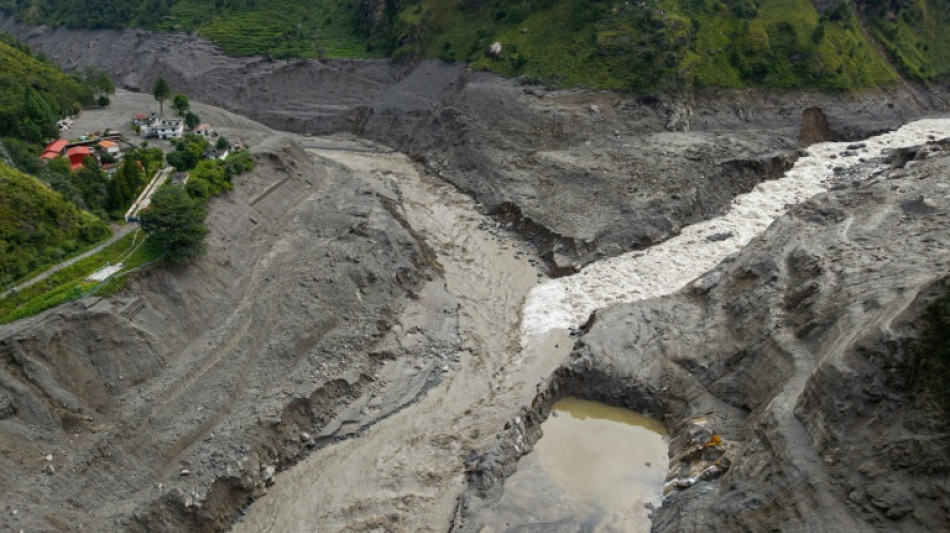
Nepal seeks climate justice after Himalayan disaster / Photo: Prabin Ranabhat - AFP

 Stocks rise, yields ease as oil slips on Trump hint at short bombing campaign

 Farming experts tout 'conscious' food systems to fix agriculture woes

 US energy firms dominate Venezuela deals worth billions

 Rare train of Pacific cyclones fueled by historic El Nino

 Cupertino Chamber President Claudio Bono Invited to White House with GiveaRoof 3-Year Plan to End Homelessness

 US judge rejects bid to break up Google's ad business
 Venice festival gets underway with Clooney taking swipe at US government

 Chevron unveils deal to double Venezuela venture output in 5 years

 Liminal Launches Liminal Prime for Institutional OTC and Stablecoin Liquidity
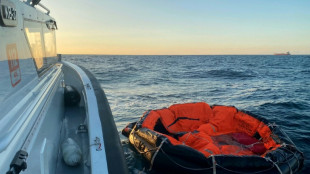 10 missing as cargo ship sinks after collision off Istanbul
 George Clooney says US run by 'least qualified people'
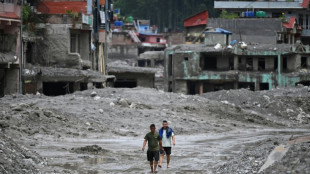
 Pacific islands to face food shortages over global warming: scientists

 UN says world must navigate 'reality' of 1.5C overshoot
 Ourbit SuperCEX Launches "Cosmic Wheel Season 3. Oracle Realm" on September 2 with 3M USDT Prize Pool

 Australia defends Pacific climate meeting despite doubts on attendance
 Venice to roll out red carpet for Clooney on opening night
 John Ternus takes over as Apple enters era of AI, foldable phones

 OpenAI to launch new model with 'stronger safeguards' after hack

 Fans mourn 'bittersweet' final Ariana Grande gig in London

 Back-to-school in Cuba a grim day with shortages of everything

 China's Xi arrives in Egypt as US sanctions threat looms over Iran links

 Alkemya Metacore Secures $50M via Tokenised Equity to Scale Nickel Energy and Security Tech

 Even at Elysee, phones are handed in, Macron tells French pupils
 China's Xi visits Egypt as US sanctions threat looms over Iran links

 RISE Robotics Awarded $100,000 MassVentures Grant to Accelerate Commercialization of Beltdraulic Technology

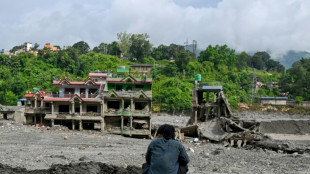
When a wall of icy debris from a glacial collapse on the China-Nepal border tore through his village last week, Pemba Chhring Tamang watched the landscape he had known all his life disappear.
"The flood was one like I had never seen before," said the 57-year-old, rescued from his Himalayan village in Nepal's devastated Rasuwa district. "It destroyed everything, our homes, our village."
The August 26 disaster, one of Nepal's worst climate-linked catastrophes, brought grief but also anger.
"What has Nepal done to deserve this?" asked Tashi Lhazom, a Nepali climate activist and politician.
"It is among the most climate-vulnerable countries, but at the same time, it is also the most climate-friendly."
The huge wave of debris killed more than 1,200 people and left more than 4,750 missing in Nepal and China's Tibet region, smashing towns, roads, bridges and multiple hydropower dams.
Rescuers are still searching for survivors and the dead, while helicopters ferry food and medicine to those left with nothing.
While the exact cause of the glacial collapse is unclear, climate change is causing glaciers to melt worldwide, heightening the risk of such disasters.
"We have been hearing news about climate change, and there have been floods before -- but never like this," said Tamang, speaking to AFP in Kathmandu.
Nepal, a largely rural nation of 30 million people that has contributed little to the greenhouse gas emissions driving global warming, says reconstruction could cost "billions" of dollars.
"We are suffering for a crime that we did not commit," Lhazom said.
Nepali glaciologist Tenzing Chogyal Sherpa said wealthy industrialised countries driving global emissions should accept their role.
"They should take some responsibility, and there should be some accountability," he said.
Scientists say the warming climate is already altering the risks facing the Himalayan region.
Disaster specialist Saswata Sanyal, at Kathmandu-based International Centre for Integrated Mountain Development (ICIMOD), said the region is warming roughly "at twice the rate" of anywhere else in the world.
"We have seen cascading disasters, like what we saw August 26, where one event triggers multiple events," he said.
- 'Warning signal' -
Nepal's leaders say the country needs long-term international support to adapt to a rapidly changing mountain environment.
Prime Minister Balendra Shah said Nepal must "strongly raise" with the international community the disasters it has experienced as a result of climate change.
Foreign Minister Shisir Khanal called it a "warning signal".
He told AFP that the support to Nepal should not be viewed only "from an angle of aid or charity, but should be seen from a perspective of climate justice as well".
For communities living beneath the world's highest mountains, a seemingly small rise in global temperatures can bring devastating consequences, Lhazom said.
"Just a degree increase in temperature may not seem much to most people, but it has a very different meaning in the mountains," Lhazom said.
"A change in a degree can translate to the loss of thousands of lives and livelihoods."
Lhazom pointed at richer countries.
"Are those who are causing it doing enough for Nepal and other vulnerable countries? No," Lhazom said.
The United Nations launched a "loss and damage" fund in 2025 to aid the impacts of climate change, though it has not yet begun distributing its limited cash.
A UN preliminary assessment estimated building damage from Nepal's floods at $158 million alone, warning that total losses -- including damage to roads and bridges, agricultural land and humanitarian costs -- would be far higher.
- 'Across South Asia' -
Khanal said the disaster underlined the "impetus and urgency" needed to build data-sharing mechanisms to help warn of future disasters, noting that neighbouring China had shared key data after the flood.
Glaciers across the wider Hindu Kush-Himalayan region are a vital water source for 240 million people in the mountains and another 1.65 billion downstream across South and Southeast Asia.
"With climate change intensifying, there is no indication that such hazards will stop," said Dhondup Wangmo, a research fellow at the Tibet Policy Institute, a thinktank linked to the exiled Tibetan government in India.
"In fact, they are more likely to occur in the future, potentially with even more tragic consequences."
For Nepal and its neighbours, the danger does not end in the mountains.
"It impacts the entirety of the Himalayan region's civilisation," Khanal said.
In neighbouring India, Rushati Das, from the New Delhi-based Climate Action Network South Asia (CANSA), said the Nepal disaster showed that climate change is "knocking on our doorsteps".
"What happens high in the mountains does not remain confined there," Das said.
"A disaster originating in one part of the Himalayan region can have consequences far beyond national boundaries, affecting river systems, ecosystems, livelihoods and communities across South Asia."
For Tamang, however, such debates are already too late.
"We have been born in a country like this," he said. "What should we do?"
P.Gonzales--CPN