
-
 MemeCore Arrives on Nasdaq Through $1 Billion Landmark Treasury Transaction
-
China's rapid solar expansion hurt bird diversity: study
-
 US, Canada resume talks to finalize trade deal as details emerge
-
Walmart reports mixed results as gas prices drag on US sales growth

-
 Scorching summer triggers record rockfalls in Alps, scientist says
-
Milky Way's fastest star discovered spinning around black hole

-
 ARKBRIDGE’s David Mali Highlights AI-Driven Risk Management at the Finance Magnates London Summit
-
Evergrande's Xu Jiayin: from real-estate tycoon to life in prison

-
 Japan to launch probe for Mars moons in October: space agency
-
Huge questions loom over Prince Harry's shock return to UK

-
 BYDFi Joins Coinfest Asia 2026, Connecting with Institutions, Builders and Traders in Bali
-
Prince Harry: key dates in life of returning UK royal

-
 Oil jumps on Iran war tensions, offsetting bond yield fears
-
PrimeXBT Expands Swap-Free Trading to PXTrader 2.0

-
 Record number of locations in France top 40C over summer: AFP analysis
-
'It is tough': Indonesia battles wildfires, bracing for worse to come

-
 Asian stocks rally as US Treasury steps in to ease bond fears
-
What property giant Evergrande's sentence means for China's economy

-
 In Senegal's Saint-Louis, traces of slave-trading past fade away
-
US national debt exceeds $40 trillion for first time

-
 Prince Harry and Meghan moving back to UK: British press
-
NASA satellite rescue mission fails

-
 Many US Fed policymakers back interest rate hikes if inflation stays high
-
PSG Ligue 1 opener moved over state of Parc des Princes pitch

-
 UK PM launches bid to help homeless, donating part of his wages
-
Lake Zurich sees water level hit record low amid drought

-
 Merck and Moderna's tailored cancer drug curbs melanoma recurrence in trial
-
Oldest human brain cells grown in lab 'recorded passage of time'

-
 UK media skewered for 'hounding' black academic
-
Robots sort packages and serve fast food at Beijing showcase

-
 UK PM launches bid to get rough sleepers off streets by Christmas
-
Europe can't afford to miss AI revolution: ECB chief

-
 Texas Counseling Center Highlights the Role of Counseling in Supporting Immigration Psychological Evaluations
-
Humanoid-maker Unitree surges more than 600% on Shanghai debut

-
 STARPRIME Completes Beta Testing of Market-Maker Model for Retail Brokers
-
Southern African mothers plead for sons lured to Russia's war

-
 Campaigns kick off in Nigerian presidential race
-
Freedom Holding Marks New Türkiye Milestone as Freedom Yatırım Secures Brokerage License

-
 Trump pauses 50% tariffs on Canadian goods for three days
-
Humanoid resources: China's robots search for workforce breakthrough

-
 China goes rural with data centres in quest to power AI
-
China's robots open to opportunities in search of commercial breakthrough

-
 Trump pauses planned 50% tariffs on Canadian goods for three days
-
New Zealand blocks lawsuits against firms over climate harm

-
 Trump, Carney talk as Canada seeks to hold off new US tariffs
-
NASA images reveal crater left by SpaceX rocket's Moon crash
-
 Angelique Kidjo immortalised on Hollywood Walk of Fame
-
French producer Nicolas Altmayer, Dior PR chief Favier die in car crash

-
 Germany opens new drone research centre as security threats mount
-
How only a few tree species drive Amazon forest recovery
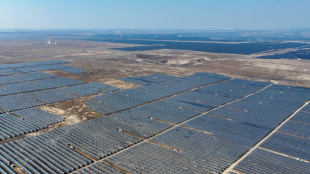
'Green dilemma': China's solar boom hurt birds, says study
The global push for solar energy expansion could carry hidden biodiversity costs, according to a study on China published in the journal Science on Thursday.
According to the research spanning more than 2,300 Chinese counties, pro-solar policies led to reductions in bird diversity as cropland and grassland were rapidly cleared for development.
The authors called it an example of a "green dilemma" pitting carbon reduction against conservation.
"The main message is not to slow the renewable energy transition, but to make solar development more ecologically informed," first author Huiming Zhang, of the Nanjing University of Information Science & Technology, told AFP.
China's goal to achieve carbon neutrality before 2060 has seen it embark on a renewables revolution.
By 2024, its solar footprint reached an estimated 4,520 square kilometers (1,745 square miles) -- equivalent in size to the US state of Rhode Island -- and solar energy is projected to constitute 45 percent of its energy mix by 2060.
Choosing solar locations in China is not based on sunny locations and available land, but rather on government "Five-Year Plans" to promote economic development in certain regions.
Zhang and his colleagues exploited these variations in solar expansion policy in 2,344 counties across China from 2014 to 2023, while also accounting for national trends, weather, socioeconomic conditions, land cover and birdwatching effort.
This data was paired with citizen science records to understand the impact on bird diversity.
Their findings revealed a negative trade-off, with increased policy stringency consistently associated with decreased bird biodiversity, though the effect was moderate.
The effects were stronger in wealthier and non-desert regions.
Both resident and migratory birds suffered significant declines, but species that were native to mountain habitats poorly suited to solar farms were unaffected.
- 'Inferior greening' -
The push for solar farms in China was accompanied by greening efforts to satisfy environmental requirements, but the authors identified what they called "inferior greening" -- where the total amount of leafiness may go up but because it was too homogeneous, the ecological quality went down.
Writing in a related commentary, Yuanning Liang of Peking University said "birds serve as an effective indicator group for large-scale biodiversity assessment" because they are among the few animal groups for which abundance data over time and space is readily available.
Although the authors studied solar power, the problems they identified equally apply to other forms of renewable energy such as wind farm expansion, she added.
"The next step is to move from biodiversity measurement to valuation by linking changes in bird diversity to ecosystem services and conservation values," Liang said.
"Without such valuation, policy analysis gives insufficient weight to conservation, and benefit-cost analysis can understate the social cost of development."
The research team offered a number of recommendations, including directing large solar projects toward locations with lower ecological conflict, greater assessments of each site, and limiting land conversion in productive, habitat-rich regions.
"Clean energy development and biodiversity conservation do not have to come at each other's expense, but careful siting and biodiversity safeguards are essential," said Zhang.
H.Müller--CPN