
Western Europe experienced hottest June-July on record: EU monitor / Photo: Idriss Bigou-Gilles - AFP

 S.African activists push back on data centre rush

 Billionaire Ambani's Jio to debut after record India IPO

 UK set for cautious budget as borrowing costs climb

 US Fed expected to hold rates steady ahead of key midterm elections

 AI chip giant SK hynix says quarterly operating profit soars 630%

 Charles tackles thorny legacy of slavery on Caribbean trip

 UN nuclear watchdog chief urges Iran to grant access

 Boeing releases cautious growth plan as shares fall sharply

 Tech firms gain on Anthropic IPO optimism; HSBC slumps in London

 Tech firms track Wall St rally on mixed day for stock markets

 HSBC profit jumps on higher rates, lower costs

 Reparations calls follow Charles on tough Caribbean trip

 China brands drop Mbappe for 'offending national sentiments'

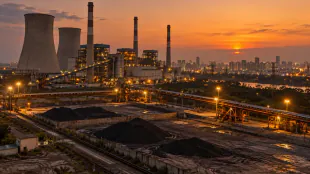 Critical coal inventories affect nearly half of India’s domestic power plants

 Gold ETF flows turn negative after 13 weeks as bullion loses 4%
Western Europe experienced its hottest June-July on record as climate change fuels an historic summer of heat, drought and wildfires across the region, the EU's global warming monitor said Monday.
Europe is the world's fastest-warming continent and the first two months of summer have been marked by successive heatwaves, scorching temperatures and bone-dry conditions.
The Copernicus Climate Change Service said the combined average temperature in western Europe for June-July was 21.62C -- beating the 2022 record for the same period.
This reflected "the exceptional persistence of heat" so far this summer, Copernicus said.
Levels of soil moisture were "significantly lower" than in July 2022 when the last severe drought gripped western Europe, Copernicus added.
"This is a clear example of how climate change is intensifying heat extremes, with heat and drought increasingly reinforcing one another," said Samantha Burgess from the European Centre for Medium-Range Weather Forecasts, which operates Copernicus.
Very dry conditions were observed in July across western and central European nations including France, Spain, Austria and Hungary but also the United Kingdom, Ireland and part of Iceland.
River flows were unusually low with the Seine, Rhine and Danube particularly affected. Transport, irrigation and energy production has been impacted in several European countries.
These hot and dry conditions were also ideal for fires and scientists say the frequency of extreme fire-prone weather in Europe is increasing with climate change.
France and Spain have battled their worst infernos in living memory this summer, while other nations in Europe and as well as the US northwest and Canada have also experienced serious blazes.
- Heat on the horizon -
Copernicus also said the world's oceans hit record-high temperatures for a second straight month in July, driven by marine heatwaves around Europe and a powerful El Nino taking shape in the Pacific.
Global average sea surface temperatures in July were 20.96C, beating the previous record of 2023.
Copernicus director Carlo Buontempo said parts of the Mediterranean and Atlantic were unusually warm but the developing El Nino "is probably the driving force" behind the record sea temperatures.
"We are now facing a very large El Nino -- possibly unprecedented in terms of amplitude. It is clear that the contribution coming from the tropical Pacific becomes quite important," the climate scientist told reporters on August 5.
El Nino is the warm phase of a natural climate cycle that temporarily raises ocean temperatures in the tropical Pacific and can influence weather extremes like drought and floods around the world.
It also adds heat to a planet already warmed from burning fossil fuels.
El Nino events typically peak at the end of a year before heat is released from the ocean into the atmosphere, pushing up global temperatures.
The last El Nino helped make 2023 and 2024 the second- and first-hottest years on record, respectively.
Buontempo said scientists expect a new record for global average temperatures later this year or early 2027.
- Climate regulator -
Globally, last month was the joint second-warmest July on record with an average surface air temperature 1.47C above the 1850-1900 pre-industrial benchmark, Copernicus said.
The last 11 years have been the hottest on record and "we have not seen a climate that warm during our lifetime, and very possibly our civilisation", Buontempo said.
"And the main driver for this warming -- as we know -- are the greenhouse gases", he said.
Oceans absorb most of the excess heat caused by humanity's carbon emissions and therefore play a key role in regulating the climate.
Hotter seas can have damaging knock-on effects on the planet, fuelling stronger storms and rainfall and bleaching coral reefs.
Copernicus takes measurements using billions of satellite and weather readings, both on land and at sea, and their data extends back to 1940.
D.Goldberg--CPN