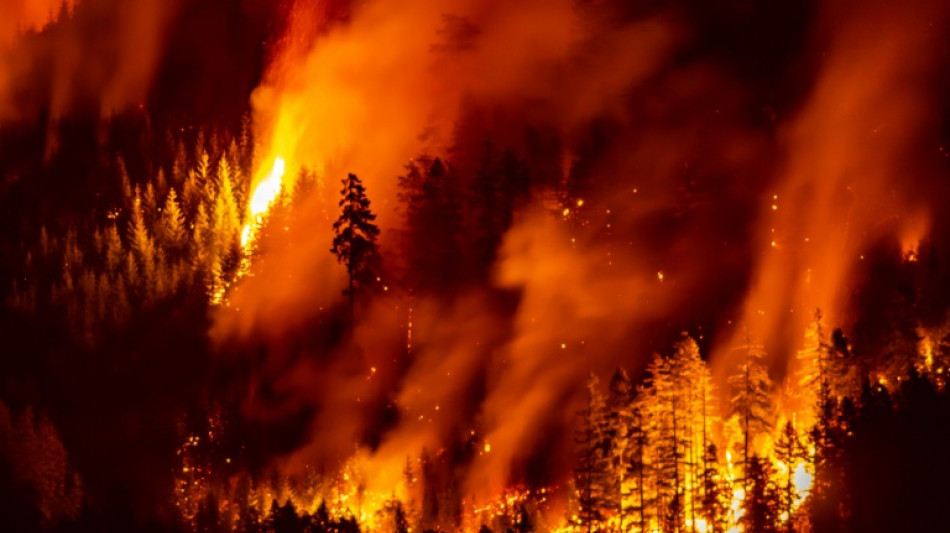
Canada tries to adapt to a future of wildfires / Photo: Colby Rex O'Neill - AFP

 Kenya's economy faces climate change risks: World Bank
 India's 'cockroach' protest movement keeps heat on Modi
 Call for Infantino to resign comes amid wave of support

 Apple and OpenAI escalate legal battle over devices
 Trump renews effort to remove US Fed Governor Lisa Cook

 Movement, El Vecino and RISE Partner to Launch First Digital Dollar Wallet for Mexican Remittances

 Cambridge to review hiring process amid plagiarism row

 STARTRADER in Discussions with Trustpilot to Consolidate Review Profiles

 Thai students in disbelief after deadly school shooting
 MEXC Lists New Ondo Tokenized Stock Pairs Spanning AI Infrastructure, Semiconductor and Rare Earth Sectors

 Volt Funded Launches Globally with Evaluation Program Offering Up to 90% Profit Share
 PU Prime Expands Gold Trading with the Launch of XAUUSD247

 Military shake-up poses little threat to Ukraine's drone revolution
 North Korea touts dog soup and other home-cooked recipes to beat the heat
 Meta ordered to pay US state $567 mn to abate 'public nuisance' and child harm

 Most UK teens to opt out of planned social media curfew: poll

 Stocks tread water with earnings, tech in focus

 Forex Expo Dubai Announces Opportunity to Win Up to 150 Grams of Gold This September 2026

 'Don't have to hide': Thai IDs, legal work give hope to Myanmar refugees

 'Stretch our money': Romanians face highest EU inflation
 Asian stocks mostly down with tech firms back under pressure
 Rising Kenyan lakes push crocodiles closer to homes
 Google-parent Alphabet shakes up AI division

 Castaway SpaceX rocket stage crashed into Moon, scientists say

 نوشا أوبيل: هل هي على مستوى التحديات التي تواجهها بوتسدام؟

Faced with another summer when wildfires have scorched millions of hectares of land and blankets of smoke have disrupted daily life nationwide, Canada is trying to limit the annual devastation.
Yet, despite procuring new water bombers and deploying forest management strategies to protect populated areas, experts caution that intense wildfires will remain a fixture of Canadian life.
"We're going to have to live with this," said Normand Lacour, who spent decades at Quebec's wildfire prevention and detection organization (SOPFEU).
Canada is home to about a quarter of Earth's boreal forest area and average annual temperatures in the country are increasing roughly twice as fast as the global average.
That makes conditions in Canada particularly "conducive to intense and very extensive forest fires," University of Ottawa geography professor Patricia DeRepentigny told AFP.
Canada's last three wildfire seasons have been among the 10 worst on record, including the devastating summer of 2023 when 18 million hectares (44.5 million acres) were torched, an area nearly as large as Syria.
This summer is not currently on track to approach that historic toll, with 4 million hectares burned so far, but the damage has been widespread.
In the western province of British Columbia, 15,000 people have been ordered to evacuate their homes, while residents of major eastern population centers like Toronto endured some of the world's worst air quality last month.
- Changing methods -
Canada's emerging response is broad-based.
The federal government has invested CAD$317 million (US$227 million) over five years "to establish a new national aerial firefighting surge capacity," Ottawa announced in May.
The money is being used to lease 10 aircraft capable of confronting wildfires, to be dispatched to provinces facing intensifying blazes.
Ottawa is also backing a CAD$150 million program that aims to clear flammable material such as vegetation from populated areas.
Provinces have also beefed up their firefighter capacity, including in Quebec where SOPFEU staffing levels are up 40 percent.
But, when it comes to protecting people from wildfires, "Canada is not in an excellent position," said Ryan Ness, the director of adaptation research at the Canadian Climate Institute.
There are "too many communities that are in areas that are exposed to wildfires that continue to develop," he told AFP.
- Fire clouds -
Canada is also extremely vulnerable to "fire clouds," or pyrocumulonimbus clouds, immense blazes that create their own wind and even lightning that can spark fresh fires.
The phenomenon, a consequence of the more frequent heat waves caused by climate change, was once rare in Canada, but that is changing.
Fire clouds were recorded 140 times in Canada in 2023, compared with once or twice a year historically, DeRepentigny said.
Fire clouds are unpredictable and can spread at staggering speeds. Battling them is a near-impossible challenge.
"There's not much we can do when this happens, apart from pulling crews out of the field and repositioning them behind the fire," said SOPFEU meteorologist Claudia Vaillancourt.
Ng.A.Adebayo--CPN