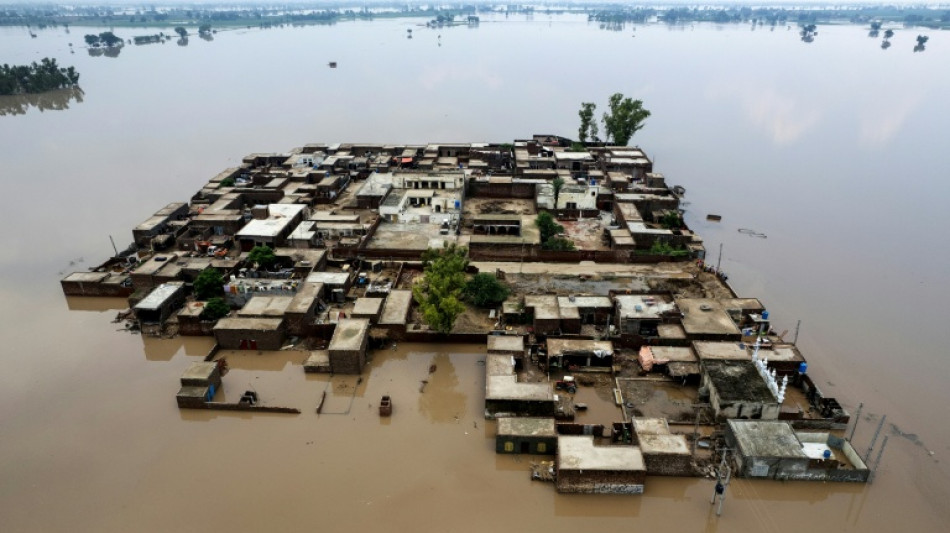
Flooding forces residents to flee homes by boat in Pakistan / Photo: Arif ALI - AFP

 Lights out in Laos as electricity exports surge

 Steven Strogatz weighs AI mathematics advances and their consequences for researchers

 Anthropic boss calls for AI slowdown, Altman and Musk agree

 French IT giant Capgemini sells subsidiary after row over ICE links

 Quebec Brokerage Qubit Insurance Announces New Data on Coverage Shortfalls as Rebuilding Costs Rise

 Lady Gaga welcomes first child with fiance: US media

 Bhutan business bets on hazelnuts for farming future

 'Widow's Bay' and 'The Pitt' are favorites for Emmys night

 Coastal erosion forces cancellation of California music festival

 Argentina's Dirty War rears its head in Venice film

 UK lawmakers throw out bill to legalise assisted dying

 US inflation steady in August, fueling Fed rate hike expectations

 New York marks 25th anniversary of 9/11 attacks

 Nepal flood reconstruction bill to be $4.78 bn: foreign ministry

 JUMO and Standard Bank launch Social Finance Framework to scale inclusive finance in Africa

 Doomsday tech: could AI really kill us all?

 French comedy show 'Call my agent' makes film comeback

 It's all coming back: Celine Dion fans gear up for Paris return

 Researchers eye AI revolution in natural disaster forecasts

 US braces for inflation report that may push Fed to hike rates

 Musk threatens legal action over documentary

 Latin America fact-check group asks Meta not to replace verification practice

 AI Risks to Enter 60–80% of Liability and Cyber Insurance Underwriting by 2028, ScienceSoft Predicts

 Tribal Launches Campfire, Letting Business and Technical Teams Build on Salesforce Together

 Stocks fall as fresh oil surge fans inflation fears

Flooding from heavy monsoon rains inundated villages in eastern Pakistan, pushing residents to flee their homes by boat over fields turned into vast swathes of water on Monday.
AFP journalists witnessed small motor boats chartered by volunteers ferrying residents to safety, but many more were left stranded in Muridke district in Pakistan's most populous province of Punjab.
"It has been four days, and no rescue team has reached us," said 32-year old Iqra Salman.
"We have no electricity, no clean water, and now we have completely run out of food supplies," she said. "We are surrounded by floodwater on all sides."
Flood-related incidents, including by drowning and from house collapses, have killed 109 people in Pakistan since June 26, according to official disaster agency figures.
Around a third of the deaths are in Punjab.
Volunteer rescuers said they had launched an effort to rescue people and recover their belongings from around a dozen villages.
"Four rescue boats... are actively conducting rescue operations, evacuating people stranded by the flooding," said Haris Dar, a volunteer rescuer, standing by a huge lake-like body of brown water.
- 'We have lost everything' -
But even when brought to safety, residents faced difficult conditions, sleeping in small tents in humid heat, nestled between the huge body of water and the road.
Muhammad Ramzan, 45, recalled water rushing in during the early hours of the morning shortly before his family's house collapsed.
"The water rose so rapidly that we had no opportunity to save or remove any of our belongings," he said.
"We have lost everything and have nothing," he added.
Pakistan is vulnerable to the effects of climate change, with limited resources for adaptation.
While South Asia's seasonal monsoon brings rainfall that farmers depend on, climate change is making the phenomenon more erratic, unpredictable and deadly across the region.
In neighbouring Afghanistan, flash floods and heavy rainfall killed 34 people between July 20-26, according to disaster authorities, including a deluge in eastern Nuristan province that left around 100 missing.
In 2022, what UN chief Antonio Guterres called a "monsoon on steroids" caused havoc across Pakistan, killing around 1,700 people and submerging huge areas of the country.
O.Hansen--CPN