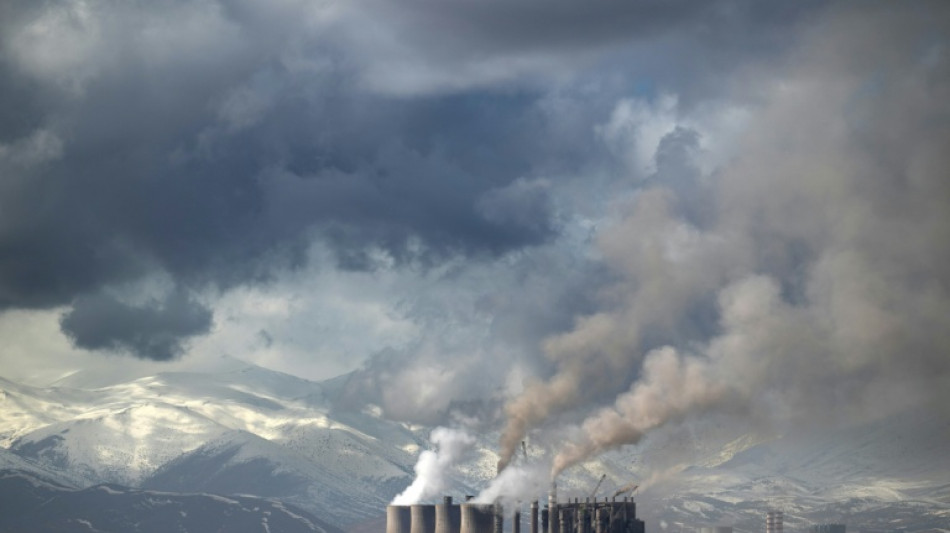
Coal-fired power generation rising globally on Mideast war: IEA / Photo: Ozan KOSE - AFP/File

 Lights out in Laos as electricity exports surge

 Steven Strogatz weighs AI mathematics advances and their consequences for researchers

 Anthropic boss calls for AI slowdown, Altman and Musk agree

 French IT giant Capgemini sells subsidiary after row over ICE links

 Quebec Brokerage Qubit Insurance Announces New Data on Coverage Shortfalls as Rebuilding Costs Rise

 Lady Gaga welcomes first child with fiance: US media

 Bhutan business bets on hazelnuts for farming future

 'Widow's Bay' and 'The Pitt' are favorites for Emmys night

 Coastal erosion forces cancellation of California music festival

 Argentina's Dirty War rears its head in Venice film

 UK lawmakers throw out bill to legalise assisted dying

 US inflation steady in August, fueling Fed rate hike expectations

 New York marks 25th anniversary of 9/11 attacks

 Nepal flood reconstruction bill to be $4.78 bn: foreign ministry

 JUMO and Standard Bank launch Social Finance Framework to scale inclusive finance in Africa

 Doomsday tech: could AI really kill us all?

 French comedy show 'Call my agent' makes film comeback

 It's all coming back: Celine Dion fans gear up for Paris return

 Researchers eye AI revolution in natural disaster forecasts

 US braces for inflation report that may push Fed to hike rates

 Musk threatens legal action over documentary

 Latin America fact-check group asks Meta not to replace verification practice

 AI Risks to Enter 60–80% of Liability and Cyber Insurance Underwriting by 2028, ScienceSoft Predicts

 Tribal Launches Campfire, Letting Business and Technical Teams Build on Salesforce Together

 Stocks fall as fresh oil surge fans inflation fears

Coal-fired power generation is set to increase in 2026, driven by supply difficulties and soaring natural gas prices linked to the war in the Middle East, the International Energy Agency said Thursday.
The conflict in the Middle East, pitting the United States against Iran, has led since March 2026 to regular blockages of the Strait of Hormuz, through which 20 percent of liquefied natural gas (LNG) transits, pushing some economies back toward coal.
As a result, "global coal-fired generation is expected to increase by 1.4 percent in 2026, after remaining roughly constant in 2025," the IEA wrote in a new report.
The increased use of coal-fired power plants is also explained by a surge in energy prices in 2026.
Up 30 percent compared with the first half of 2025, they are "at their highest level since the energy crisis of 2022 and 2023," which was triggered by the war in Ukraine, the IEA said.
Consequently, global carbon dioxide (CO2) emissions from electricity generation are expected to rise by one percent in 2026, with large regional disparities, the agency wrote.
Southeast Asia is expected to see its emissions grow by six percent, while the European Union should record a five-percent decline.
CO2 emissions should, however, stabilise in 2027, thanks to the growth of renewable electricity generation, which is "overtaking coal as the world's largest source of electricity generation, after reaching near parity in 2025," the report said.
Renewable supply is expected to increase by eight percent in 2026, and its share in global electricity supply should rise from 33 percent in 2025 to 37 percent in 2027.
The sector is being driven by solar power, whose generation is expected to surpass that of wind in 2026 and thus "become the world's second-largest source of renewable electricity generation after hydropower," the IEA wrote.
Overall, demand for electricity "forecast to stay on a solid upward trajectory," driven in particular by industry, electric vehicles and data centres, the IEA said.
It forecast demand growth of 3.6 percent in 2026 and 3.8 percent in 2027, compared with a three-percent increase in 2025.
Finally, the El Nino event, a natural climate fluctuation that warms temperatures and leads to changes in wind patterns, is proving stronger than expected this year.
This weather phenomenon "could affect electricity demand" by increasing cooling needs and limiting hydropower and wind power generation, the IEA said.
Y.Uduike--CPN