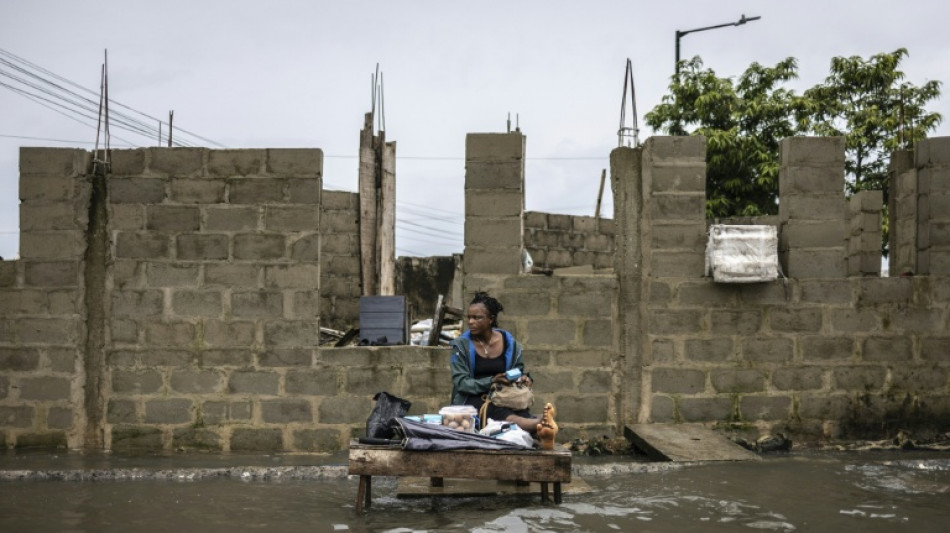
Climate change, urban growth fuel Lagos flooding / Photo: OLYMPIA DE MAISMONT - AFP

 Lights out in Laos as electricity exports surge

 Steven Strogatz weighs AI mathematics advances and their consequences for researchers

 Anthropic boss calls for AI slowdown, Altman and Musk agree

 French IT giant Capgemini sells subsidiary after row over ICE links

 Quebec Brokerage Qubit Insurance Announces New Data on Coverage Shortfalls as Rebuilding Costs Rise

 Lady Gaga welcomes first child with fiance: US media

 Bhutan business bets on hazelnuts for farming future

 'Widow's Bay' and 'The Pitt' are favorites for Emmys night

 Coastal erosion forces cancellation of California music festival

 Argentina's Dirty War rears its head in Venice film

 UK lawmakers throw out bill to legalise assisted dying

 US inflation steady in August, fueling Fed rate hike expectations

 New York marks 25th anniversary of 9/11 attacks

 Nepal flood reconstruction bill to be $4.78 bn: foreign ministry

 JUMO and Standard Bank launch Social Finance Framework to scale inclusive finance in Africa

 Doomsday tech: could AI really kill us all?

 French comedy show 'Call my agent' makes film comeback

 It's all coming back: Celine Dion fans gear up for Paris return

 Researchers eye AI revolution in natural disaster forecasts

 US braces for inflation report that may push Fed to hike rates

 Musk threatens legal action over documentary

 Latin America fact-check group asks Meta not to replace verification practice

 AI Risks to Enter 60–80% of Liability and Cyber Insurance Underwriting by 2028, ScienceSoft Predicts

 Tribal Launches Campfire, Letting Business and Technical Teams Build on Salesforce Together

 Stocks fall as fresh oil surge fans inflation fears

After hours of overnight torrential rain lashed Lagos recently, church pastor Samuel Akpan spent most of next day bailing water from his flooded parsonage in an upscale district of Nigeria's commercial capital.
Inside the Apostolic Church of Nigeria in Lekki district, chairs and their sodden cushions were piled in knee-high floodwaters that had engulfed the building.
The mega city lies on a low-lying coastline, making the city of around 20 million people vulnerable to flooding.
But experts say rising sea levels driven by climate change, erratic rainfall and unregulated groundwater extraction fuelled by rapid urbanisation are also major drivers.
Most Lagos households don't have access to treated piped water, forcing them to drill boreholes for potable water, disrupting the equilibrium of the ground.
The crowded city is among those the World Economic Forum says is sinking by up to 87 millimetres (3.4 inches) per year.
As Nigeria's commercial hub, Lagos attracts thousands of people daily from across the country seeking better economic opportunities. The UN puts Lagos's annual growth rate at six percent.
Rapid development of residential, commercial and industrial buildings is everywhere, especially in Lekki, which has a designated special free trade zone to attract investment and is also earmarked for a new international airport.
Akpan, 42, recalled waking to "discover that everywhere is flooded," he told AFP, standing in the middle of a soaked church auditorium. His children's schoolbooks, waterlogged and tattered, lay strewn across the grounds.
- 'Under siege' -
Heavy rains sweep Nigeria between May and November, often resulting in dangerous and at times deadly floods.
Last year, authorities forecast annual rainfall of 1,952 mm, above the average of 1,721 millimetres recorded between 2012 and 2022.
This year, it is expected to range between 1,650 mm and 3,030 mm.
"It is like we are under siege with the flood," said Uche Adibua, 46, in the Okota area of Lagos. His apartment has been flooding since it started raining this year.
"It didn't happen before," he said.
But such disasters are becoming more common: late June storms that dumped rain from Ivory Coast to Nigeria, sparking flooding that killed about 100 people, were "supercharged" by climate change, according to World Weather Attribution, a global coalition of scientists.
The wider Lagos state, which encompasses the city, has 180 kilometres of coastline and extensive waterways, leaving it particularly vulnerable.
"Lagos is located in a low-lying coastal environment, which predisposes it to coastal flooding," Ibidun Adelekan, a geography professor at the University of Ibadan, told AFP, adding increasing rainfall compounds the risk.
Scientific analyses have shown that the state now experiences heavier rainstorms than in the past, she added.
Poor infrastructure, inadequate drainage and indiscriminate waste disposal add to the crisis.
It is common to see heaps of empty plastic bags and bottles floating in Lagos lagoons and open-air drainage channels, and piles of rotting waste on sidewalks of the city where garbage bins are almost non-existent.
Loss of natural surfaces, the destruction of wetlands and unstructured land reclamation for development have further reduced the city's ability to absorb excess rainwater, experts say.
"Annual flooding in Lagos is caused by heavy rainfall, inadequate drainage, clogged gutters laden with debris and fast urban growth that hinders natural water absorption," an independent environmentalist, Olumide Idowu, told AFP.
Tokunbo Wahab, Lagos government's environmental chief, agrees that "illegal dredging and land reclamation" has caused "significant environmental challenges," with vast wetlands filled and built over as the city grapples with rapid population growth.
- Highway headache -
Some residents of Lekki district blame the construction of the 700-kilometre Lagos-Calabar coastal highway, which will link Lagos to Calabar city near the Cameroon border, for worsening flooding.
"Water has never entered the house before," Babatunde Vaughn, a technology consultant whose apartment is about 150 metres from the highway told AFP.
The road, a government flagship project, was the "only significant thing that has happened between the last rainy season and this year", said Vaughn. "It didn't flood this way."
But works minister Dave Umahi and Hitech, the Nigerian company building the highway, reject the notion that the road has worsened flooding.
Umahi insisted at a recent meeting with residents that the road has instead created a buffer protecting surrounding communities from coastal flooding.
For environmentalists, many of the fixes should be low-hanging fruit for the government: updating building codes, regulating urban development and building drainage systems to accommodate increased rainfall.
Ng.A.Adebayo--CPN