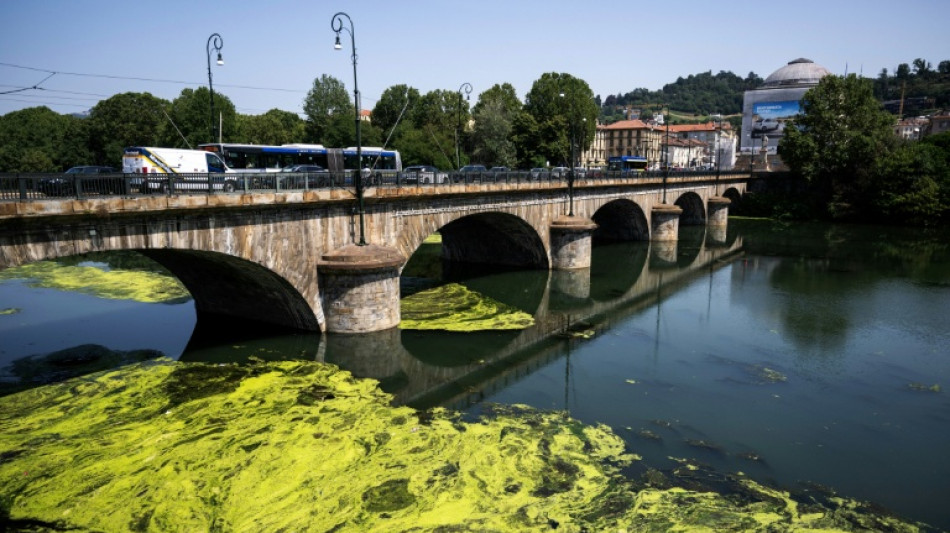
Algae fed by farm waste carpet Italy's warm River Po / Photo: Marco BERTORELLO - AFP

 Lights out in Laos as electricity exports surge

 Steven Strogatz weighs AI mathematics advances and their consequences for researchers

 Anthropic boss calls for AI slowdown, Altman and Musk agree

 French IT giant Capgemini sells subsidiary after row over ICE links

 Quebec Brokerage Qubit Insurance Announces New Data on Coverage Shortfalls as Rebuilding Costs Rise

 Lady Gaga welcomes first child with fiance: US media

 Bhutan business bets on hazelnuts for farming future

 'Widow's Bay' and 'The Pitt' are favorites for Emmys night

 Coastal erosion forces cancellation of California music festival

 Argentina's Dirty War rears its head in Venice film

 UK lawmakers throw out bill to legalise assisted dying

 US inflation steady in August, fueling Fed rate hike expectations

 New York marks 25th anniversary of 9/11 attacks

 Nepal flood reconstruction bill to be $4.78 bn: foreign ministry

 JUMO and Standard Bank launch Social Finance Framework to scale inclusive finance in Africa

 Doomsday tech: could AI really kill us all?

 French comedy show 'Call my agent' makes film comeback

 It's all coming back: Celine Dion fans gear up for Paris return

 Researchers eye AI revolution in natural disaster forecasts

 US braces for inflation report that may push Fed to hike rates

 Musk threatens legal action over documentary

 Latin America fact-check group asks Meta not to replace verification practice

 AI Risks to Enter 60–80% of Liability and Cyber Insurance Underwriting by 2028, ScienceSoft Predicts

 Tribal Launches Campfire, Letting Business and Technical Teams Build on Salesforce Together

 Stocks fall as fresh oil surge fans inflation fears

Rowers on the River Po in Turin are battling vast blooms of algae, as high temperatures in northwest Italy and runoff from farms create ideal conditions for rampant plant growth.
"Look at these (plants), if you put your oar in, they wouldn't let it go," rowing coach Roberto Romanini told AFP, as four rowers struggled in their boat through a patch of green slime.
Sitting between the Alpine chain on one side and hills on the other, heavily urbanised Turin has suffered soaring temperatures this summer, as heat waves rendered more intense by man-made climate change have gripped Italy.
And the Po, Italy's longest river, is struggling.
It has experienced a significant decline in flow, down 50 percent on its yearly average, due to low rainfall and persistently high temperatures in June and July.
Despite that, dozens of plant species have been blooming since May.
"It looks like a meadow," 60-year-old Romanini said, adding he had "never seen anything like it."
Tearing tangled plants off his motor boat's propeller, he noted, "The river is changing, the climate is changing".
- 'Exceptional' -
At the dyke that has controlled the river's level since the 19th century, a thick layer of algae trapped various bottles and a shoe.
Local species such Spirogyra, known as mermaid's tresses, and the blanket weed Cladophora, mingle with the invasive Blitum nuttallianum -- or Nuttall's povertyweed, which is native to North America.
Further upstream, herons have nested under the historic stone Isabella Bridge, and their chicks are taking advantage of the thick layer of vegetation to learn how to walk.
Algae have always been present in the Po, but climate change "makes these phenomena more extreme", said Turin Deputy Mayor Francesco Tresso, calling this year's proliferation "quite exceptional".
"It's no longer really a river, but rather a warm lake," reaching temperatures of 28 degrees Celsius even though it originates in the nearby Alps, he told AFP.
"Agricultural nutrients from livestock farms are also dumped throughout the basin, which means that plants find an ideal environment here to thrive," he said.
Alice de Marco, the local head of environmental organisation Legambiente, said the algae blooms were encouraged "above all by excess nutrients" from farms.
She said a large part of the solution would be "limiting, reducing, or even eliminating the use of pesticides in agriculture".
This mass of vegetation "has an impact on the food chain -- it reduces the oxygen level underwater, affecting other plants and animals," she said.
- 'More respect' -
Algae have also invaded Lake Iseo in neighbouring Lombardy this summer, as well as further afield, from canals in France to the Ebro River in Zaragoza, Spain.
Turin wants to make the Po one of its starring attractions: two river shuttles are scheduled to resume service in 2027 and the city council has renovated a large park next to the river.
But first it needs to get rid of the green weeds.
Near Turin's mock medieval village, an excavator perched on a barge pulls up clumps of dripping algae.
A truck comes every morning to collect the plants, which are then turned into compost. More than 150 tons have been removed in three weeks, at a cost of approximately 100,000 euros ($115,000).
Secondo Barbero, director of the Piedmont Environmental Protection Agency, noted that there is a correct way to remove it.
"The plant shouldn't be cut but uprooted; otherwise, the cut parts can generate new plants," while also contaminating downstream riverbanks, he said.
The growth should slow with the drop in temperatures in autumn, but the city should prepare for a fresh round in spring, Barbero said.
Rower Romanini said that, for now, locals will just have to learn to live with it -- "and show more respect for the river."
Y.Tengku--CPN