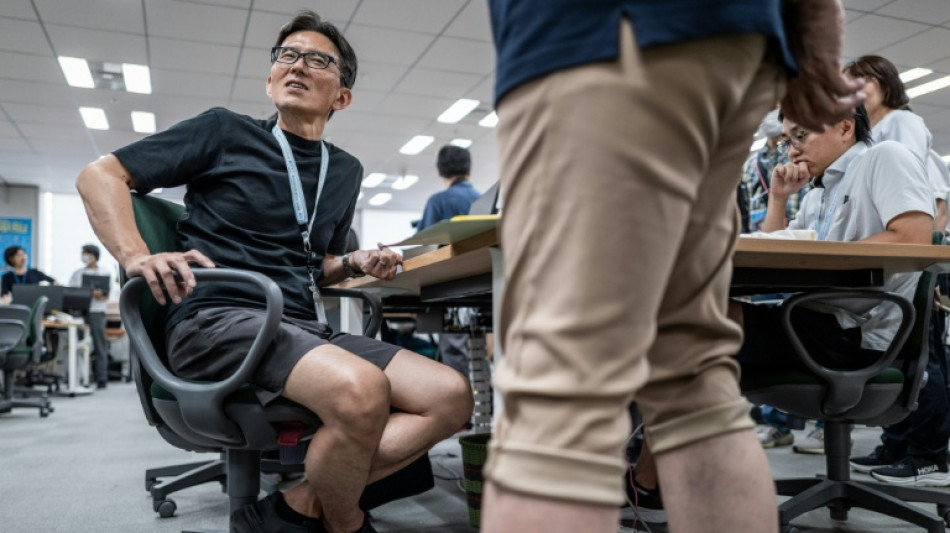
Too hot: Buttoned-up Tokyo officials ditch suits for 'cool' shorts / Photo: Philip FONG - AFP

 Lights out in Laos as electricity exports surge

 Steven Strogatz weighs AI mathematics advances and their consequences for researchers

 Anthropic boss calls for AI slowdown, Altman and Musk agree

 French IT giant Capgemini sells subsidiary after row over ICE links

 Quebec Brokerage Qubit Insurance Announces New Data on Coverage Shortfalls as Rebuilding Costs Rise

 Lady Gaga welcomes first child with fiance: US media

 Bhutan business bets on hazelnuts for farming future

 'Widow's Bay' and 'The Pitt' are favorites for Emmys night

 Coastal erosion forces cancellation of California music festival

 Argentina's Dirty War rears its head in Venice film

 UK lawmakers throw out bill to legalise assisted dying

 US inflation steady in August, fueling Fed rate hike expectations

 New York marks 25th anniversary of 9/11 attacks

 Nepal flood reconstruction bill to be $4.78 bn: foreign ministry

 JUMO and Standard Bank launch Social Finance Framework to scale inclusive finance in Africa

 Doomsday tech: could AI really kill us all?

 French comedy show 'Call my agent' makes film comeback

 It's all coming back: Celine Dion fans gear up for Paris return

 Researchers eye AI revolution in natural disaster forecasts

 US braces for inflation report that may push Fed to hike rates

 Musk threatens legal action over documentary

 Latin America fact-check group asks Meta not to replace verification practice

 AI Risks to Enter 60–80% of Liability and Cyber Insurance Underwriting by 2028, ScienceSoft Predicts

 Tribal Launches Campfire, Letting Business and Technical Teams Build on Salesforce Together

 Stocks fall as fresh oil surge fans inflation fears

On a hot, humid day in Tokyo, metropolitan government official Noboru Watanabe overcame embarrassment to come to work in shorts, an unusual choice in a country where formal business attire is still the norm.
The loosening of a strict dress code, particularly for men, comes as Japanese offices cut reliance on air conditioning due to high energy costs linked to the Middle East war.
On Tuesday, as temperatures in the capital soared to around 34C, at least five brave men at Watanabe's office swapped their suits for shorts.
The 50-year-old told AFP he initially found it "embarrassing" to bare his legs in the office.
"But once you wear them (shorts), you realise just how comfortable they are," he said.
He wears a formal shirt when necessary, but admitted it "feels hot".
The shorts initiative was announced this spring by Tokyo governor Yuriko Koike, citing "challenging outlook for electricity supply".
It is part of an upgraded version of "Cool Biz", an energy-saving campaign that encourages bureaucrats to ditch ties and jackets in summer, and which Koike started in 2005 when she was environment minister.
"We encourage 'cool' attire that prioritises comfort, including polo shirts, t-shirts and sneakers, and -- depending on job responsibilities -- shorts," she told reporters in April.
The scheme has sparked some envy among other Tokyo workers.
Takayuki Deguchi, a 30-year-old employee at a marketing company that still insists on suits, loves the initiative.
"I think being able to wear shorts that allow you to regulate your temperature when it's so hot is a very flexible approach," Deguchi told AFP.
However, the campaign has also sparked discussions online over whether short pants are appropriate workwear.
Sachie Koike, a 52-year-old realtor, said she was fine with men ditching a tie or jacket in summer -- but shorts were a step too far.
"I associate them with a day-off," Koike said.
"I just don't think hairy legs look very neat" in the workplace, she added.
Last year Japan sweltered through its hottest summer since records began in 1898, according to the Japan Meteorological Agency.
Temperatures rising to 40C and above have become so common that the agency in April unveiled an official designation for these extreme weather events, labelling them "cruelly hot" or "kokusho" days.
Scientists say human-driven climate change is making extreme weather more frequent, prolonged and intense.
Tokyo government worker Takuya Ozawa, 38, told AFP that he finds his journey home from work particularly hot in long trousers.
"But it feels nice and cool in shorts."
A.Samuel--CPN