Japan's samurai spirit still burns in cooler conditions / Photo: Yuichi YAMAZAKI - AFP

 Lights out in Laos as electricity exports surge

 Steven Strogatz weighs AI mathematics advances and their consequences for researchers

 Anthropic boss calls for AI slowdown, Altman and Musk agree

 French IT giant Capgemini sells subsidiary after row over ICE links

 Quebec Brokerage Qubit Insurance Announces New Data on Coverage Shortfalls as Rebuilding Costs Rise

 Lady Gaga welcomes first child with fiance: US media

 Bhutan business bets on hazelnuts for farming future

 'Widow's Bay' and 'The Pitt' are favorites for Emmys night

 Coastal erosion forces cancellation of California music festival

 Argentina's Dirty War rears its head in Venice film

 UK lawmakers throw out bill to legalise assisted dying

 US inflation steady in August, fueling Fed rate hike expectations

 New York marks 25th anniversary of 9/11 attacks

 Nepal flood reconstruction bill to be $4.78 bn: foreign ministry

 JUMO and Standard Bank launch Social Finance Framework to scale inclusive finance in Africa

 Doomsday tech: could AI really kill us all?

 French comedy show 'Call my agent' makes film comeback

 It's all coming back: Celine Dion fans gear up for Paris return

 Researchers eye AI revolution in natural disaster forecasts

 US braces for inflation report that may push Fed to hike rates

 Musk threatens legal action over documentary

 Latin America fact-check group asks Meta not to replace verification practice

 AI Risks to Enter 60–80% of Liability and Cyber Insurance Underwriting by 2028, ScienceSoft Predicts

 Tribal Launches Campfire, Letting Business and Technical Teams Build on Salesforce Together

 Stocks fall as fresh oil surge fans inflation fears

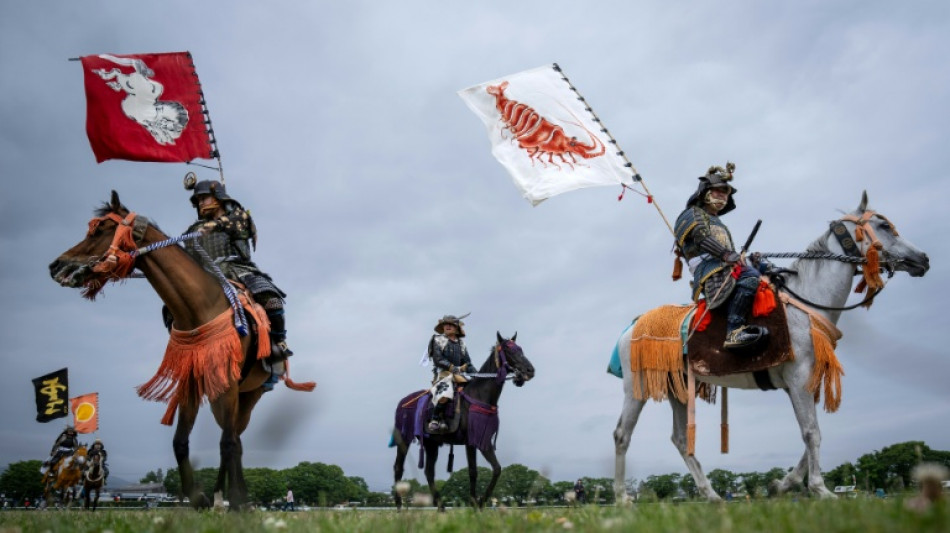
Japan's thousand-year-old samurai horse festival has survived wars, earthquakes and a nuclear disaster. Now it's battling a new challenge -- climate change.
The Soma Nomaoi began as a way to train mounted warriors and it still looks the same a millennium later, with riders dressed in samurai armour competing in horseback events.
Until 2024, the festival took place at the height of Japan's gruelling summers, which had become so hot that riders and spectators were collapsing and horses dying of heatstroke.
That prompted organisers to switch the festival to the cooler temperatures of late May.
Mitsukiyo Monma, who has been taking part in the event for 54 years, told AFP that the change had given the festival a new lease of life.
"You have to wear a kimono under the armour, which is not like going out in just a T-shirt in the summer," said the 69-year-old, adding that he needed medical attention on a day when the mercury was close to 40C.
"Your clothes would be so soaked that you could wring out the sweat," he said.
"When the festival moved to May, it was the first time I could drink hot coffee before going out."
Scientists say climate change is making extreme weather events more frequent and severe, and temperatures around the world have soared in recent years.
Japan is no exception. Last year, the country had its hottest summer since records began in 1898.
Temperatures rising to 40C and above have become so common that Japan's weather agency recently created an official designation for them, labelling them "cruelly hot" days.
- 'Truly a samurai' -
Such conditions are hardly ideal for the Soma Nomaoi, where participants compete on horseback in samurai armour weighing around 25 kg.
The main event starts with races around a flat, oval track, with riders carrying giant flags on their backs.
Hundreds of riders then gather in a large grass field and compete to grab coloured flags that drift to the ground after being fired high into the air.
On the last of the festival's three days, participants try to grab wild horses with their bare hands and offer them to the gods.
The action is fast and furious, and Monma says it is serious business for the riders taking part.
"I feel like I've truly become a samurai," he said.
"I feel more courageous, and on the day itself, my whole body and mind tighten."
The Soma Nomaoi takes place around Minamisoma, almost 300 kilometres (190 miles) north of Tokyo.
It started around 1,000 years ago and records suggest it has been held uninterrupted for at least the last 400 years.
The festivities kept going even in the aftermath of a 2011 earthquake and tsunami that left over 18,000 people dead or missing and caused a devastating meltdown at the Fukushima nuclear plant.
Fumihiko Futakami, director of the Minamisoma City Museum, says the Soma Nomaoi was a source of comfort when he was evacuated to Tokyo after the disaster.
"Even for people who have left here and now live elsewhere, when they think of their hometown, they think of mounted warriors," he said.
"It's the identity of our town."
- Uncertain future -
The festival's warrior roots meant only samurai could take part until the feudal system was abolished in the late 19th century.
Women were admitted after World War II, and festival veteran Monma fulfilled a lifelong dream when his two granddaughters joined him for this year's event.
It took place under cloudy skies, with the temperature hovering around a pleasant 18C.
There was little chance of a repeat of the 2023 Soma Nomaoi, when more than 100 horses and dozens of people needed treatment for heatstroke, and two animals died.
"There isn't much shade anywhere, so I think this is the most comfortable temperature for everyone," said 25-year-old Haruto Inoue, who was visiting from nearby Tochigi to watch the festival for the first time.
"They look so cool in their samurai gear, racing through the mud and giving it everything they've got."
Anyone can participate in the Soma Nomaoi, but owning or hiring a horse is not cheap.
The number of participants is steadily declining, and Japan's ageing population is a major factor.
Monma worries that the festival might not survive another 100 years unless organisers can come up with solutions.
Museum director Futakami believes moving it away from the punishing summer heat has been a good start.
"The horses are livelier and the participants aren't so exhausted that they can barely move the next day," he said.
"I think most people would say it's been a good thing."
H.Cho--CPN