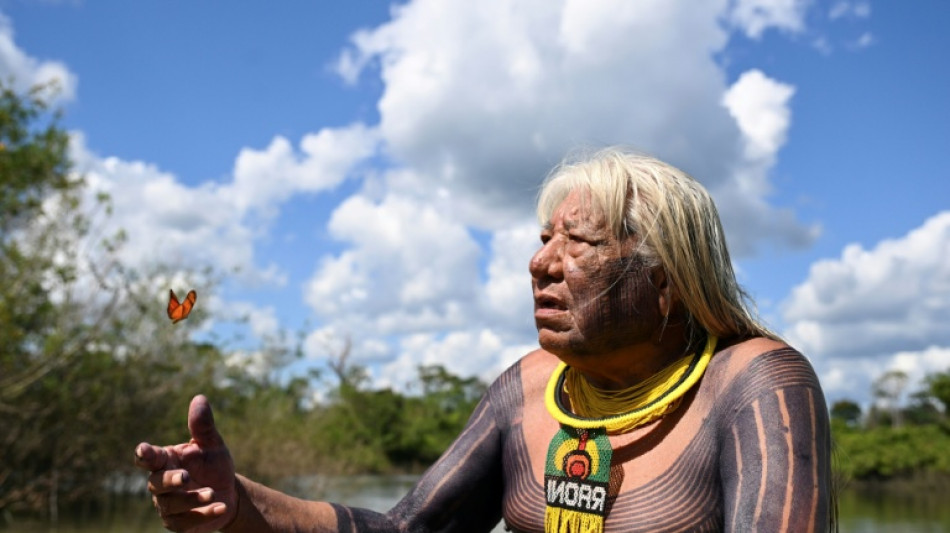
Chief Megaron: heir to the fight for Brazil's Amazon / Photo: Evaristo Sa - AFP

 Lights out in Laos as electricity exports surge

 Steven Strogatz weighs AI mathematics advances and their consequences for researchers

 Anthropic boss calls for AI slowdown, Altman and Musk agree

 French IT giant Capgemini sells subsidiary after row over ICE links

 Quebec Brokerage Qubit Insurance Announces New Data on Coverage Shortfalls as Rebuilding Costs Rise

 Lady Gaga welcomes first child with fiance: US media

 Bhutan business bets on hazelnuts for farming future

 'Widow's Bay' and 'The Pitt' are favorites for Emmys night

 Coastal erosion forces cancellation of California music festival

 Argentina's Dirty War rears its head in Venice film

 UK lawmakers throw out bill to legalise assisted dying

 US inflation steady in August, fueling Fed rate hike expectations

 New York marks 25th anniversary of 9/11 attacks

 Nepal flood reconstruction bill to be $4.78 bn: foreign ministry

 JUMO and Standard Bank launch Social Finance Framework to scale inclusive finance in Africa

 Doomsday tech: could AI really kill us all?

 French comedy show 'Call my agent' makes film comeback

 It's all coming back: Celine Dion fans gear up for Paris return

 Researchers eye AI revolution in natural disaster forecasts

 US braces for inflation report that may push Fed to hike rates

 Musk threatens legal action over documentary

 Latin America fact-check group asks Meta not to replace verification practice

 AI Risks to Enter 60–80% of Liability and Cyber Insurance Underwriting by 2028, ScienceSoft Predicts

 Tribal Launches Campfire, Letting Business and Technical Teams Build on Salesforce Together

 Stocks fall as fresh oil surge fans inflation fears

On a hot afternoon deep in Brazil's Amazon rainforest, Indigenous chief Megaron soaps himself and enjoys a quick swim in the river, a brief respite from battling threats to his people's lands.
The 75-year-old, with long white hair and sharp black geometric lines painted across his body, is stepping into a role he has long prepared for: succeeding his uncle, Brazil's most iconic Indigenous leader, Raoni Metuktire.
Chief Raoni, 93, who has devoted his life to warning the world about the destruction of the Amazon, has been hospitalized several times in recent weeks.
Megaron Txucarramae vowed to carry forward his uncle's fight at a gathering of Kayapo leaders in the village of Pykany in Para state last week. They had come to see Raoni before he became too ill to attend.
"I told them that I will continue to support the struggle of our uncle to preserve not only Indigenous lands and the forest, but also to preserve our health, our culture, and our language," Megaron told AFP on the riverbank.
The Kayapo are one of hundreds of Indigenous groups in Brazil, but their fight to defend their land has become one of the most visible internationally.
Pykany lies in one of several Kayapo territories which together form one of the largest blocks of protected rainforest in the world -- an area larger than Portugal which they have thanks to the struggle of leaders like Raoni and Megaron.
Experts see Indigenous territories as one of the best barriers to climate change by preventing deforestation, as the Amazon edges closer to a tipping point in which it could transition to a drier, savannah-like ecosystem.
- Invasions and protest -
Megaron, like Raoni, is one of the last of a generation born before sustained contact with the outside world.
He was born in 1950 in the village of Piaraçu in the north of the state of Mato Grosso and lived through the "truly awful" violence of incursions into Indigenous lands by settlers, ranchers and miners.
"I saw it with my own eyes. A thug hired by ranchers killed two of my uncles right in front of me, when I was just a child," he told AFP.
He was by Raoni's side in the 80s leading major protests against the construction of the Belo Monte hydroelectric dam on the Xingu River. The dam, one of the biggest in the world, was eventually built and inaugurated in 2016.
In 2010, the outspoken chief slammed President Luiz Inacio Lula da Silva -- then in his second term -- as the "number one enemy" of the Indigenous people.
Megaron's acts against the dam saw him fired as a co-ordinator with Brazil's Indigenous affairs agency, FUNAI.
Roiti Metuktire, 35, Raoni's grand-nephew, said the nonagenarian chief has come to see Megaron as "a trusted confidant."
Megaron served as his translator on international trips and since the 90s has been seen as the natural choice to "carry Raoni's struggle forward," said Metuktire.
- Poisonous gold -
As women chop up a fresh catch of piranha from the river, Megaron bemoans constant incursions by illegal gold miners into Indigenous territory, whose mercury poisons such waters that sustain villages.
A boom in gold prices due to global instability has ramped up the pressure once again.
"The government has failed to take decisive action to permanently expel them and put an end to mining within Indigenous territories," he said.
Megaron and two other Indigenous leaders are travelling to four European capitals between June 6 and 19, and plan to knock on the door of top jewellry brands like Cartier and Bulgari to urge them to put more pressure on suppliers to ensure their gold does not come from Indigenous land.
- 'Deeply apprehensive' -
Megaron told AFP he was concerned about Brazil's presidential election in October.
Seeking a fourth term, Lula's main rival is Flavio Bolsonaro, son of former president Jair Bolsonaro, who oversaw a dramatic increase in illegal gold mining and deforestation in the Amazon.
While Indigenous communities have expressed frustration with Lula's government, he is credited with demarcating 20 new territories since 2023 and cracking down on illegal gold miners.
"It worries us because the political right is anti-Indigenous. We are deeply apprehensive about what might happen if they win," said Megaron.
Ch.Lefebvre--CPN