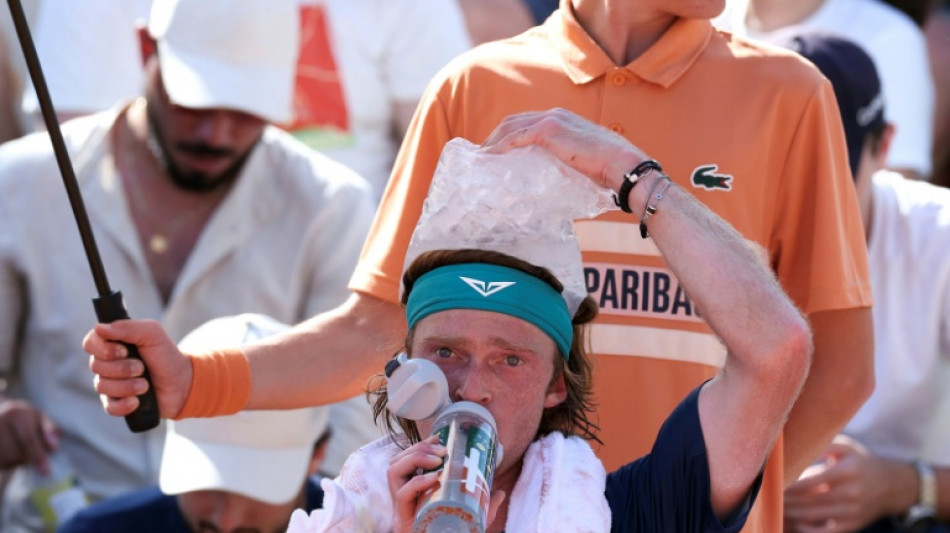
French Open: What level of heat would stop play? / Photo: ALAIN JOCARD - AFP

 Lights out in Laos as electricity exports surge

 Steven Strogatz weighs AI mathematics advances and their consequences for researchers
 Anthropic boss calls for AI slowdown, Altman and Musk agree

 French IT giant Capgemini sells subsidiary after row over ICE links
 Quebec Brokerage Qubit Insurance Announces New Data on Coverage Shortfalls as Rebuilding Costs Rise
 Lady Gaga welcomes first child with fiance: US media

 Bhutan business bets on hazelnuts for farming future

 'Widow's Bay' and 'The Pitt' are favorites for Emmys night

 Coastal erosion forces cancellation of California music festival

 Argentina's Dirty War rears its head in Venice film

 UK lawmakers throw out bill to legalise assisted dying

 US inflation steady in August, fueling Fed rate hike expectations

 New York marks 25th anniversary of 9/11 attacks

 Nepal flood reconstruction bill to be $4.78 bn: foreign ministry

 JUMO and Standard Bank launch Social Finance Framework to scale inclusive finance in Africa

 Doomsday tech: could AI really kill us all?

 French comedy show 'Call my agent' makes film comeback

 It's all coming back: Celine Dion fans gear up for Paris return

 Researchers eye AI revolution in natural disaster forecasts

 US braces for inflation report that may push Fed to hike rates

 Musk threatens legal action over documentary

 Latin America fact-check group asks Meta not to replace verification practice

 AI Risks to Enter 60–80% of Liability and Cyber Insurance Underwriting by 2028, ScienceSoft Predicts

 Tribal Launches Campfire, Letting Business and Technical Teams Build on Salesforce Together

 Stocks fall as fresh oil surge fans inflation fears

As a relentless Parisian sun continued to beat down on Roland Garros and temperatures remained uncomfortably in the mid-30s Celsius, organisers laid out what it would take to stop play.
The French Tennis Federation (FFT) said that a match had never been called off at the French Open because of extreme heat but they would do it on all courts where the reading on one of their two wet bulb thermometers reached 32.2 Celsius (90 degrees Fahrenheit).
The FFT said that would included the display courts with retractable roofs: Philippe Chatrier and Suzanne Lenglen.
Wet Bulb Globe Temperature (WBGT) is an index that measures how effectively the human body can cool itself under heat, humidity, sun exposure and wind. At less than 100 per cent humidity it will give a lower reading than a normal thermometer.
The FTT said their two wet bulbs were on Chatrier and Court 14, at the western end of the Roland Garros precinct.
The FTT said that when the WBGT reached 30.1 degrees Celsius before the start of a singles match players, would be entitled to request one 10-minute break -- before a possible third set for women and before a possible fourth set for men.
The FTT also said that play would be halted for lightning.
The FTT is exactly emulating the policies and thresholds of the women's and men's tours. The WTA introduced their first heat rule in 1992 and the ATP adopted one at the start of this year saying they were copying the latest WTA verison.
Other tennis majors, notably the Australian Open, have long struggled with extreme heat.
The Melbourne tournament introduced a "heat stress index" in 2019 which calculated "the maximum heat stress an athlete can safely withstand," Dr Carolyn Broderick of Tennis Australia said in a statement at the time.
The five-step 'scale' takes into account "air temperature, radiant heat or the strength of the sun, humidity and wind speed" and goes from one to five.
At level five, play is suspended on the outside courts but can continue on the three main courts once the roof is closed and the air conditioning turned on.
This occurred during the round of 16 in Melbourne this year when play was suspended for nearly five hours on the outside courts.
Wimbledon operates a similar system to French Open and used 10-minute breaks last June when it opened in a heat wave.
Like Australia, the extreme heat protocol does not apply to courts with a roof: Centre Court and Court No. 1.
At the US Open, an extreme heat protocol was activated for the first time in 2018 it includes a provision for 'case-by-case' ten-minute breaks.
M.P.Jacobs--CPN