With ice cream and giant fans, hajj pilgrims battle searing heat
/ Photo: Zain JAAFAR - AFP

 Lights out in Laos as electricity exports surge

 Steven Strogatz weighs AI mathematics advances and their consequences for researchers
 Anthropic boss calls for AI slowdown, Altman and Musk agree

 French IT giant Capgemini sells subsidiary after row over ICE links
 Quebec Brokerage Qubit Insurance Announces New Data on Coverage Shortfalls as Rebuilding Costs Rise

 Lady Gaga welcomes first child with fiance: US media

 Bhutan business bets on hazelnuts for farming future

 'Widow's Bay' and 'The Pitt' are favorites for Emmys night

 Coastal erosion forces cancellation of California music festival

 Argentina's Dirty War rears its head in Venice film

 UK lawmakers throw out bill to legalise assisted dying

 US inflation steady in August, fueling Fed rate hike expectations

 New York marks 25th anniversary of 9/11 attacks

 Nepal flood reconstruction bill to be $4.78 bn: foreign ministry

 JUMO and Standard Bank launch Social Finance Framework to scale inclusive finance in Africa

 Doomsday tech: could AI really kill us all?

 French comedy show 'Call my agent' makes film comeback

 It's all coming back: Celine Dion fans gear up for Paris return

 Researchers eye AI revolution in natural disaster forecasts

 US braces for inflation report that may push Fed to hike rates

 Musk threatens legal action over documentary

 Latin America fact-check group asks Meta not to replace verification practice

 AI Risks to Enter 60–80% of Liability and Cyber Insurance Underwriting by 2028, ScienceSoft Predicts

 Tribal Launches Campfire, Letting Business and Technical Teams Build on Salesforce Together

 Stocks fall as fresh oil surge fans inflation fears

To avoid the punishing sun, Inas Gamal abandoned her ambitious plan of spending the days ahead of the hajj praying in Mecca's Grand Mosque and retreated to the comfort of an air-conditioned hotel room to perform her daytime prayers.
Despite travelling all the way from Egypt for the annual pilgrimage, Gamal said it was just too hot to spend much time outside during the day, where temperatures crossed 40 degrees Celsius (104 degrees Fahrenheit).
"It's very hot, much hotter than I imagined," the mother of four, who is performing the hajj for the first time, told AFP.
"I can't adapt," she added while adjusting her sunglasses to protect her eyes from the harsh glare of the sun.
"I had planned to perform all my prayers at the Grand Mosque, but I couldn't go down for the prayers held during the day."
Pilgrims perform most of the hajj's rites outdoors where more than a million devotees gather in stifling conditions, with many attendees succumbing to heatstroke, fainting spells and even cardiac arrest triggered by the heat.
Saudi Arabia's National Center for Meteorology predicted daytime temperatures this week would hover between 42 and 47 degrees Celsius in Mecca during the hajj, which officially begins on Monday.
For pilgrims travelling from outside the region, the harsh desert climate can be brutal.
"I make sure to drink large amounts of water and beverages rich in salts and minerals, because we sweat constantly and are always on the move," said Imad Ahmed, visiting from Britain.
- 'Really hot' -
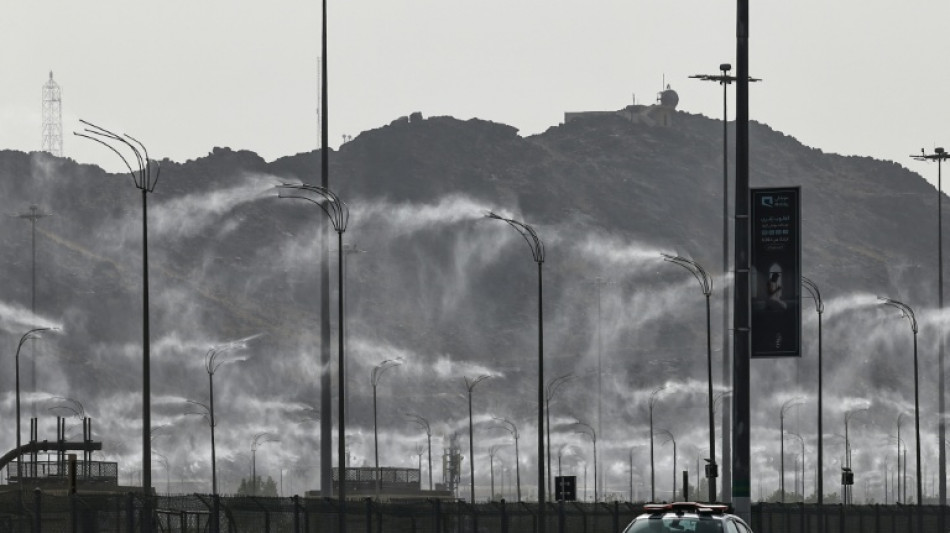
To protect worshippers from the extreme heat, authorities rely on one of the most powerful air conditioning systems in the world to cool the Grand Mosque's courtyards, according to Saudi state television.
Other areas have huge fans, mist sprayers and cooled flooring systems to mitigate the searing heat.
Trucks are also continuously distributing free bottles of ice-cold water to pilgrims.
But even with these measures, the unrelenting sun continues to bake the white marble surrounding the grounds of the Grand Mosque where most pilgrims have congregated in recent days.
"It's really hot," said Mohamed Nabil, who hails from the Algerian coastal city of Oran, where temperatures are currently around 25 degrees Celsius.
The 43-year-old professor said he regularly pours water on his face to stay cool, while racking up 30,000 steps a day as he explores Mecca.
- Heatstrokes -
Ice cream stands are often mobbed by pilgrims, while others seek shelter in the shade of buildings near the mosque or in indoor galleries, where they lie on carpets beneath enormous fans while waiting to perform their prayers.
When the hajj begins, pilgrims will be forced to beat the heat for many of the rites, including the pilgrimage's climax at Mount Arafat on Tuesday where there is little if any shade to be found on the rocky hill.
More than 50,000 healthcare staff and 3,000 ambulances are on hand to help pilgrims in need, the Saudi health ministry said.
On Saturday, the ministry said its medical teams had already treated 144 people suffering from heatstroke.
In 2024, more than 1,300 pilgrims died as temperatures crossed 50 degrees Celsius, according to authorities.
Speaking from a hospital room in the Mina camp, where authorities treat pilgrims for heat exhaustion, the health ministry's Jameel Abualenain said he was mainly concerned "about rising temperatures" affecting pilgrims.
To protect against heatstroke, he said people must "drink enough water, use umbrellas and avoid prolonged exposure to the sun".
A.Levy--CPN