India warns of power use as demand peaks during heatwave / Photo: Arun SANKAR - AFP

 Lights out in Laos as electricity exports surge

 Steven Strogatz weighs AI mathematics advances and their consequences for researchers

 Anthropic boss calls for AI slowdown, Altman and Musk agree

 French IT giant Capgemini sells subsidiary after row over ICE links

 Quebec Brokerage Qubit Insurance Announces New Data on Coverage Shortfalls as Rebuilding Costs Rise

 Lady Gaga welcomes first child with fiance: US media

 Bhutan business bets on hazelnuts for farming future

 'Widow's Bay' and 'The Pitt' are favorites for Emmys night

 Coastal erosion forces cancellation of California music festival

 Argentina's Dirty War rears its head in Venice film

 UK lawmakers throw out bill to legalise assisted dying

 US inflation steady in August, fueling Fed rate hike expectations

 New York marks 25th anniversary of 9/11 attacks

 Nepal flood reconstruction bill to be $4.78 bn: foreign ministry

 JUMO and Standard Bank launch Social Finance Framework to scale inclusive finance in Africa

 Doomsday tech: could AI really kill us all?

 French comedy show 'Call my agent' makes film comeback

 It's all coming back: Celine Dion fans gear up for Paris return

 Researchers eye AI revolution in natural disaster forecasts

 US braces for inflation report that may push Fed to hike rates

 Musk threatens legal action over documentary

 Latin America fact-check group asks Meta not to replace verification practice

 AI Risks to Enter 60–80% of Liability and Cyber Insurance Underwriting by 2028, ScienceSoft Predicts

 Tribal Launches Campfire, Letting Business and Technical Teams Build on Salesforce Together

 Stocks fall as fresh oil surge fans inflation fears

India's power ministry urged careful use of electricity on Friday, a day after breaking records for power generation during an intense heatwave in the world's most populous nation.
Peak power usage this week has broken records for four straight days, with temperatures hitting 47C, according to the India Meteorological Department (IMD).
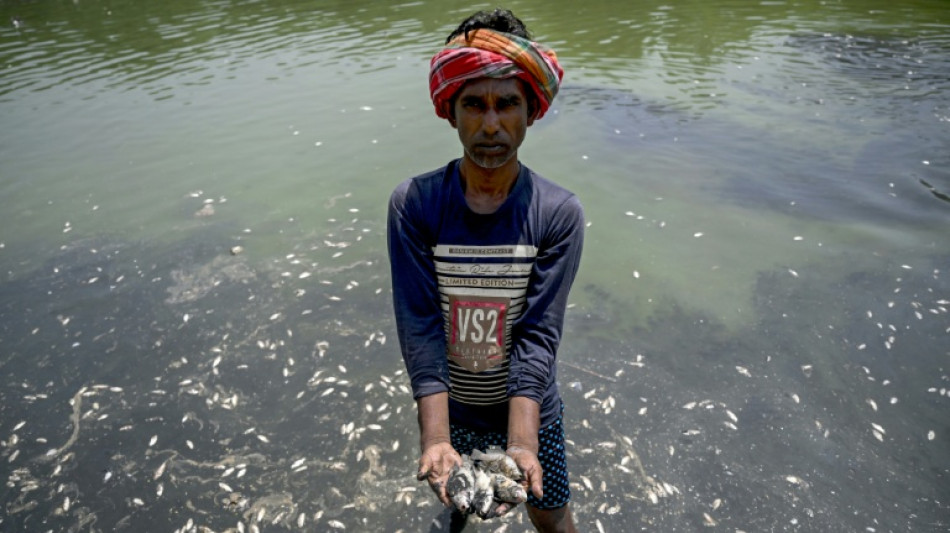
Workers on Friday scooped up dead fish floating on the surface of the Sanjay Park lake in the capital New Delhi. The fish died as the water shrank after days of relentless summer sun.
Temperatures in the megacity hit 43C on Friday.
On Thursday, the power ministry said it had "successfully met" the "fourth consecutive day when the peak power demand... reached a new all-time high", supplying 270.82 gigawatts (GW).
But it also warned that the grid was being stretched.
"Although we are prepared to supply electricity as required, due to the intense summer, let us all try to use electricity wisely and judiciously," it said in a statement.
It had earlier noted that the "surge in demand appears to be linked to the greater usage of cooling appliances".
Thermal power -- largely coal -- accounted for 62 percent of generation on Thursday, with solar making up 22 percent, wind and hydropower taking up five percent each and the rest coming from other sources.
In addition to burning heat in the peak of the sunshine, India's minimum temperatures during the night are scorching hot -- giving people little respite.
In New Delhi, one of the main weather stations recorded a minimum temperature of 31.9C on Thursday, the highest for the month of May in the city in 14 years, according to IMD data.
The IMD said that average minimum temperatures were 0.78C higher than normal countrywide in April, and warned of above normal minimum temperatures in May.
- More intense -
India, the third-largest emitter of greenhouse gases, has committed to reaching net-zero emissions by 2070, but remains heavily reliant on coal.
Despite the power production, followers of the ministry's X account reported that there had been cuts in their districts.
The intense heat can overload old wiring and transformers, and cause localised blackouts.
The South Asian country of 1.4 billion people is no stranger to sizzling summers, with routine heatwaves between April and June.
Years of scientific research has found climate change is causing heatwaves to become longer, more frequent and more intense.
The IMD said the highest maximum temperature recorded on Thursday was 47.6C in the city of Banda in Uttar Pradesh state, 450 kilometres (289 miles) southeast of New Delhi, moderately cooler than the 48.2C earlier in the week. It was 4.1C above normal temperatures.
The country's highest officially recorded temperature is 51C, measured at Phalodi in Rajasthan in 2016.
In April, international air-quality monitoring platform AQI said its daily heat index -- made up of six measurements including temperature, solar intensity, wind, precipitation and humidity -- recorded that all of the world's top 50 hottest cities were in India.
M.Mendoza--CPN