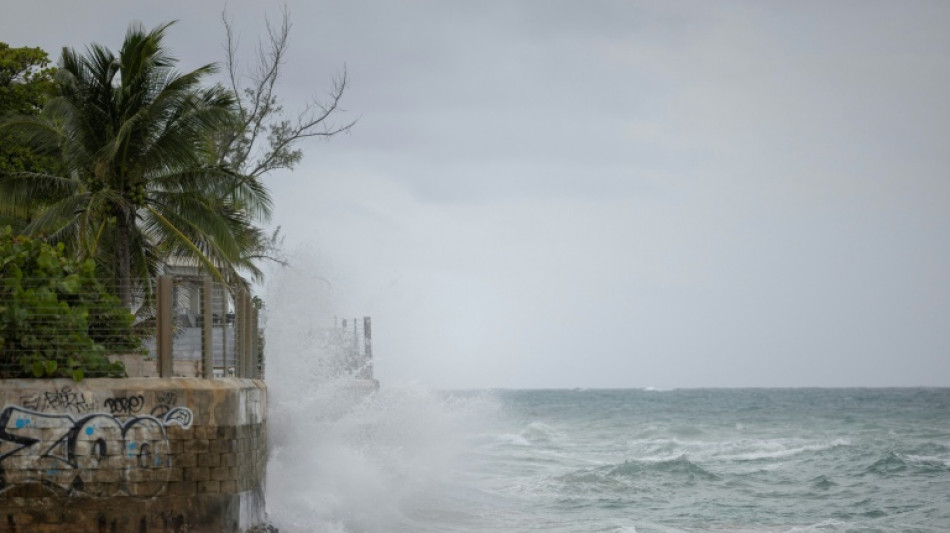
Hurricane Erin intensifies offshore, lashes Caribbean with rain / Photo: Ricardo ARDUENGO - AFP

 Archaeological 'breakthrough' could confirm origins of Paris

 Australian PM says OpenAI hacked government health website

 Rio breaks record for rainiest September amid powerful El Nino

 Mandela Digital Extends Early Access Programme to 11 February 2027 Following Strong Response

 McDonald's to boost franchisees as inflation weighs on consumers

 Archaelogical 'breakthrough' could confirm origins of Paris

 Fendi brings disco bling, Italian style, to Milan Fashion Week

 アレックス・ボディ氏とシュテファン・ハウプト教授、ルーマニアの伝説的な美術コレクションをめぐり提携に合意

 Stocks dip, oil rises as traders eye chances of Iran deal

 Oil falls, stocks steady as Trump hails 'good' Iran talks

 Canada judge to decide prison term for suicide poison seller

 Meta leans into AI, smart glasses amid privacy pushback

 Oil prices fall after Trump hails 'good' talks with Iran

 AI political ads warp reality ahead of US midterms

 Oil prices retreat as markets welcome US-Iran talks
 French prosecutors probe secret filming of women with smart glasses

 Trump renames AI "super intelligence," rejects international oversight

 How is the EU approaching record fuel prices?

 11 hurt as teen opens fire outside school in western Turkey

 UN chief says 'Big Oil' treats atmosphere as open sewer

 Memoir by Diana's brother goes on sale after rocking UK monarchy

 Stocks climb as oil slides, AI buzz returns

 MEXC Launches “Real Stocks, Real Friends” with Rewards for Bringing Friends to Wall Street

 Stocks rise on AI buzz, oil prices cool

 In Bangladesh, Pakistan's Jinnah photo stirs anger

Hurricane Erin rapidly strengthened offshore to a "catastrophic" Category 5 storm on Saturday, as rain lashed Caribbean islands and weather officials warned of possible flash floods and landslides.
The first hurricane of what is expected to be a particularly intense Atlantic season, Erin is expected to drench Caribbean islands with rain and strong winds but not make landfall.
The US National Hurricane Center (NHC) said in its latest report the storm's maximum sustained winds had increased to 160 miles (255 kilometers) per hour.
It was located about 135 miles (215 kilometers) northwest of Anguilla in the northern Leeward Islands, an area that includes the US and British Virgin Islands.
A flash flood warning was issued for Saint Thomas and Saint John in the US Virgin Islands as outer rain bands from Erin swept across, according to the US National Weather Service.
Tropical storm watches were in effect for St Martin, St Barthelemy, Sint Maarten and the Turks and Caicos Islands.
"Erin is now a catastrophic Category 5 hurricane," the NHC announced earlier Saturday, denoting highly dangerous storms with sustained windspeeds above above 157 mph.
The storm reached the highest level on the Saffir-Simpson scale just over 24 hours after becoming a Category 1 hurricane, a rapid intensification that scientists say has become more common due to global warming.
The hurricane's center is expected to move over the weekend just north of the northern Leeward Islands, the Virgin Islands and Puerto Rico.
It is then forecast to pass east of the Turks and Caicos Islands and the southeastern Bahamas on Sunday night before weakening.
The storm could drench the islands with as much as six inches (15 centimeters) of rain in isolated areas, the NHC said.
"Continued rapid strengthening is expected today, followed by fluctuations in intensity through the weekend," the agency said in an earlier report.
It also warned of "locally considerable flash and urban flooding, along with landslides or mudslides."
- Climate hazard -
Swells generated by Erin will affect portions of the northern Leeward Islands, Virgin Islands, Puerto Rico, Hispaniola and the Turks and Caicos Islands through the weekend.
Those swells will spread to the Bahamas, Bermuda and the US East Coast early next week, creating "life-threatening surf and rip currents," the NHC said.
The hurricane is expected to turn northwest on Saturday night, then turn northward early next week. It is expected to weaken from Monday.
While meteorologists have expressed confidence that Erin will remain well off the US coastline, they said the storm could still cause dangerous waves and erosion in places such as North Carolina.
The Atlantic hurricane season, which runs from June until late November, is expected to be more intense than normal, US meteorologists predict.
Several powerful storms wreaked havoc in the region last year, including Hurricane Helene, which killed more than 200 people in the southeastern United States.
The National Oceanic and Atmospheric Administration -- which operates the NHC -- has been subject to budget cuts and layoffs as part of US President Donald Trump's plans to greatly reduce the size of the federal bureaucracy, leading to fears of lapses in storm forecasting.
Human-driven climate change -- namely, rising sea temperatures caused by the burning of fossil fuels -- has increased both the possibility of the development of more intense storms, and their more rapid intensification, scientists say.
A.Zimmermann--CPN