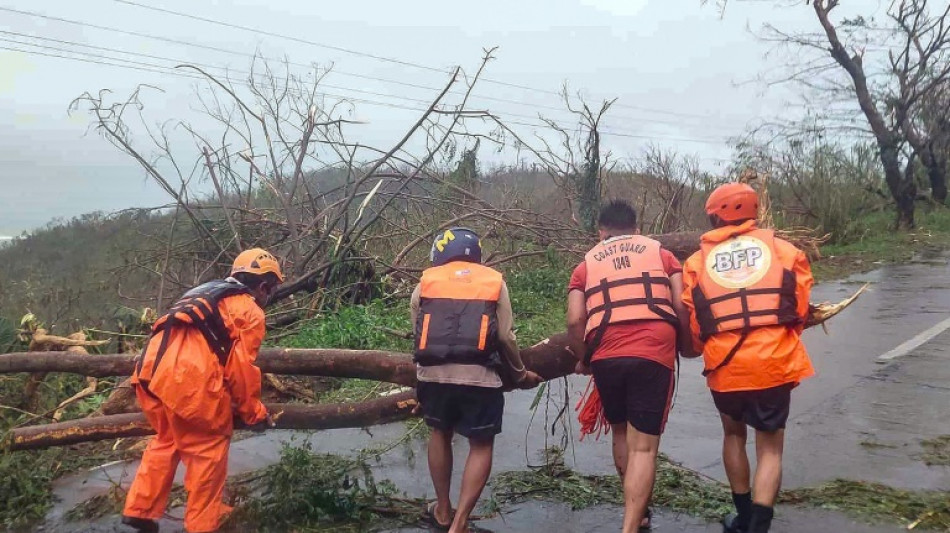
Philippines cleans up after sixth major storm in weeks / Photo: - - Philippine Coast Guard (PCG)/AFP

 Kenya's economy faces climate change risks: World Bank

 Apple tops estimates in CEO Cook's final quarter, but shares fall

 Milei demands expulsion of foreigners expressing 'hate' against Argentina

 Italy's Po River valley on drought alert

 Prada profits pinched as growth hard to chase

 Stocks climb on earnings and rates, oil retreats

 US economic growth slows in second quarter, missing expectations

 Russia adds Telegram founder Durov to 'terrorist' blacklist

 Stocks diverge on earnings, as oil steadies

 Eurozone economy grows despite Middle East war

 Singapore group will develop 'most promising' Ebola vaccine

 Shell profit surges as Mideast war fuels oil prices

 Car maker Stellantis says back in profit in second quarter

 Samsung quarterly operating profit up 1,800% on AI boom

 South Korean stocks bounce after rout, oil holds gains on Mideast woes

 South Korea's women web sleuths fight AI deepfake porn

 Anything but programmable: New cost-efficient EC-power-supply-series for the DIN rail by CAMTEC PS

 Meta misses profit expectations, sticks to massive AI spending

 Campari - king of the spritz - hopes to conquer American heartland

 Air France-KLM and Lufthansa bid for Portugal's TAP airline

 Profits soar at Airbus as it delivers more planes

 Rheinmetall shares surge after armsmaker reports record profit

 FIFA hit by furious backlash over plans to sell stake in competitions

 MEXC Integrates World-Check to Fortify Institutional Grade Compliance Architecture

 Spain returns wildfire evacuees as France braces for worsening weather

Filipinos cleared fallen trees and repaired damaged houses on Monday after the sixth major storm to batter the Philippines in a month smashed flimsy buildings, knocked out power and claimed at least one life.
The national weather service had warned of a "potentially catastrophic" impact from Man-yi, which was a super typhoon when it hit over the weekend, but President Ferdinand Marcos said Monday it "wasn't as bad as we feared".
Packing maximum sustained wind speeds of 185 kilometres (115 miles) an hour, Man-yi slammed into Catanduanes island late Saturday, and the main island of Luzon on Sunday afternoon.
It uprooted trees, brought down power lines, crushed wooden houses and triggered landslides, but did not cause serious flooding.
"Though Pepito was strong, the impact wasn't as bad as we feared," Marcos said, according to an official transcript of his remarks to media, using the local name for Man-yi.
One person was killed in Camarines Norte province, which Marcos said was "one casualty too many". Police said the victim, a 79-year-old man, died after his motorbike was caught in a power line.
There have been no other reports so far of deaths or injuries.
"We will now carry on with the rescue of those (in) isolated areas and the continuing relief for those who are, who have been displaced and have no means to prepare their own meals and have no water supplies," Marcos said.
Power outages across the island province of Catanduanes could last for months after Man-yi toppled electricity poles, provincial information officer Camille Gianan told AFP.
"Catanduanes has been heavily damaged by that typhoon -- we need food packs, hygiene kits and construction materials," Gianan said.
"Most houses with light materials were flattened while some houses made of concrete had their roofs, doors and windows destroyed."
In the coastal town of Baler in Aurora province, clean-up operations were underway to remove felled trees and debris blocking roads and waterways.
"Most of the houses here are made of light materials so even now, before the inspection, we are expecting heavy damage on many houses in town," disaster officer Neil Rojo told AFP.
"We've also received reports of roofs that went flying with the wind last night... it was the fierce wind that got us scared, not exactly the heavy rains."
- Storm weakens -
Man-yi weakened significantly as it traversed the mountains of Luzon and was downgraded to a severe tropical storm as it swept over the South China Sea towards Vietnam on Monday.
More than a million people in the Philippines fled their homes ahead of the storm, which followed an unusual streak of violent weather.
Climate change is increasing the intensity of storms, leading to heavier rains, flash floods and stronger gusts.
At least 163 people in the Philippines died in the past month's storms, which left thousands homeless and wiped out crops and livestock.
About 20 big storms and typhoons hit the Southeast Asian nation or its surrounding waters each year, killing scores of people, but it is rare for multiple such weather events to take place in a small window.
Man-yi also hit the Philippines late in the typhoon season -- most cyclones develop between July and October.
This month, four storms were clustered simultaneously in the Pacific basin, which the Japan Meteorological Agency told AFP was the first time such an occurrence had been observed in November since its records began in 1951.
Y.Tengku--CPN