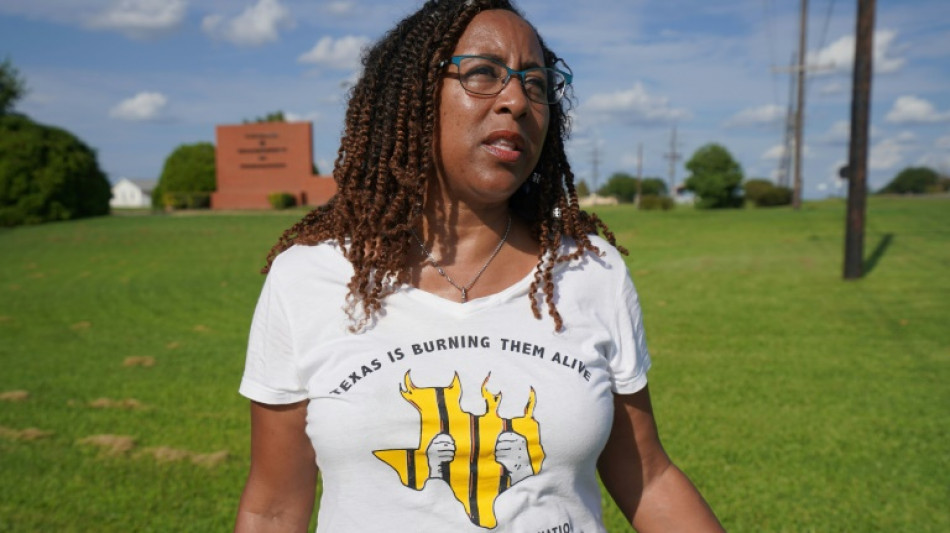
Extreme heat another form of death sentence in Texas jails / Photo: Francois PICARD - AFP

 Kenya's economy faces climate change risks: World Bank

 Anthropic's models gained unauthorized 'real-world' access during testing

 Apple tops estimates in CEO Cook's final quarter, but shares fall

 Milei demands expulsion of foreigners expressing 'hate' against Argentina

 Italy's Po River valley on drought alert

 Prada profits pinched as growth hard to chase

 Stocks climb on earnings and rates, oil retreats

 US economic growth slows in second quarter, missing expectations

 Russia adds Telegram founder Durov to 'terrorist' blacklist

 Stocks diverge on earnings, as oil steadies

 Eurozone economy grows despite Middle East war

 Singapore group will develop 'most promising' Ebola vaccine

 Shell profit surges as Mideast war fuels oil prices

 Car maker Stellantis says back in profit in second quarter

 Samsung quarterly operating profit up 1,800% on AI boom

 South Korean stocks bounce after rout, oil holds gains on Mideast woes

 South Korea's women web sleuths fight AI deepfake porn

 Anything but programmable: New cost-efficient EC-power-supply-series for the DIN rail by CAMTEC PS

 Meta misses profit expectations, sticks to massive AI spending

 Campari - king of the spritz - hopes to conquer American heartland

 Air France-KLM and Lufthansa bid for Portugal's TAP airline

 Profits soar at Airbus as it delivers more planes

 Rheinmetall shares surge after armsmaker reports record profit

 FIFA hit by furious backlash over plans to sell stake in competitions

 MEXC Integrates World-Check to Fortify Institutional Grade Compliance Architecture

Prison cells so hot that inmates splash themselves with toilet water. Jails described as ovens where convicts are baked to death.
An advocacy organization is suing the US state of Texas to mandate air conditioning for tens of thousands of inmates, arguing that temperatures reaching 120 degrees Fahrenheit (49 Celsius), according to convicts, are cruel and unconstitutional.
The suit, filed by Texas Prisons Community Advocates, follows three inmate deaths in the state's prison system in 2023 that officials admitted were partly due to extreme heat.
Fifty-year-old Patrick Womack died after being denied a cold water bath. John Castillo, 32, who suffered from epilepsy, fetched water 23 times before he died with a body temperature above 105.8 degrees Fahrenheit.
And days before her death, Elizabeth Hagerty, 37, warned prison officials that she was at a higher risk of a heat stroke because of her obesity and diabetes.
"In Texas, every summer we get triple digit weather. Every summer we have high humidity, and every summer we lose lives," the group's director Amite Dominick told AFP. "Because we are baking people in that brick building."
- 'A matter of surviving' -
As temperatures rise in the southern United States, helped by global warming, inmates' families are never sure if their loved ones will survive another summer.
With only a third of the state's prison population of 134,000 inmates having adequate air conditioning, Dominick's group wants US District Court Judge Robert Pitman to require Texas to maintain temperatures of between 65 and 85 degrees Fahrenheit inside the cells.
The heat and humidity cause inmates to become more aggressive, and fuel suicide attempts and trauma which then spread to their communities, she warned.
"We do see both assault numbers and aggressive behavior in general and suicide rates increasing every summer," Dominick said. "It really is a matter of surviving each summer."
She added: "Ninety-five percent of these individuals are coming home. The question is, what condition are they going to be coming back to our communities in?"
- At least three deaths -
Official attitudes toward the problem have been changing in Texas in recent years.
In 2012, then Texas senator John Whitmire said that Texans "are not motivated" to pay for air conditioning for "sex offenders, rapists, murderers" at the expense of regular citizens who may also need air conditioning.
But at a court hearing in early August, TDCJ director Bryan Collier acknowledged the gravity of the situation and said that "heat contributed to the death" of the three inmates in 2023.
Since 2017, the agency has been asking the state legislature for funding. A part of the requested sum was finally disbursed last year and the agency is currently building 1,760 additional climate-controlled beds.
While Collier urged lawmakers to approve more funding, he said prisons will continue relying on fans, ice water, cold baths and temporary transfers to air-conditioned common areas such as the library or medical center to help inmates deal with the heat.
- A humanitarian right -
Meanwhile, the suffering continues.
Marci Marie Simmons, 45, who spent 10 years in a women's prison in Texas for accounting offenses, said at one point she saw the reading on a thermometer in her jail dormitory -- 136 degrees Fahrenheit.
It would get so hot that she would "use toilet water because the toilet water was cooler than the water that came out of the tap."
"We believe that safe temperatures, that's a humanitarian right," Simmons, who is now a spokeswoman for the Alliance of Women Impacted by Justice, told AFP.
From her home in Weatherford, Texas, Simmons uses social media to talk about the deadly heat in prisons.
"You are not asking for a privilege. You are asking for something human, humanitarian consideration for people who (are) inside the prison under extreme heat," she said.
Samuel Urbina, 59, was recently released from jail after serving a sentence for drug offenses. He recalled serving time in a jail in Brazoria county in Texas, where the temperature would climb to 120 degrees Fahrenheit.
"It's extremely hot, very humid," Urbina told AFP, before hugging his daughter who came to pick him up. "It was miserable. I would not come back."
A.Agostinelli--CPN