Tunisia fisherwomen battle inequality and climate change / Photo: Mohamed KHALIL - AFP

 Kenya's economy faces climate change risks: World Bank

 Tech rebound fuels record-breaking rally in South Korean stocks
 Cables and cooling bring AI windfall to Indian suppliers

 Anthropic's models gained unauthorized 'real-world' access during testing

 Apple tops estimates in CEO Cook's final quarter, but shares fall

 Milei demands expulsion of foreigners expressing 'hate' against Argentina

 Italy's Po River valley on drought alert

 Prada profits pinched as growth hard to chase

 Stocks climb on earnings and rates, oil retreats

 US economic growth slows in second quarter, missing expectations

 Russia adds Telegram founder Durov to 'terrorist' blacklist

 Stocks diverge on earnings, as oil steadies

 Eurozone economy grows despite Middle East war

 Singapore group will develop 'most promising' Ebola vaccine

 Shell profit surges as Mideast war fuels oil prices

 Car maker Stellantis says back in profit in second quarter

 Samsung quarterly operating profit up 1,800% on AI boom

 South Korean stocks bounce after rout, oil holds gains on Mideast woes

 South Korea's women web sleuths fight AI deepfake porn

 Anything but programmable: New cost-efficient EC-power-supply-series for the DIN rail by CAMTEC PS

 Meta misses profit expectations, sticks to massive AI spending

 Campari - king of the spritz - hopes to conquer American heartland
 Air France-KLM and Lufthansa bid for Portugal's TAP airline

 Profits soar at Airbus as it delivers more planes

 Rheinmetall shares surge after armsmaker reports record profit
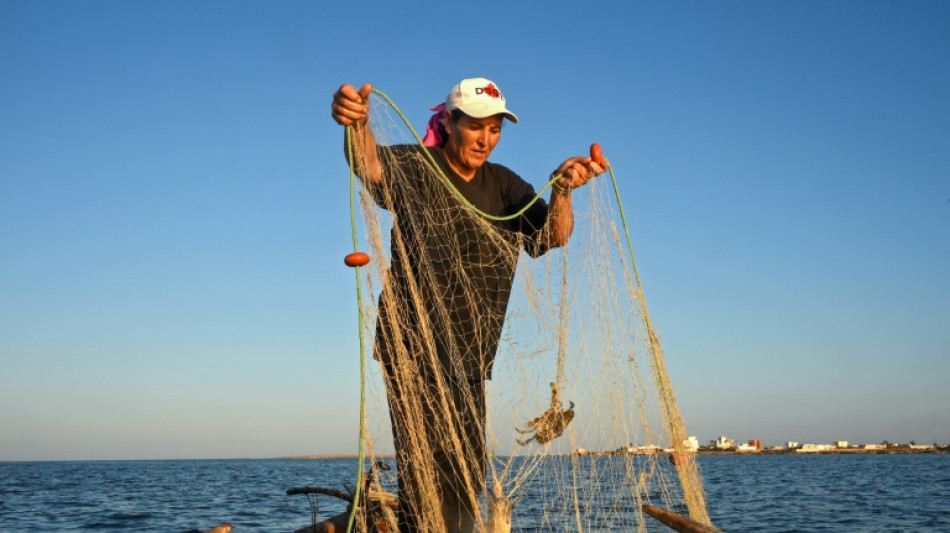
Off a quiet Tunisian island, Sara Souissi readies her small fishing boat. As a woman in the male-dominated trade, she rows against entrenched patriarchy but also environmental threats to her livelihood.
Souissi began fishing as a teenager in a family of fishers off their native Kerkennah Islands near the city of Sfax, defying men who believed she had no place at sea.
"Our society didn't accept that a woman would fish," she said, hauling a catch onto her turquoise-coloured boat.
"But I persisted, because I love fishing and I love the sea," said Souissi, 43, who is married to a fisherman and is a mother of one.
A substantial portion of Tunisia is coastal or near the coast, making the sea an essential component of everyday life.
Seafood, a staple in Tunisian cuisine, is also a major export commodity for the North African country, with Italy, Spain and Malta top buyers, and revenues nearing 900 million dinars ($295 million) last year, according to official figures.
Tunisian women have long played a major role in this vital sector.
But their work has been undervalued and unsupported, a recent study by the United Nations Food and Agriculture Organization (FAO) found.
The study said that while women were actively involved throughout the fishing value chain, they remained "generally not considered as an actual worker" by their male counterparts.
Fisherwomen also have less access to administrative benefits, training and banking services, where they are viewed as "high-risk borrowers" compared to men, the study said.
As a result, many don't own their own boats, and those working with male relatives are "considered as family help and therefore not remunerated", it added
- Under the table -
In Raoued, a coastal town on the edge of the capital Tunis, the Tunisian Society for Sustainable Fishing launched a workshop in June for women's integration into the trade.
But most of the women attending the training told AFP they were only there to help male relatives.
"I want to help develop this field. Women can make fish nets," said Safa Ben Khalifa, a participant.
There are currently no official numbers for fisherwomen in Tunisia.
Although Souissi is formally registered in her trade, many Tunisian women can work only under the table -- the World Economic Forum estimates 60 percent of workers in informal sectors are women.
"We want to create additional resources amid climate change, a decrease in marine resources, and poor fishing practices," said Ryma Moussaoui, the Raoued workshop coordinator.
Last month, the Mediterranean Sea reached its highest temperature on record at a daily median of 28.9 degrees Celsius (84 Fahrenheit), Spain's leading institute of marine sciences said.
The strain on sea life and resources has been compounded in countries like Tunisia by pollution and overfishing.
Rising temperatures make the waters uninhabitable for various species, and unsustainable fishing like trawling or using plastic traps indiscriminately sweeps up the dwindling sea life and exacerbates pollution.
"They don't respect the rules," Souissi said about fishers using those methods. "They catch anything they can, even off-season."
- 'Unfavourable environment' -
In 2017 in Skhira, a port town on the Gulf of Gabes, 40 women clam collectors formed an association to enhance their income -- only to see their hard-won gains later erased by pollution.
Before its formation, the women earned about a tenth of the clams' final selling price in Europe, said its president, Houda Mansour. By cutting out "exploitative middlemen", the association helped boost their earnings, she added.
In 2020, however, the government issued a ban on clam collecting due to a severe drop in shellfish populations, leaving the women unemployed.
"They don't have diplomas and can't do other jobs," Mansour, now a baker, explained.
In hotter, polluted waters, clams struggle to build strong shells and survive. Industrial waste discharged into the Gulf of Gabes for decades has contributed to the problem.
It has also forced other species out, said Emna Benkahla, a fishing economics researcher at the University of Tunis El Manar.
"The water became an unfavourable environment for them to live and reproduce," undermining the fishers' revenue, she said.
"Because they couldn't fish anymore, some sold their boats to migrants looking to cross the Mediterranean illegally," she added, calling for more sustainable practices.
Souissi, who only uses relatively small nets with no motor on her boat, said she and others should fish responsibly in order to survive.
"Otherwise, what else can I do?" she said, rowing her boat back to shore. "Staying at home and cleaning? No, I want to keep fishing."
A.Samuel--CPN