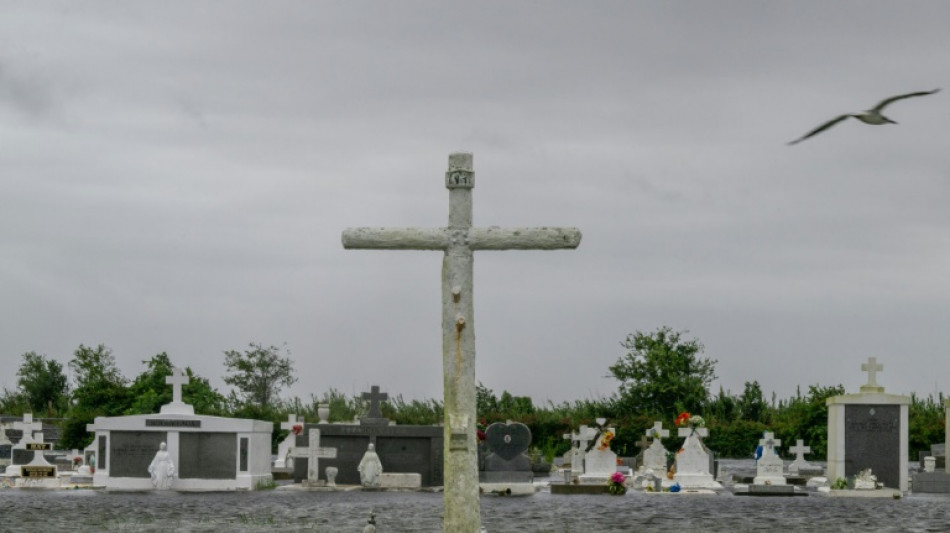
Tropical Storm Francine batters US state of Louisiana / Photo: Brandon Bell - GETTY IMAGES NORTH AMERICA/AFP

 Kenya's economy faces climate change risks: World Bank

 Far right and far left battle for power in polarised Berlin

 The last trio: S.Africa's zoo elephants await their fate

 Oil industry sees war windfall but girds for political blowback

 Amazon beats expectations with cloud and AI growth

 Blowout Microsoft results lift US stocks as oil retreats

 'Beginning of the end': Relief but no party as French wildfire winds down

 Southern Europe 'becoming more flammable' in hotter climate, experts say

 Mammoth bones found on parched bed of Danube in Bulgaria

 MEXC Lists Grvt (GRVT) with $60,000 Worth of GRVT and 10,000 USDT in Airdrop+ Rewards

 George and Amal Clooney flee French home due to wildfire

 MEXC Ventures Supports Alpha Arena's APAC Debut at Coinfest Bali

 AI data centre supplier Zhongji InnoLight slips on Hong Kong debut

 May, June heatwaves caused 2,877 extra deaths in England: govt

 BMW profit down a third as carmaker plans job cuts

 Seoul extends losses as most Asian markets drop, oil rises again

 Gambling.com Group Is Now Grandstand

 Meet the astronomer digging into the Milky Way's 'fossils'

 AI data centre supplier Zhongji InnoLight falls on Hong Kong debut

 Samsung operating profit up 1,800% in second quarter on AI boom

 Japanese population below 120 million for first time in decades

 US actor Jared Leto denies latest accusations of sexual assault

 Danube drops to 'historic lows' as fresh heatwave hits

 BTS pulls out of Grammys after Asian pop category introduction

 OpenAI says rogue AI agent attack hit other companies

Heavy rains and strong winds hammered Louisiana early Thursday as Tropical Storm Francine moved inland, leaving many residents without power while floods threatened the US southern state.
The storm weakened from a hurricane as it moved over land, forecasters said, but it still posed risks and a flash flood emergency was earlier issued for the city of New Orleans.
Local TV stations and footage on social media showed coastal towns battered by the storm, with some streets flooded and locals filling sandbags to protect property from floodwaters.
More than 370,000 customers across Louisiana were without power, according to monitoring website poweroutage.us.
Francine made landfall as a Category 2 hurricane on a five-level scale in Terrebonne Parish, on the southern edge of the state, at 5:00 pm local time (2200 GMT), according to the National Hurricane Center (NHC).
Hours later Francine was downgraded to a tropical storm with sustained winds of 50 miles (85 kilometers) per hour, with three to six feet (one to two meters) of storm surge, and up to a foot of rain in some parts of Louisiana, as well as areas of Mississippi, Alabama and the Florida panhandle, the NHC added.
"This rainfall could lead to considerable flash, urban, and river flooding," the NHC said in a bulletin at 0600 GMT.
The National Weather Service's New Orleans office issued a flash flood emergency for the city and nearby districts known as parishes, while New Orleans Mayor LaToya Cantrell urged residents to shelter in place.
"You need to be inside right now. Time to hunker down," Cantrell said in a video posted on social media.
In the town of Houma, residents filled sandbags, stocked up on supplies and filled their cars with gas ahead of the storm's arrival.
"We're working hard to stay here as long as we can... to take care of our people," a gas station manager who gave her name as Alicia B. told AFP.
The NHC said the storm is expected to quickly weaken as it moves inland over Louisiana and neighboring Mississippi.
Louisiana Governor Jeff Landry has declared a state of emergency, and on Tuesday requested a federal emergency declaration from President Joe Biden, which he quickly approved.
The Louisiana National Guard said on X that its soldiers were fuelling up vehicles in preparation for the storm. On Tuesday, it said it was mobilizing helicopters, boats and supplies for evacuations and search and rescue.
Schools and universities around the state capital Baton Rouge were preemptively closed until Friday, according to a government website.
Curfews starting as early as 6:00 pm were issued for communities across the Louisiana capital region, local media reported.
Low-lying Louisiana was the site of one of the most devastating storms in US history -- Hurricane Katrina -- which killed more than 1,300 people as it slammed into populous New Orleans in late August 2005.
Katrina overwhelmed the city's levee system and caused extensive flooding.
At the mouth of the Mississippi River, Louisiana is a major US trade hub with a significant part of its economy linked to the oil and natural gas industry.
The 2024 Atlantic hurricane season, which began on June 1 and will end November 30, was expected to be busy but has seen just three hurricanes so far, reportedly puzzling scientists.
Hurricane Beryl became the earliest highest-level Category 5 storm on record after it formed in late June and plowed through the Caribbean, eventually hitting Texas and Louisiana, with dozens of deaths reported in its wake.
Scientists say climate change likely plays a role in the rapid intensification of storms, because there is more energy in a warmer ocean for them to feed on.
P.Schmidt--CPN