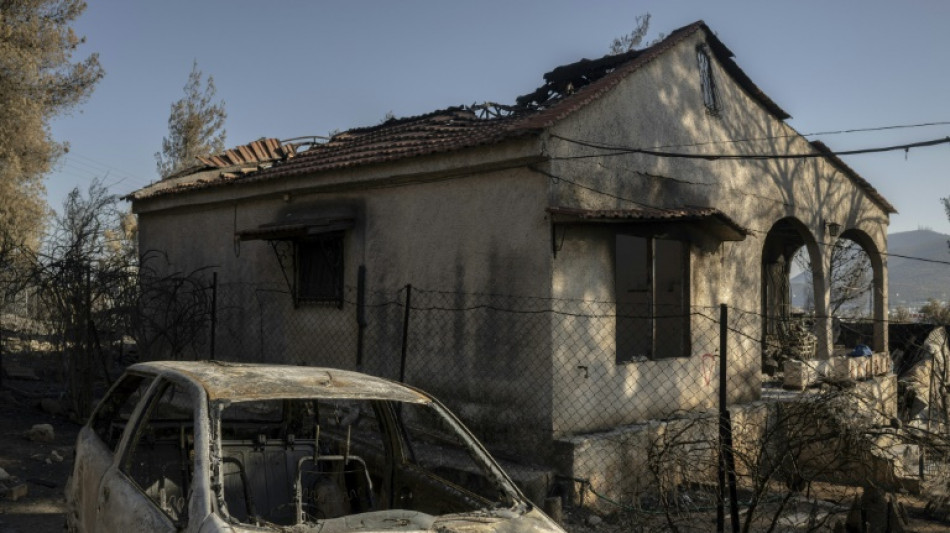
Athens faces new dangers as forest fires edge closer / Photo: Angelos TZORTZINIS - AFP

 Kenya's economy faces climate change risks: World Bank

 Far right and far left battle for power in polarised Berlin

 The last trio: S.Africa's zoo elephants await their fate

 Oil industry sees war windfall but girds for political blowback

 Amazon beats expectations with cloud and AI growth

 Blowout Microsoft results lift US stocks as oil retreats

 'Beginning of the end': Relief but no party as French wildfire winds down

 Southern Europe 'becoming more flammable' in hotter climate, experts say

 Mammoth bones found on parched bed of Danube in Bulgaria

 MEXC Lists Grvt (GRVT) with $60,000 Worth of GRVT and 10,000 USDT in Airdrop+ Rewards

 George and Amal Clooney flee French home due to wildfire

 MEXC Ventures Supports Alpha Arena's APAC Debut at Coinfest Bali

 AI data centre supplier Zhongji InnoLight slips on Hong Kong debut

 May, June heatwaves caused 2,877 extra deaths in England: govt

 BMW profit down a third as carmaker plans job cuts

 Seoul extends losses as most Asian markets drop, oil rises again

 Gambling.com Group Is Now Grandstand

 Meet the astronomer digging into the Milky Way's 'fossils'

 AI data centre supplier Zhongji InnoLight falls on Hong Kong debut

 Samsung operating profit up 1,800% in second quarter on AI boom

 Japanese population below 120 million for first time in decades

 US actor Jared Leto denies latest accusations of sexual assault

 Danube drops to 'historic lows' as fresh heatwave hits
 BTS pulls out of Grammys after Asian pop category introduction

 OpenAI says rogue AI agent attack hit other companies

With the smell still lingering in its suburbs after Greece's worst wildfire this year, floods and pollution now threaten Athens, experts say.
Thousands were forced to flee their homes as the massive blaze raged out of control for three days towards the capital earlier this month, swallowing up houses and cars and killing one woman.
Fanned by strong winds, the inferno that began at Varnavas, 40 kilometres (25 miles) northeast of Athens, reached suburbs at the foot of Mount Penteli, devastating some 10,000 hectares (24,700 acres).
With more than a third of the Mediterranean country's population of 10 million crammed into the capital's region of Attica, and the fires edging closer and closer to the city, experts are warning that the situation is becoming critical.
The National Observatory says 37 percent of forests around Athens have been consumed by fire over the past eight years alone.
"Attica has lost most of its forest, and now there is imminent danger for the people of Athens, in terms of polluted environment and risk of flooding" from soil erosion, said Alexandros Dimitrakopoulos, of the Aristotle University of Thessaloniki.
"Where 100 years ago there were vigorous forests of pines, now forest vegetation is of weak and low pines and evergreen shrubs," the professor of forest fire science told AFP.
Fire meteorologist Theodore M. Giannaros, of the National Observatory, said the situation is aggravated by the "torrential rainfalls which unfortunately we are getting quite frequently".
He warned of soil erosion and flash floods which "I believe we will face during the coming winter".
Dimitrakopoulos said the loss of the forests will push Greece's already sweltering summer temperatures higher. This year the country saw its hottest June and July on record.
- 'Repeatedly burnt' -
Scientists say human-caused fossil fuel emissions are increasing the length, frequency and intensity of global heatwaves, raising the risk of wildfires.
"Attica can't lose more forest," fire ecology expert Dimitris Kazanis told AFP.
"The percentage is diminishing year by year. A solution must be found.
"In an area with so much cement, so many roads, so much noise, we need forests," said the lecturer from the National and Kapodistrian University of Athens.
But the frequent fires are impacting the forest's ability to regenerate.
The Varnavas blaze struck an area covered by Aleppo pine -- a species that has evolved to cope with fire but which requires at least 15 to 20 years between fires to regenerate naturally.
"The area burnt has experienced many fire events in the past, some in very frequent intervals," said ecology professor Margarita Arianoutsou, also of the National and Kapodistrian University.
"This has already caused a serious problem. There are patches repeatedly burnt which need our intervention in order to be restored."
Reforestation and fire prevention studies were among measures unveiled this month by Prime Minister Kyriakos Mitsotakis.
- Pines 'demonised' -
Some have called for the planting of other types of trees altogether, as pines burn very quickly because of their naturally flammable resin.
But forester Nikos Georgiadis, from the World Wide Fund for Nature, said people "have demonised the pines".
"If nature decides that the pines must be there, it's not easy to change."
The trick is to create a more resilient, mixed forest -- with some broadleaf or less flammable species -- and build green belts, said Georgiadis.
"You try to set these zones around settlements, so as to protect both forest and humans," he added.
Rather than blame the pines, experts fault the encroachment of urban areas into forest land.
"Where trees are burned, houses grow," said Dimitrakopoulos.
"It was very common in areas of high demand such as Athens... to burn forest in order to create land for construction," he said.
Most Greek fires are human-caused, through arson or neglect, he added.
Investigators believe a faulty electricity pole may have sparked the Varnavas fire.
"Where there are people, there is fire," said Dimitrakopoulos.
Y.Ibrahim--CPN