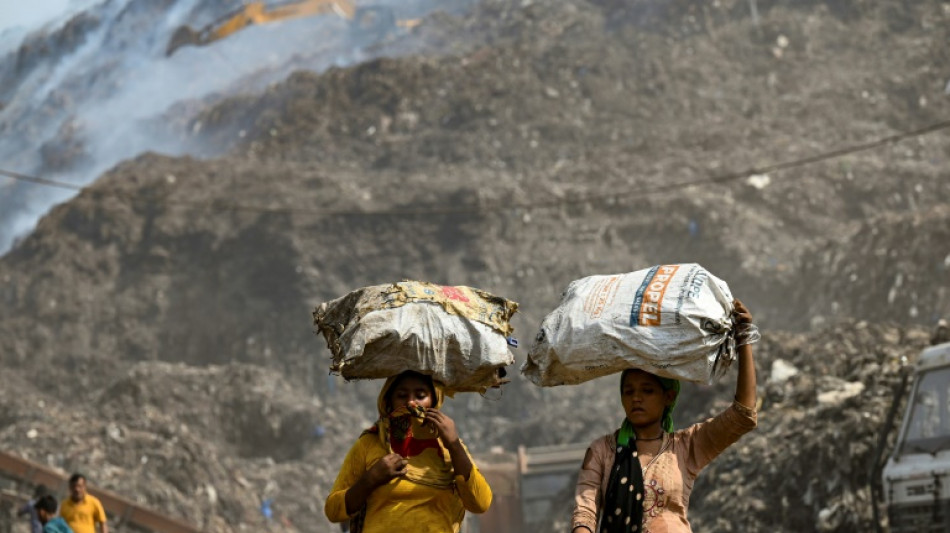
South Asia wilts in heat as Delhi rubbish dump burns / Photo: Prakash SINGH - AFP

 Lights out in Laos as electricity exports surge

 Steven Strogatz weighs AI mathematics advances and their consequences for researchers

 Anthropic boss calls for AI slowdown, Altman and Musk agree

 French IT giant Capgemini sells subsidiary after row over ICE links

 Quebec Brokerage Qubit Insurance Announces New Data on Coverage Shortfalls as Rebuilding Costs Rise

 Lady Gaga welcomes first child with fiance: US media

 Bhutan business bets on hazelnuts for farming future

 'Widow's Bay' and 'The Pitt' are favorites for Emmys night

 Coastal erosion forces cancellation of California music festival

 Argentina's Dirty War rears its head in Venice film

 UK lawmakers throw out bill to legalise assisted dying

 US inflation steady in August, fueling Fed rate hike expectations

 New York marks 25th anniversary of 9/11 attacks

 Nepal flood reconstruction bill to be $4.78 bn: foreign ministry

 JUMO and Standard Bank launch Social Finance Framework to scale inclusive finance in Africa

 Doomsday tech: could AI really kill us all?

 French comedy show 'Call my agent' makes film comeback

 It's all coming back: Celine Dion fans gear up for Paris return

 Researchers eye AI revolution in natural disaster forecasts

 US braces for inflation report that may push Fed to hike rates

 Musk threatens legal action over documentary

 Latin America fact-check group asks Meta not to replace verification practice

 AI Risks to Enter 60–80% of Liability and Cyber Insurance Underwriting by 2028, ScienceSoft Predicts

 Tribal Launches Campfire, Letting Business and Technical Teams Build on Salesforce Together

 Stocks fall as fresh oil surge fans inflation fears

Millions sweltered in an early summer heatwave across India and Pakistan on Thursday, leading to power and water shortages as annual furnace-like temperatures hit South Asia.
In New Delhi, a burning rubbish dump choked residents for a third day with temperatures crossing 45 Celsius (113 Fahrenheit) in parts of South Asia on Thursday -- several degrees higher than normal -- and forecasters warning that it will get even hotter this weekend.
Heatwaves have killed over 6,500 people in India since 2010, and scientists say climate change is making them harsher and more frequent across the region.
"This is the first time I've seen such horrible weather in April. Usually, we're prepared for this in May and onwards," said 30-year-old Delhi housewife Somya Mehra, as she and her family thirstily searched for a cold drink.
"Today we stepped out because of our anniversary but otherwise I'm not stepping out at all. I've stopped sending my kid out to play".
The Indian states of Rajasthan, Gujarat and Andhra Pradesh imposed power cuts on factories as consumption for air conditioning and fans skyrocketed.
Media reports said that power stations were also facing shortages of coal -- the main source of electricity in the nation of 1.4 billion people.
Many regions also reported falling water supplies that will only worsen until the annual monsoon rains in June and July.
Water shortages will hit farmers hardest, including those growing wheat as India aims to boost exports to help ease a global shortage due to the war in Ukraine.
- Hottest since 1961 -
Temperatures are expected to be up to eight degrees higher than usual in parts of Pakistan, with the mercury peaking at 48 degrees in parts of rural Sindh on Wednesday, Pakistan's Meteorological Society warned.
Farmers have to use water sparingly in a country where agriculture is the mainstay of the economy and accounts for around 40 percent of the workforce.
"Public health and agriculture in the country will face serious threats due to the extreme temperature this year," climate change minister Sherry Rehman said.
Last month was the hottest March on record since 1961, the Pakistani Met office said.
Coming during the month of Ramadan, the heat makes fasting in both India and Pakistan even tougher for Muslims -- who shun even water during daylight hours.
"Temperatures are rising rapidly in the country, and rising much earlier than usual," Indian Prime Minister Narendra Modi said Wednesday, adding that India has seen "increasing incidents of fires in various places -- in forests, important buildings and in hospitals -- in the past few days."
In New Delhi, a 60-metre (200-feet) high rubbish mountain has been ablaze since Tuesday, which firefighting teams have been battling with lorry-loads of sand and mud.
The inferno, belching toxic black smoke that engulfed nearby districts, was the fourth such incident at a landfill site in the megacity of 20 million people in less than a month.
Pradeep Khandelwal, the former head of Delhi's waste management, said they were likely sparked by warmer temperatures speeding up the decomposition of organic waste.
"The dry and hot weather produces excess methane gas at the dumping sites that trigger such fires," Khandelwal told AFP.
"Before human activities increased global temperatures, we would have seen the heat that hit India earlier this month around once in 50 years," said Mariam Zachariah from the Grantham Institute at Imperial College London.
"But now it is a much more common event -- we can expect such high temperatures about once in every four years. And until net emissions are halted, it will continue to become even more common".
C.Smith--CPN