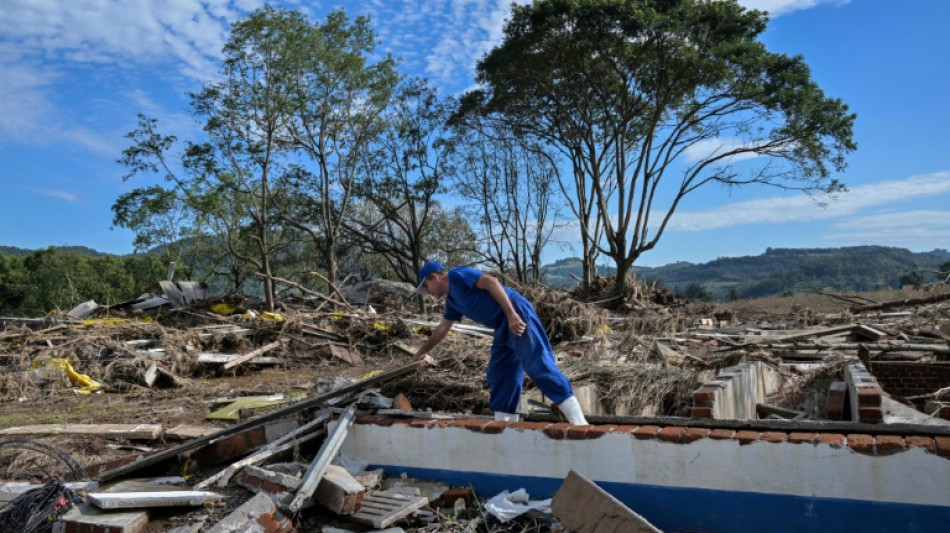
Brazil farmer who lost everything to floods recalls water's fury / Photo: Nelson ALMEIDA - AFP

 Kenya's economy faces climate change risks: World Bank

 Chipmaker Kioxia reports AI-driven 45-fold surge in quarterly net profit

 Far right and far left battle for power in polarised Berlin

 The last trio: S.Africa's zoo elephants await their fate

 Oil industry sees war windfall but girds for political blowback

 Amazon beats expectations with cloud and AI growth

 Blowout Microsoft results lift US stocks as oil retreats

 'Beginning of the end': Relief but no party as French wildfire winds down

 Southern Europe 'becoming more flammable' in hotter climate, experts say

 Mammoth bones found on parched bed of Danube in Bulgaria

 MEXC Lists Grvt (GRVT) with $60,000 Worth of GRVT and 10,000 USDT in Airdrop+ Rewards

 George and Amal Clooney flee French home due to wildfire

 MEXC Ventures Supports Alpha Arena's APAC Debut at Coinfest Bali

 AI data centre supplier Zhongji InnoLight slips on Hong Kong debut

 May, June heatwaves caused 2,877 extra deaths in England: govt

 BMW profit down a third as carmaker plans job cuts

 Seoul extends losses as most Asian markets drop, oil rises again

 Gambling.com Group Is Now Grandstand

 Meet the astronomer digging into the Milky Way's 'fossils'

 AI data centre supplier Zhongji InnoLight falls on Hong Kong debut

 Samsung operating profit up 1,800% in second quarter on AI boom

 Japanese population below 120 million for first time in decades

 US actor Jared Leto denies latest accusations of sexual assault

 Danube drops to 'historic lows' as fresh heatwave hits

 BTS pulls out of Grammys after Asian pop category introduction

It was 6:00 in the morning when Brazilian farmer Vernei Kunz heard the roar of water as the Forqueta river overflowed its banks and swept away most of his 5,000 pigs.
Kunz, 60, has been farming for the past 42 years in the town of Travesseiro, one of hundreds devastated by weeks of cataclysmic flooding that killed more than 160 people in the southern state of Rio Grande do Sul.
"The sows and piglets were all in the sheds," he told AFP of the morning of May 2.
"We opened the doors to let them out. We managed to grab some that were swimming in the water. We pulled them out and brought them to the road, where they were safe."
Kunz and his workers managed to save about 700 pigs, he said. The slaughterhouse he works with collected them and is sending them to other farms in the region.
"The rest drowned," said Kunz, pointing to piles of rubble that used to be concrete-and-metal sheds.
A foul smell fills the air, a pungent reminder of the pigs still buried beneath the mud three weeks later.
- 'Burn it all' -
The river, about 500 meters (yards) from Kunz's property, swelled as torrential rains pounded the region in late April.
It finally burst its banks with a vengeance, sweeping up virtually everything in its path, including the bridge into Travesseiro.
Today, only the two ends of the nearly 20-meter-high bridge remain, suspended in the air.
Kunz laid off his 12 employees the same day with severance pay, he said.
Without any insurance coverage, he estimates his losses at between 10 million and 15 million reais ($2 million to $3 million).
Overall, the agricultural sector -- the engine of the region's economy -- lost around $430 million, according to the National Confederation of Municipalities.
The pig farmers' association for Rio Grande do Sul, one of Brazil's biggest producers and exporters of pork, said the devastation affected between 25 and 28 percent of production.
"I had been through big floods before in 2010, but nothing like this," said Kunz.
"That time, we could rebuild. This time, the water destroyed everything."
Experts say the intensity of the floods was linked to climate change.
"You can't go against nature," said Kunz, still wearing galoshes.
His property, which spans several thousand square meters, is littered with twisted metal, aluminum sheets, pieces of walls and tree trunks.
"I'll have to burn it all. What else can I do?" he said.
His son, Eduardo, 34, explains that the farm was a modern operation, including using artificial insemination to breed animals with the best characteristics.
"We had very expensive machines. It would be difficult to get that back," he said.
Eduardo, his wife and their two-year-old son share a small house with his parents on higher ground up the road, where the water did not reach this time.
- Restarting from scratch -
The family plans to stay in Travesseiro, a quiet farming town of 2,000 people.
Mayor Gilmar Southier estimates 80 percent of the local population were affected by the floods.
He said the priority is to rebuild the bridge, the key link between the town and the region's main cities.
Kunz, for his part, plans to start over. But instead of pigs, he wants to farm corn and soybeans.
"If I lose everything again, it will cost less to start over next time."
He expects his first harvest in August 2026. Until then, he said, he will have to find loans to get back on his feet.
C.Peyronnet--CPN