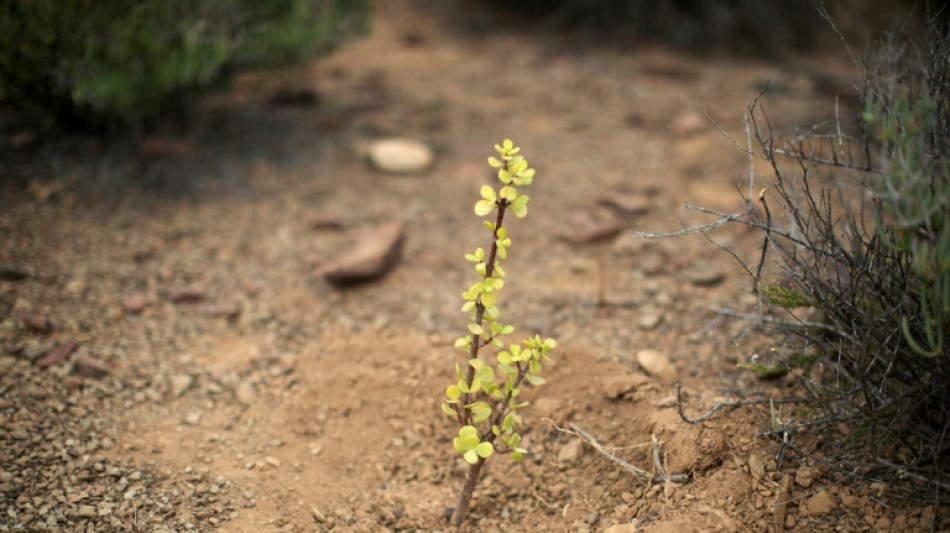
Spekboom bushes protect earth but can they cool Earth? / Photo: GIANLUIGI GUERCIA - AFP

 Kenya's economy faces climate change risks: World Bank

 Fornaro Legal Releases Guidance to Help Businesses Maintain Clear Ownership Records During Growth

 Japan probe made closest-ever asteroid flyby: space agency
 British oil giant BP aims to sell North Sea business

 China factory activity slides as leaders seek spending boost

 Tech rebound fuels record-breaking rally in South Korean stocks
 Cables and cooling bring AI windfall to Indian suppliers

 Anthropic's models gained unauthorized 'real-world' access during testing

 Apple tops estimates in CEO Cook's final quarter, but shares fall

 Milei demands expulsion of foreigners expressing 'hate' against Argentina
 Italy's Po River valley on drought alert
 Prada profits pinched as growth hard to chase
 Stocks climb on earnings and rates, oil retreats

 US economic growth slows in second quarter, missing expectations

 Russia adds Telegram founder Durov to 'terrorist' blacklist

 Stocks diverge on earnings, as oil steadies

 Eurozone economy grows despite Middle East war

 Singapore group will develop 'most promising' Ebola vaccine

 Shell profit surges as Mideast war fuels oil prices

 Car maker Stellantis says back in profit in second quarter

 Samsung quarterly operating profit up 1,800% on AI boom

 South Korean stocks bounce after rout, oil holds gains on Mideast woes

 South Korea's women web sleuths fight AI deepfake porn

 Anything but programmable: New cost-efficient EC-power-supply-series for the DIN rail by CAMTEC PS

 Meta misses profit expectations, sticks to massive AI spending

Andre Britz pulled over his pick-up truck on a rocky mountain track to show off the nature-preserving powers of southern Africa's spekboom shrub.
The 62-year-old Afrikaner is an evangelist for Portulacaria afra, a red-stemmed bush or small tree with thick, dense green leaves that acts as a sponge for carbon dioxide.
"Here you can see the difference between degraded land and what we call pristine spekboom veld," he said, pointing out a division running like a contour between lush green hilltop and arid valley side.
The plant once dominated the dry terrain of the Little Karoo in South Africa's Western Cape.
But decades of what Britz calls over-grazing and mismanagement have destroyed the shrub and the vital shade it offers the sun-scorched earth, not to mention its strength at absorbing carbon.
"The spekboom does carbon sequestration day and night. It is one of the few plants that do it," Britz told AFP on a tour to explain his ten-year-old mission.
"And the other thing is that it occurs here naturally," he said. "So that was why it was important to plant spekboom here and to have that secondary effect on the change of climate."
Ten years ago Britz founded Jobs 4 Carbon, an organisation dedicated to replanting and encouraging the spekboom in an area where farming was devastated by the long 2015-2020 drought.
Now he has a team of planters, labouring with shovels and picks in the rocky terrain to nurture new plants that could once more blanket the dry ground with lush green leaves.
- 'Miracle plant' -
Nearby, a two-year-old replanted Spekboom has begun to spread its branches above fresh shoots. Jobs 4 Carbon has already replanted almost 700 hectares (1,730 acres).
"It brings nature back to life," team leader Jan Cloete, 49, said with a smile.
To botanist Alastair Potts, 41, in its natural semi-arid ecosystem or "subtropical thicket", it is a "miracle plant".
It "creates forest-like micro-environments", a "carpet" of leaves that "trap water and dust and nutrients", as well as carbon, he said.
The latter is stored in large quantities because of the succulent's rare ability to swing between two types of photosynthesis.
In dry, hot weather, spekboom sucks carbon dioxide out of the atmosphere at night and stores it in the form of malic acid.
During the day, the plant closes its pores, called stomata, to minimise water loss and uses its night stash for photosynthesis.
This greatly boosts its sequestration capacity.
Fact-checkers have debunked overenthusiastic claims that the plant rivals the Amazon rainforest in terms of carbon absorption, but proponents say it still pulls above its weight when allowed to grow in its natural environment.
A 2006 paper estimated that one hectare of spekboom sequestered on average four tonnes of CO2 per year. Others put the figure at more than 15 tonnes.
- Carbon credits -
Jobs 4 Carbon is hoping to plant more of it and fund the venture selling carbon credits, a financial instrument bought by companies to offset their greenhouse gas emissions.
To make that viable, however, scientists first have to agree on just how much CO2 the little succulent exactly sequesters.
Still, Potts is optimistic. Spekboom doesn't have the drawbacks of other tree-planting projects criticised for setting up monocultures in unsuitable ecosystems, he said.
And by restoring the environment, it helps prevent emissions from land degradation.
"I feel that carbon farming and spekboom is the perfect mix," he said.
"We're changing the ecosystem functioning back to what it was, through carbon, which is fantastic."
With funding from international foundations and private companies, Jobs 4 Carbon is looking to green 13,000 hectares across the region, said Andre Britz.
But much more could be done across the country, according to Potts.
The group currently plants the shrub for free if landowners agree to leave their plot fallow for at least 15 years in return.
In the courtyard of his village church, 15,000 small plants are ready to put down roots in the arid ground, which reminds him of an old saying he heard from his grandfather: "Take care of your veld, and your veld will take care of you".
Ng.A.Adebayo--CPN