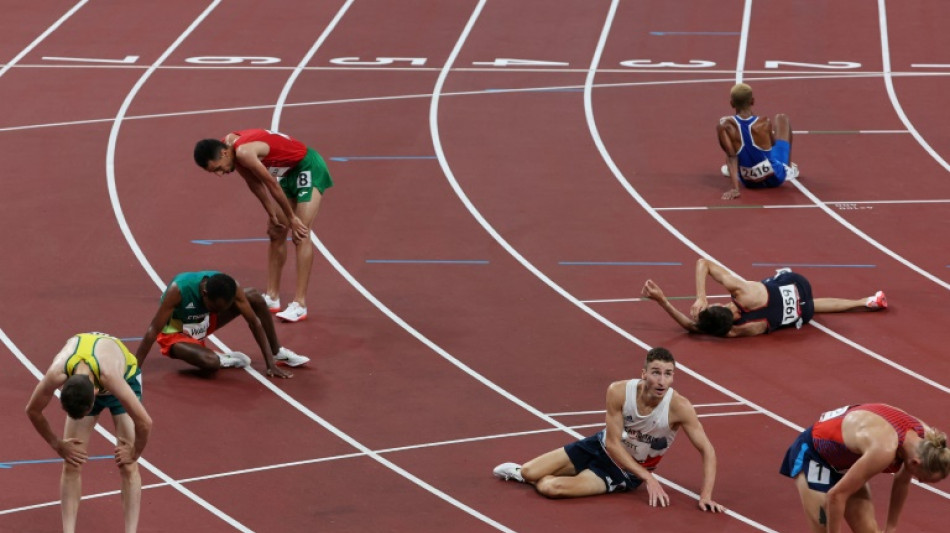
Heatwave risk hovers over Paris Olympics / Photo: Giuseppe CACACE - AFP

 Kenya's economy faces climate change risks: World Bank

 Profits surge at US oil giant amid Iran war supply shock

 Stock markets rally on tech rebound

 France, Spain assess scorched terrain as new wildfires threaten other regions
 Chipmaker Kioxia reports AI-driven 45-fold surge in quarterly net profit
 Far right and far left battle for power in polarised Berlin

 The last trio: S.Africa's zoo elephants await their fate
 Oil industry sees war windfall but girds for political blowback

 Amazon beats expectations with cloud and AI growth

 Blowout Microsoft results lift US stocks as oil retreats

 'Beginning of the end': Relief but no party as French wildfire winds down

 Southern Europe 'becoming more flammable' in hotter climate, experts say

 Mammoth bones found on parched bed of Danube in Bulgaria

 MEXC Lists Grvt (GRVT) with $60,000 Worth of GRVT and 10,000 USDT in Airdrop+ Rewards

 George and Amal Clooney flee French home due to wildfire

 MEXC Ventures Supports Alpha Arena's APAC Debut at Coinfest Bali

 AI data centre supplier Zhongji InnoLight slips on Hong Kong debut

 May, June heatwaves caused 2,877 extra deaths in England: govt

 BMW profit down a third as carmaker plans job cuts

 Seoul extends losses as most Asian markets drop, oil rises again

 Gambling.com Group Is Now Grandstand

 Meet the astronomer digging into the Milky Way's 'fossils'

 AI data centre supplier Zhongji InnoLight falls on Hong Kong debut

 Samsung operating profit up 1,800% in second quarter on AI boom

 Japanese population below 120 million for first time in decades

Scorching summer heat is hard to imagine now in mid-winter Paris, but in six months' time when the world's athletes arrive for the Olympics, another pounding heatwave would spell trouble for organisers.
A new study presenting "climate simulations to anticipate worst-case heatwaves during the Paris 2024 Olympics" has focused minds after it warned that the French capital faced a not insignificant risk of record-breaking high temperatures.
The research, published in December in the Npj Climate and Atmospheric Science journal, looked at the risk of a two-week heatwave that would surpass the all-time record hot spell seen in Paris in 2003.
"In 20 years, the climate has changed and the idea was to warn policymakers that something even worse than 2003 could happen, that it's possible," lead author Pascal Yiou told AFP.
"In the 20th century, it wasn't possible to go beyond this record, but now we cannot only equal it but surpass it with a probability that is ultimately quite high, in the region of 1/100," he added.
A separate study in the Lancet Planet Health journal last May found that Paris had the highest heat-related death rates of 854 European towns and cities, partly due to its lack of green space and dense population.
The statistics were also heavily skewed by the events of 2003 when 15,000 people died, most of them vulnerable elderly people living on their own, sparking a bout of national soul-searching.
- Stress testing -
In the last five years, Paris has witnessed a series of blistering summers that have seen heat records crumble.
A new all-time temperature peak was set in July 2019 when the Meteo-France weather service clocked 42.6 degrees Celsius (108.7 degrees Fahrenheit) in the capital.
Organisers of the 2024 Paris Olympics, which will run from July 26 to August 11 and the Paralympics which start in late August, say they are "fully aware" of the climate-related risks to the Games.
"Heatwaves and extreme weather events are factors that we take into account and that we are preparing for as much as possible, in order to take necessary action," a spokesperson told AFP.
Operational teams have run simulations looking at the consequences of shifting some outdoor events to earlier or later start times to avoid the midday heat.
The athletics events, particularly the marathon, as well as tennis or beach volleyball are all seen as being vulnerable to the effects of punishing sunshine and high temperatures.
Young and fit athletes might also prove more resistant than spectators who will likely face queues to enter venues and potentially hours without shade in open-air stadia.
The head of the French agency responsible for building the Olympics venues, Nicolas Ferrand, reassured a Senate hearing that all indoor facilities had been built with global heating in mind.
"We checked that all of our buildings would be comfortable in the summer of 2050," he said last month, adding that the national weather office and IT consultancy firm Dassault Systemes had helped with the modelling.
- A/C issue -
Another area of ongoing concern is the athletes' village in northern Paris which has been built without air conditioning as part of efforts to set new environmental standards for the Paris Games.
Instead, the river-side tower blocks have a natural geo-thermal cooling systems, as well as sunshades, planted areas, and wind ventilation.
They guarantee an indoor temperature at least 6.0 degrees Celsius lower than outside -- something viewed as insufficient by some attending nations.
"Air-conditioning at the village has been an issue," a European diplomat involved in Olympics coordination told AFP on condition of anonymity.
As a compromise, French organisers are now offering to provide portable air conditioners to visiting delegations at their expense.
- Torrid Tokyo -
The last Summer Olympics in Tokyo is widely thought to have been the hottest on record, with temperatures regularly above 30 Celsius coupled with 80 percent humidity.
Tokyo organisers moved the race walk events and two marathons 800 kilometres (500 miles) north of Tokyo in the hope of cooler weather that did not really materialise.
Despite a range of anti-heat measures including misting stations, many athletes struggled in the heat, including Russian tennis player Daniil Medvedev who wondered aloud on court if he might die.
Many athletes are adapting to climate change by doing more hot-weather training, either in overseas camps or in specially designed bubbles that can artificially increase heat and humidity.
Speaking after Tokyo, World Athletics president Sebastian Coe warned that the "new norm" was competing in "really harsh climatic conditions".
H.Müller--CPN