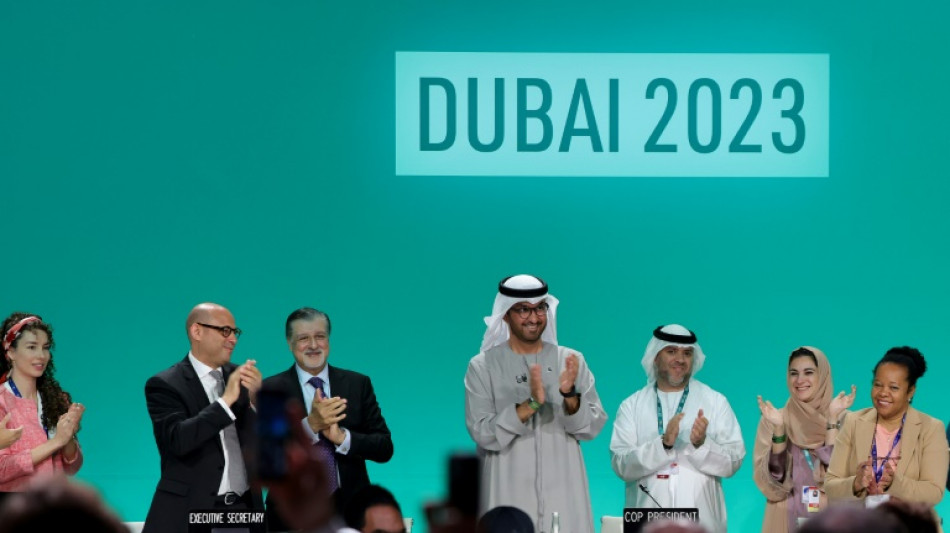
Dubai summit adopts world-first 'transition' from fossil fuels / Photo: Giuseppe CACACE - AFP

 Kenya's economy faces climate change risks: World Bank
 New York sues online prediction markets giant Kalshi

 Profits surge at US oil giant amid Iran war supply shock

 Stock markets rally on tech rebound

 France, Spain assess scorched terrain as new wildfires threaten other regions
 Chipmaker Kioxia reports AI-driven 45-fold surge in quarterly net profit

 Far right and far left battle for power in polarised Berlin

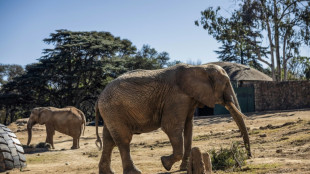 The last trio: S.Africa's zoo elephants await their fate
 Oil industry sees war windfall but girds for political blowback

 Amazon beats expectations with cloud and AI growth

 Blowout Microsoft results lift US stocks as oil retreats

 'Beginning of the end': Relief but no party as French wildfire winds down

 Southern Europe 'becoming more flammable' in hotter climate, experts say

 Mammoth bones found on parched bed of Danube in Bulgaria

 MEXC Lists Grvt (GRVT) with $60,000 Worth of GRVT and 10,000 USDT in Airdrop+ Rewards

 George and Amal Clooney flee French home due to wildfire

 MEXC Ventures Supports Alpha Arena's APAC Debut at Coinfest Bali

 AI data centre supplier Zhongji InnoLight slips on Hong Kong debut

 May, June heatwaves caused 2,877 extra deaths in England: govt

 BMW profit down a third as carmaker plans job cuts

 Seoul extends losses as most Asian markets drop, oil rises again

 Gambling.com Group Is Now Grandstand

 Meet the astronomer digging into the Milky Way's 'fossils'

 AI data centre supplier Zhongji InnoLight falls on Hong Kong debut

 Samsung operating profit up 1,800% in second quarter on AI boom

Nearly 200 nations meeting in Dubai on Wednesday approved a first-ever call for the world to transition away from fossil fuels, the top culprit of climate change behind a planetary crisis.
After 13 days of talks and another sleepless night in a country built on oil wealth, the Emirati leadership of the COP28 summit banged a gavel to signal the world had reached consensus.
"You did step up, you showed flexibility, you put common interest ahead of self-interest," said COP28 president Sultan Al Jaber, whose role as head of the United Arab Emirates' national oil company raised suspicion among many environmentalists.
The United Arab Emirates, he said, was "rightly proud" of its role in bringing "transformational change" to the planet.
"The world needed to find a new way. And by following our North Star, we have found that new path," he said to applause, referring to the goal of limiting warming to 1.5 degrees Celsius.
Jaber hours earlier released a draft of the agreement aiming to bring onboard countries from islands fearing extinction to Saudi Arabia, which has led the charge to keep exporting its oil.
Toughening language from an earlier draft that was roundly denounced, the agreement calls for "transitioning away from fossil fuels in energy systems, in a just, orderly and equitable manner, accelerating action in this critical decade, so as to achieve net zero by 2050 in keeping with the science".
It marked the first mention of all fossil fuels in 28 years of climate summits.
"For the first time in 30 years, we might now reach the beginning of the end of fossil fuels," EU climate chief Wopke Hoekstra said before heading into the plenary session.
Danish negotiator Dan Jorgensen, part of a group in charge of making headway, called the agreement "historic progress".
The text, however, stopped short of calls during the summit for a "phase-out" of oil, gas and coal, which together account for around three-quarters of the emissions responsible for the planetary crisis.
Low-lying islands fear extinction from rising sea levels and worsening storms, with the Marshall Islands denouncing the earlier draft as a "death warrant".
The bloc of small island states called the revised text "an improvement" but it reiterated concerns, saying that the deal was "incremental and not transformational".
- UAE steps up language -
Jaber's earlier draft merely suggested that nations "could" reduce the consumption and production of fossil fuels, among other options, drawing fury from green groups.
Environmentalists virtually all saw the new text as an improvement, although many cautioned that there will still far more to do.
"We are finally naming the elephant in the room. The genie is never going back into the bottle and future COPs will only turn the screws even more on dirty energy," said Mohamed Adow, director of the Power Shift Africa think tank, referring to the annual UN climate meetings known as Conferences of the Parties.
"Some people may have had their expectations for this meeting raised too high, but this result would have been unheard off two years ago, especially at a COP meeting in a petrostate," he said.
The agreement also made more explicit the near-term goals in the goal of ending net emissions by 2050.
It called for the world to cut greenhouse gas emissions by 43 percent by 2030 compared with 2019 levels.
Rachel Cleetus, policy director at the Union of Concerned Scientists, said the deal "sends a strong signal that world leaders recognise that a sharp turn away from fossil fuels toward clean energy in this critical decade and beyond, aligned with the science, is essential to meet our climate goals".
- Still loopholes -
But Jean Su of the Center for Biological Diversity, while seeing progress, said there were still "cavernous loopholes" for fossil fuels.
The agreement tackles only fossil use in energy, not in industrial areas such as production of plastics and fertiliser.
She also voiced alarm at the recognition of the role of "transitional fuels", which she saw as a codeword for producers of natural gas and other fossil fuels such as the United States on the grounds of energy security.
While not using the term "phase-out" on fossil fuels, it endorses work towards a phase-down of "unabated coal power" -- meaning that coal with carbon capture technology to reduce emissions, panned by many environmentalists as unproven, could continue.
The biggest-ever COP meeting hosted more than 88,000 people, including a record number of lobbyists from the fossil fuel industry.
The 2015 Paris summit endorsed checking warming at 1.5C -- a goal repeated in the latest draft, but which critics say is virtually impossible without serious efforts to curb oil, gas and coal.
L.Peeters--CPN