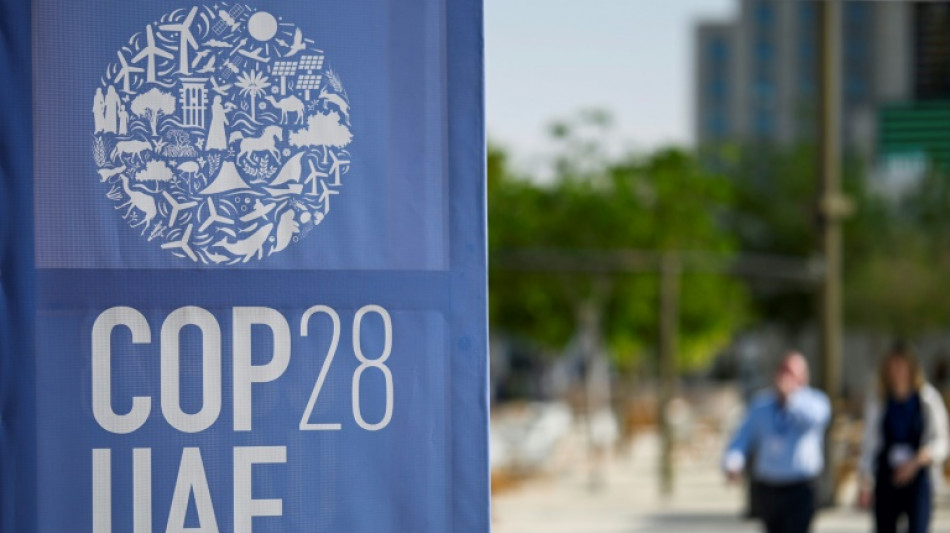
COP28 puts out welcome mat to lobbyists / Photo: Jewel SAMAD - AFP

 Kenya's economy faces climate change risks: World Bank
 US Fed dissenters call for rate hikes over sustained inflation
 New York sues online prediction markets giant Kalshi
 Profits surge at US oil giant amid Iran war supply shock
 Stock markets rally on tech rebound

 France, Spain assess scorched terrain as new wildfires threaten other regions
 Chipmaker Kioxia reports AI-driven 45-fold surge in quarterly net profit

 Far right and far left battle for power in polarised Berlin

 The last trio: S.Africa's zoo elephants await their fate

 Oil industry sees war windfall but girds for political blowback

 Amazon beats expectations with cloud and AI growth

 Blowout Microsoft results lift US stocks as oil retreats

 'Beginning of the end': Relief but no party as French wildfire winds down

 Southern Europe 'becoming more flammable' in hotter climate, experts say

 Mammoth bones found on parched bed of Danube in Bulgaria

 MEXC Lists Grvt (GRVT) with $60,000 Worth of GRVT and 10,000 USDT in Airdrop+ Rewards

 George and Amal Clooney flee French home due to wildfire

 MEXC Ventures Supports Alpha Arena's APAC Debut at Coinfest Bali

 AI data centre supplier Zhongji InnoLight slips on Hong Kong debut

 May, June heatwaves caused 2,877 extra deaths in England: govt

 BMW profit down a third as carmaker plans job cuts

 Seoul extends losses as most Asian markets drop, oil rises again

 Gambling.com Group Is Now Grandstand

 Meet the astronomer digging into the Milky Way's 'fossils'

 AI data centre supplier Zhongji InnoLight falls on Hong Kong debut

"All views are welcome. All views are needed," declared Sultan Al Jaber, president of the UN's COP28 and head of the Emirates state oil and gas company in the run-up to the climate talks in Dubai.
That welcome also extends to lobbyists and big oil companies, some of whom will be part of national delegations when negotiations start on Thursday.
Here we look at some of the questions that raises.
- Are lobbies allowed at COP? -
"Leaders, experts and people of influence" come together in the COP's "blue zone", where talks take place, the UN states, without mentioning lobbyists.
But lobbyists can get accreditation by joining a national delegation or from one of the 2,000 "observer" groups made up of NGOs and professional groups.
"When people think about lobbying, they think about behind-closed-doors meetings between a company or their representatives and a policymaker. And that's certainly a lot of it," Faye Holder, program manager at think tank InfluenceMap, told AFP.
But it can also "include things like social media posts, advertising, sponsorships, the use of trade groups or astroturf groups", fake organisations made to look like grassroots groups, she said.
The lack of clear rules at the talks about conflict of interest has long been criticised.
Indeed, hosts the UAE were accused this week of using its role as COP28 hosts to discuss fossil fuel deals with other governments, according to leaked documents obtained by the BBC. COP28 dismissed the reports as "inaccurate".
Until this year, the UN did not oblige delegates to reveal their links to the organisation they were accredited with or who they are employed by, making it extremely difficult to detect lobbyists.
Some 65 members of the US Congress and the European Parliament wrote to the UN to voice their "profound concern that current rules... permit private sector polluters to exert undue influence" on the talks.
A report by high level experts mandated by the UN called for "non-state actors to publicly disclose their trade association affiliations" and said they cannot be allowed to "lobby to undermine ambitious government climate policies either directly" or indirectly.
- A record number at COP28? -
The last COP in Egypt set a new record for lobbyists, with 636 official delegates working for fossil fuel companies, according to Global Witness, which combed through participants' CVs.
The NGO told AFP that that record will be broken again in Dubai.
The umbrella group Kick Big Polluters Out claims that at least 7,200 lobbyists working for fossil fuel interests have been accredited to COP summits over the last two decades.
And that is only the "tip of the iceberg", they claim, with many passing under the radar.
Kick Big Polluters Out said lobbyists sometimes outnumber both the delegations from some of the countries most vulnerable to climate change and activists from NGOs.
Many state-owned oil and gas companies also form part of their countries' national delegations.
COP28, which will have a record 70,000 delegates, has thrown the doors open to the private sector, with oil and gas majors officially invited along with other polluting industries.
Ironically, according to the experts, it is perhaps the first time that fossil fuel producers' part in the talks has been addressed so openly. COP28 president Jaber told AFP this week that "everyone needs to be held accountable".
Some NGOs, however, have appealed for a boycott of the talks, while others want to counter lobbyists by turning up themselves in large numbers.
- How can lobbyists affect the talks? -
One of the clearest examples of the influence of the oil and gas companies on a COP was the Paris Agreement in 2015. Its Article 6 created a system of exchange of carbon credits, something the industry had demanded for years.
David Hone, Shell's chief climate advisor, admitted that they spent four years pushing "for the need for carbon unit trading to be part of the Paris Agreement.
"We can take some credit for the fact that Article 6 is even there at all," he told a 2018 conference organised by IETA, a lobby group founded by oil companies that will have dozens of delegates at COP28.
In Dubai, the lobbies could again have a strong influence on the language of the agreements "and what it means", said Holder, particularly the vaunting of carbon capture, green hydrogen and "low-carbon gas" as possible solutions.
She said the big question will be around the phrase "phasing out fossil fuels", and if this might be altered to "unabated fossil fuels", which means without carbon capture, "which is a sort of sneaky word that makes quite a big difference", and gives the oil industry lots of wriggle room.
M.Davis--CPN