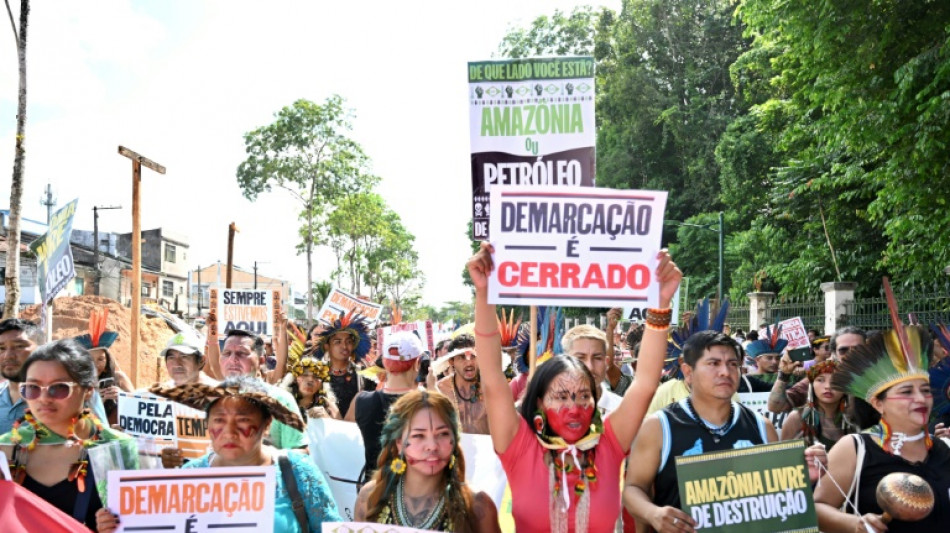
Amazon nations launch alliance to fight deforestation at summit / Photo: Evaristo Sa - AFP

 iPhone 18預購後出現可疑扣款 四間銀行調查未授權交易

 Galaxy Tab S12系列效果圖曝光 Ultra擬配雙鏡頭及瀏海螢幕

 Altman tells Fortune OpenAI will not go public in 2026
 ستاندرد آند بورز تثبت تصنيف السعودية عند A+

 Steven Strogatz weighs AI mathematics advances and their consequences for researchers

 Venezuelans outside Caracas say capital not sharing blackout burden

 Anthropic boss calls for slowing pace of AI development

 BRICS nations urge 'maximum restraint' in Middle East war

 Europe eyes battle over 'pervert' AI glasses

 Children in flood-hit Nepal grapple with loss, cling to hope

 Venice Film Festival: A look back on the highlights

 DR Congo school fire stampede death toll rises to 26: UNICEF

 Dance Fitness Tempe Announces Expansion of Accessible Digital Movement Programs

 Europe saw record summer air traffic despite Mideast war: Eurocontrol

 Relatives of 9/11 victims hit out at Saudi Arabia -- and US leaders

 Relative of 9/11 victim unleashes searing attack on Saudi Arabia

 Czech antitrust office lets Turkey's Pegasus Airlines buy Smartwings

 Investors on edge as energy costs, surging bond yields roil markets

 UK lawmakers to vote again on failed assisted dying bill

 Yemen's Houthis complete takeover of Bab al-Mandab area: govt official to AFP

 Fast-pace dance takes I.Coast's working-class streets by storm

 Fans celebrate Celine Dion's Paris return with giant karaoke

 Appreciation, anger await as Trump heads to Irish golf resort

 Putin arrives in India for BRICS summit coloured by wars

 Carney says in touch with Trump, Canada ready for 'fair' trade deal

Eight South American countries agreed Tuesday to launch an alliance to fight deforestation in the Amazon, vowing at a summit in Brazil to stop the world's biggest rainforest from reaching "a point of no return."
The closely watched summit of the Amazon Cooperation Treaty Organization (ACTO) adopted what host country Brazil called a "new and ambitious shared agenda" to save the rainforest, a crucial buffer against climate change that experts warn is being pushed to the brink of collapse.
The group's members -- Bolivia, Brazil, Colombia, Ecuador, Guyana, Peru, Suriname and Venezuela -- signed a joint declaration in Belem, at the mouth of the Amazon River, laying out a nearly 10,000-word roadmap to promote sustainable development, end deforestation and fight the organized crime that fuels it.
But the summit stopped short of environmentalists' and Indigenous groups' boldest demands, including for all member countries to adopt Brazil's pledge to end illegal deforestation by 2030 and Colombia's pledge to halt new oil exploration.
The two-day summit opened the same day the European Union's climate observatory confirmed July was the hottest month ever recorded on Earth.
Brazilian President Luiz Inacio Lula da Silva emphasized the "severe worsening of the climate crisis" in his opening speech.
"The challenges of our era, and the opportunities arising from them, demand we act in unison," he said.
"It has never been so urgent."
Colombian President Gustavo Petro meanwhile urged a radical rethink of the global economy, calling for a "Marshall Plan"-style strategy in which developing countries' debt is canceled in exchange for action to protect the climate.
"If we're on the verge of extinction and this is the decade when the big decisions have to be made... then what are we doing, besides giving speeches?" he said.
- 'Not enough' -
Seeking to pressure the gathered heads of state, hundreds of environmentalists, activists and Indigenous demonstrators marched to the conference venue in Belem, urging bold action.
It is the first summit in 14 years for the eight-nation group, set up in 1995 by the South American countries that share the Amazon basin: Bolivia, Brazil, Colombia, Ecuador, Guyana, Peru, Suriname and Venezuela.
Home to an estimated 10 percent of Earth's biodiversity, 50 million people and hundreds of billions of trees, the vast Amazon is a vital carbon sink, reducing global warming.
But scientists warn the destruction of the rainforest is pushing it dangerously close to a "tipping point," beyond which trees would die off and release carbon rather than absorb it, with catastrophic consequences for the climate.
Regional leaders appeared divided on some issues.
Colombia's Petro is pushing other countries to adhere to his pledge to ban all new oil exploration -- a touchy subject for some members, including Brazil, whose state-run oil company is controversially seeking to explore new offshore blocs at the mouth of the Amazon River.
"Achieving zero deforestation isn't even enough to absorb all our carbon emissions," Petro said.
"The solution is to stop burning coal, oil and gas."
- Lula test -
The summit is something of a dress rehearsal for the 2025 UN climate talks, which Belem will host.
Lula, Petro, Bolivian President Luis Arce and Peru's Dina Boluarte were all present.
Venezuelan President Nicolas Maduro, absent due to an ear infection, sent Vice President Delcy Rodriguez, while Ecuador, Guyana and Suriname were represented by high-level officials.
Arce urged wealthy nations to help fund efforts to protect the Amazon.
"All the responsibility for the climate crisis and its consequences shouldn't fall on our shoulders and our economies. We're not the ones who created the crisis," he said.
The summit is a key test for veteran leftist Lula, who previously served as president from 2003 to 2010 and returned to office in January, vowing "Brazil is back" in the fight against climate change, after four years of surging deforestation under his far-right predecessor, Jair Bolsonaro.
Indigenous groups -- whose lands are crucial buffers against the destruction of the world's forests, according to experts -- urged South American leaders to take decisive action.
"Our struggle isn't just for Indigenous peoples," said Nemo Guiquita, head of Ecuadoran Indigenous confederation CONFENIAE.
"It's for the entire world, so future generations can survive on this planet," she told AFP.
Y.Jeong--CPN