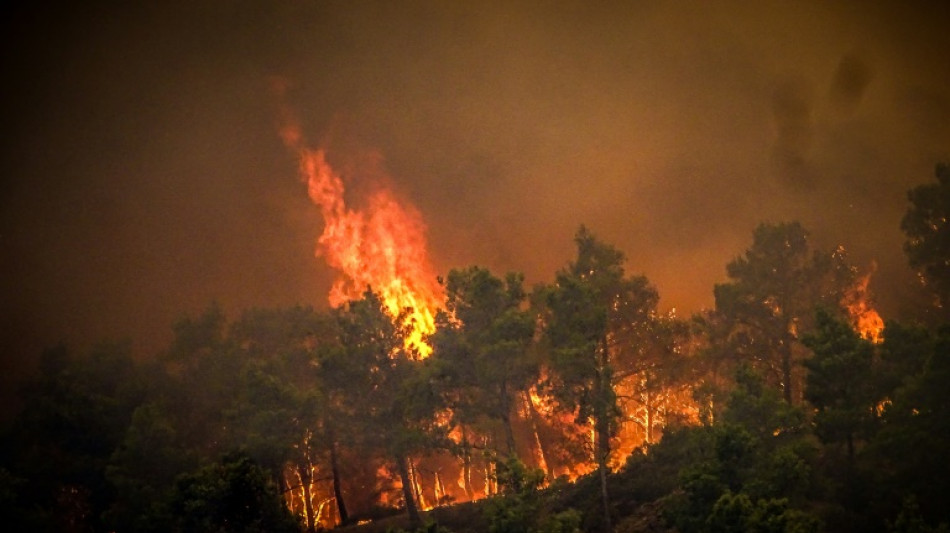
Thousands flee Greek island fires as Northern hemisphere swelters / Photo: EUROKINISSI - Eurokinissi/AFP

 iPhone 18預購後出現可疑扣款 四間銀行調查未授權交易

 Galaxy Tab S12系列效果圖曝光 Ultra擬配雙鏡頭及瀏海螢幕

 Altman tells Fortune OpenAI will not go public in 2026

 ستاندرد آند بورز تثبت تصنيف السعودية عند A+

 Steven Strogatz weighs AI mathematics advances and their consequences for researchers

 Venezuelans outside Caracas say capital not sharing blackout burden

 Anthropic boss calls for slowing pace of AI development

 BRICS nations urge 'maximum restraint' in Middle East war

 Europe eyes battle over 'pervert' AI glasses

 Children in flood-hit Nepal grapple with loss, cling to hope

 Venice Film Festival: A look back on the highlights

 DR Congo school fire stampede death toll rises to 26: UNICEF

 Dance Fitness Tempe Announces Expansion of Accessible Digital Movement Programs

 Europe saw record summer air traffic despite Mideast war: Eurocontrol

 Relatives of 9/11 victims hit out at Saudi Arabia -- and US leaders

 Relative of 9/11 victim unleashes searing attack on Saudi Arabia

 Czech antitrust office lets Turkey's Pegasus Airlines buy Smartwings

 Investors on edge as energy costs, surging bond yields roil markets

 UK lawmakers to vote again on failed assisted dying bill

 Yemen's Houthis complete takeover of Bab al-Mandab area: govt official to AFP

 Fast-pace dance takes I.Coast's working-class streets by storm

 Fans celebrate Celine Dion's Paris return with giant karaoke

 Appreciation, anger await as Trump heads to Irish golf resort

 Putin arrives in India for BRICS summit coloured by wars

 Carney says in touch with Trump, Canada ready for 'fair' trade deal

Around 30,000 people were moved to safety on the Greek island of Rhodes island where a wildfire burned on Saturday, while people in the southern United States struggled under a record-breaking heatwave.
Tens of millions of people have been suffering through intense heat this summer and the world looks set for its hottest July on record.
As temperature records tumble, experts have pointed to climate change driven by the burning of fossil fuels, arguing that global warming is playing a key role in the devastating heat.
On the Mediterranean island of Rhodes, where a wildfire has been blazing for days, boats carried 2,000 people to safety from beaches in the east of the popular tourist island.
Three coastguard ships led more than 30 private vessels in the emergency evacuation, while a Greek navy boat was heading to the area.
Elsewhere dozens of buses took people to safety, while others had to walk where fires had cut off road access.
From the moment the evacuation alert sounded early in the afternoon, tourists had headed for the beach, pulling their suitcases behind them.
People were being taken to gyms, schools and hotel conference centres on the island where they will stay overnight, while firefighters battle the blaze.
The battle to extinguish the fire continues in the area of Laermon and Lardos, where it is raging out of control.
Greece is fighting dozens of forest fires 11 days into a heatwave that has seen temperatures soaring above 40 Celsius (104 Fahrenheit). It could be the longest hot spell the country has ever seen.
- 80 million Americans sweltering -
Across the southern United States, about 80 million Americans will swelter in temperatures of 41C and above this weekend, the National Weather Service (NWS) said.
The country's worst heat of up to 46C is forecast for Phoenix, Arizona, which has seen a record-breaking three weeks in a row of highs above 43C.
Tourists have been flocking to Death Valley National Park, which straddles the border between California and Nevada, to post selfies with a temperature display outside the visitor centre.
Many are hoping to see it break a world record of 56.7C, which was set in July 1913 but was likely the result of a faulty measurement, according to several meteorologists.
Further north, in Canada, which has been suffering wildfires that left Montreal blanketed in smog, torrential rain hit the eastern province of Nova Scotia, cutting off roads and threatening to burst a dam.
Four people were reported missing, including two children who had been in a car engulfed by flood waters.
- Hottest month -
July 2023 is on track to be the hottest month -- not only since records began, but also in "hundreds, if not thousands, of years", said leading NASA climatologist Gavin Schmidt.
The effects cannot be attributed solely to the El Nino weather pattern, which "has really only just emerged" and isn't expected to strengthen until later in the year, he added.
El Nino is associated with the warming of ocean surface temperatures in the central and eastern Pacific Ocean.
Schmidt said the trend of extreme heat was expected to persist, "and the reason why we think that's going to continue, is because we continue to put greenhouse gases into the atmosphere".
The exceptional temperatures in Greece also meant key tourist sites such as the Acropolis closed during the hottest part of the day.
Emergency health officials told the state broadcaster they had admitted at least 38 heatstroke patients in the last three days, while hospitals were also seeing cases of fainting and other heat-related conditions.
Greece is just one of many countries battling a prolonged spell of extreme heat around the globe in recent days.
burs/pvh-lcm/jj
P.Gonzales--CPN