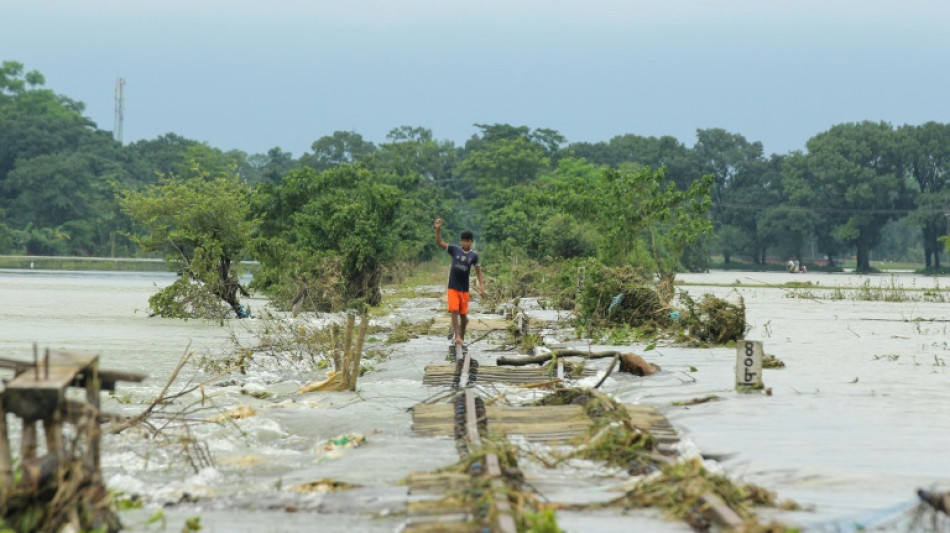
The Anthropocene heralds disaster. Can humans change course? / Photo: Mamun Hossain - AFP/File

 iPhone 18預購後出現可疑扣款 四間銀行調查未授權交易
 Galaxy Tab S12系列效果圖曝光 Ultra擬配雙鏡頭及瀏海螢幕

 Altman tells Fortune OpenAI will not go public in 2026

 ستاندرد آند بورز تثبت تصنيف السعودية عند A+

 Steven Strogatz weighs AI mathematics advances and their consequences for researchers

 Venezuelans outside Caracas say capital not sharing blackout burden

 Anthropic boss calls for slowing pace of AI development

 BRICS nations urge 'maximum restraint' in Middle East war

 Europe eyes battle over 'pervert' AI glasses

 Children in flood-hit Nepal grapple with loss, cling to hope

 Venice Film Festival: A look back on the highlights

 DR Congo school fire stampede death toll rises to 26: UNICEF

 Dance Fitness Tempe Announces Expansion of Accessible Digital Movement Programs

 Europe saw record summer air traffic despite Mideast war: Eurocontrol

 Relatives of 9/11 victims hit out at Saudi Arabia -- and US leaders

 Relative of 9/11 victim unleashes searing attack on Saudi Arabia

 Czech antitrust office lets Turkey's Pegasus Airlines buy Smartwings

 Investors on edge as energy costs, surging bond yields roil markets

 UK lawmakers to vote again on failed assisted dying bill

 Yemen's Houthis complete takeover of Bab al-Mandab area: govt official to AFP

 Fast-pace dance takes I.Coast's working-class streets by storm

 Fans celebrate Celine Dion's Paris return with giant karaoke

 Appreciation, anger await as Trump heads to Irish golf resort

 Putin arrives in India for BRICS summit coloured by wars

 Carney says in touch with Trump, Canada ready for 'fair' trade deal

Her distant ancestors paddled canoes across the Pacific Ocean to settle what became the island nation of Tuvalu, but now climate change means Grace Malie and her generation may live to see those islands swallowed by the sea.
Pacific island nations are ground zero for climate change impacts and their plight embodies the sweeping environmental damage that is the hallmark of the era of humans, the Anthropocene.
Confronted with a warming world that could engulf her home forever, Malie said it would be easy to think she and her people have "no future".
But the 24-year-old climate campaigner said young people are determined to chart their own destiny -- even if they cannot stop planet-heating emissions on their own.
"I remain hopeful," she told AFP in an interview. "My generation is really taking matters into their own hands."
Malie has worked to share the story of her community as part of her role with the Rising Nations Initiative, a global partnership launched by Pacific atoll nations to preserve their sovereignty and heritage.
"There may be solutions out there, things that we've never thought of, innovative ideas," she said.
The fossil fuels that powered the industrial revolution and prosperity have already warmed the planet 1.2 degrees Celsius, unleashing extreme weather and human upheaval.
Last week saw records for the hottest day on Earth, on three successive days.
Oceans, soils and forests have been dangerously degraded, and key life-support systems across the planet are at risk.
Humans have pushed their only home well into the danger zone. Can we change our ways and build a sustainable life on Earth?
Many experts say that is still -- if only just -- within our grasp, and that we should dare to imagine thriving, rather than simply surviving in a blighted world.
- Collapse -
Last year's UN Human Development Report warned that people across the world were facing a perfect storm of uncertainties, linked to the "destabilising planetary pressures and inequalities of the Anthropocene", societal transformations and political polarisation.
Pedro Conceicao, who led the report, said he worries that fears of "collapse" are clouding humanity's ability to envisage a way to flourish.
That echoes concerns from climate scientists that people's sense of "doom" is blocking progress.
Erle Ellis, a professor at the University of Maryland, Baltimore County, concedes that the "best time for it to be a hundred percent carbon neutral is yesterday".
Yet humanity is not trapped in a cycle of destruction, he said.
"We're capable of harnessing unbelievable amounts of energy to do things at scale, we can fly, we can leave the planet," he said.
"Things are changing really fast now, so there are a lot of possible futures that would never have existed in the past, that are realistic now."
But are people imagining these futures? Or how to avoid catastrophe?
"As a writer, as a creator, it is terrifyingly easy to build dystopias," novelist Manda Scott told AFP.
She thinks the answer is "thrutopias" that tell the stories of change, and has run workshops to share these ideas with other writers.
"Our imaginings of the future are very locked within the current system," said Scott, who has also written a new thrutopian novel.
"It's easier to imagine the total extinction of life on Earth than an end to predatory capitalism, because we think this is the way it is."
She describes imagining the transformation human societies and nature might go through in order to thrive as akin to guessing what form a caterpillar might take in adulthood.
"If you didn't know that process, I pretty much guarantee that there is no way you would predict butterfly from caterpillar," she said.
- Charting a path -
Few places have to confront the possibility of radical change more directly than Pacific island nations, with some facing becoming uninhabitable even if the world meets the Paris accord goal of eventually limiting warming to 1.5C.
Tuvalu, Kiribati and the Marshall Islands are calling for a global settlement guaranteeing their states a "permanent existence" even as the seas rise.
It is real stories that inspire Grace Malie, who is working with others to record oral histories for an online cultural archive, part of a push for UNESCO protection for Tuvalu's heritage.
Her grandfather, descended from chiefs, was among those interviewed.
As custodian of the family tree, the 75-year-old can trace heritage going back generations.
"Pacific people come from a long line of voyagers, of warriors and they carry that passion, that resilience," said Malie, who said she was "humbled" to think of the great ocean voyages of her ancestors.
"Kudos to their resilience and hard work and their bravery. That's passed on to us now, and we hope to make them proud."
P.Gonzales--CPN