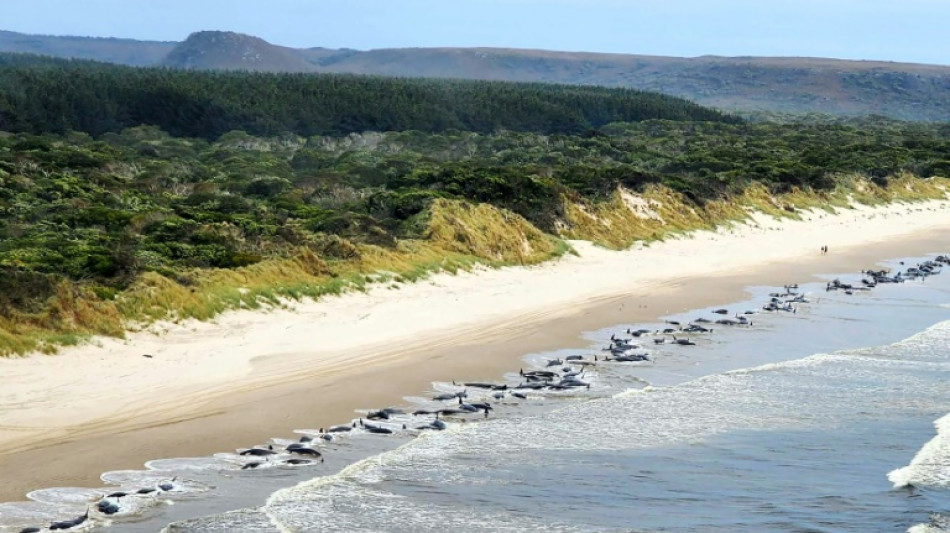
230 pilot whales stranded in Australia, 'about half' feared dead / Photo: HANDOUT - AFP

 Kenya's economy faces climate change risks: World Bank

 'Beginning of the end': Relief but no party as French wildfire winds down

 Southern Europe 'becoming more flammable' in hotter climate, experts say

 Mammoth bones found on parched bed of Danube in Bulgaria

 MEXC Lists Grvt (GRVT) with $60,000 Worth of GRVT and 10,000 USDT in Airdrop+ Rewards

 George and Amal Clooney flee French home due to wildfire

 MEXC Ventures Supports Alpha Arena's APAC Debut at Coinfest Bali

 AI data centre supplier Zhongji InnoLight slips on Hong Kong debut

 May, June heatwaves caused 2,877 extra deaths in England: govt

 BMW profit down a third as carmaker plans job cuts

 Seoul extends losses as most Asian markets drop, oil rises again

 Gambling.com Group Is Now Grandstand

 Meet the astronomer digging into the Milky Way's 'fossils'

 AI data centre supplier Zhongji InnoLight falls on Hong Kong debut

 Samsung operating profit up 1,800% in second quarter on AI boom

 Japanese population below 120 million for first time in decades

 US actor Jared Leto denies latest accusations of sexual assault

 Danube drops to 'historic lows' as fresh heatwave hits
 BTS pulls out of Grammys after Asian pop category introduction
 OpenAI says rogue AI agent attack hit other companies

 How an AFP beach snap became emblem of Europe's wildfire summer

 TRX Spot and Perpetuals Listing Launches on Backpack, Expanding Access to the TRON Ecosystem

 Nepal's tiger numbers climb 20 percent to estimated 429: survey
 FIFA's plans to sell $4.2bn stake in its tournaments widely criticised

 BMW aims to cut 8,000 jobs by end 2027: company source

A pod of 230 pilot whales was found stranded on the rugged west coast of Tasmania Wednesday, with Australian officials saying only half appeared to be alive.
Aerial images showed a devastating scene of dozens of black glossy mammals strewn across a long beach, stuck on the waterline where the frigid southern ocean meets the sand.
Locals covered survivors with blankets and doused them with buckets of water to keep them alive, as other whales nearby tried in vain to twitch free and yet more lay dead.
The whales were "stranded near Macquarie Harbour" said the state's Department of Natural Resources and Environment.
"It appears about half of the animals are alive."
Officials said marine conservation experts and staff with whale rescue gear were en route to the scene.
They will try to refloat animals that are strong enough to survive and likely tow the carcasses out to sea, to avoid attracting sharks to the area.
It is almost two years to the day since Macquarie Harbour was the scene of the country's largest-ever mass stranding, involving almost 500 pilot whales.
More than 300 pilot whales died during that stranding, despite the efforts of dozens of volunteers who toiled for days in Tasmania's freezing waters to free them.
- Distress signals -
The cause of mass strandings is still not fully understood.
Scientists have suggested they could be caused by pods going off track after feeding too close to shore.
Pilot whales -- which can grow to more than six metres (20 feet) long -- are highly sociable and can follow podmates who stray into danger.
That sometimes occurs when old, sick or injured animals swim ashore and other pod members follow, trying to respond to the trapped whale's distress signals.
Others believe gently sloping beaches like those found in Tasmania confuse the whales' sonar making them think they are in open waters.
The news came just hours after a dozen young male sperm whales were reported dead in a separate mass stranding on King Island -- between Tasmania and the Australian mainland.
The young whales' deaths may be a case of "misadventure", wildlife biologist Kris Carlyon from the state government conservation agency told the local Mercury newspaper.
"The most common reason for stranding events is misadventure, they might have been foraging close to shore, there might have been food and possibly they were caught on a low tide," Carlyon said.
"That's the theory at the moment."
In nearby New Zealand strandings are also common.
There, around 300 animals beach themselves annually, according to official figures and it is not unusual for groups of between 20 and 50 pilot whales to run aground.
But numbers can run into the hundreds when a "super pod" is involved -- in 2017, there was a mass stranding of almost 700 pilot whales.
H.Meyer--CPN