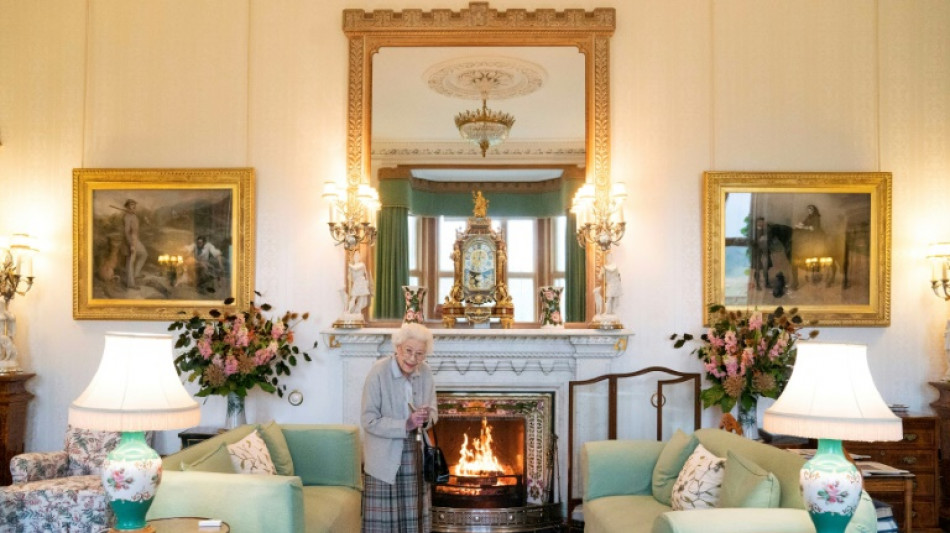
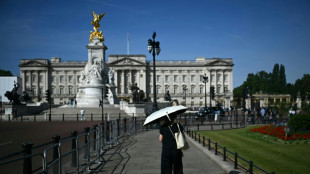
'Grief is the price we pay for love': a week of mourning for Elizabeth II / Photo: Jane Barlow - POOL/AFP/File

 Kenya's economy faces climate change risks: World Bank

 Italy's Po River valley on drought alert

 Prada profits pinched as growth hard to chase

 Stocks climb on earnings and rates, oil retreats

 US economic growth slows in second quarter, missing expectations
 Russia adds Telegram founder Durov to 'terrorist' blacklist

 Stocks diverge on earnings, as oil steadies

 Eurozone economy grows despite Middle East war
 Singapore group will develop 'most promising' Ebola vaccine

 Shell profit surges as Mideast war fuels oil prices
 Car maker Stellantis says back in profit in second quarter

 Samsung quarterly operating profit up 1,800% on AI boom

 South Korean stocks bounce after rout, oil holds gains on Mideast woes

 South Korea's women web sleuths fight AI deepfake porn

 Anything but programmable: New cost-efficient EC-power-supply-series for the DIN rail by CAMTEC PS

 Meta misses profit expectations, sticks to massive AI spending
 Campari - king of the spritz - hopes to conquer American heartland

 Air France-KLM and Lufthansa bid for Portugal's TAP airline

 Profits soar at Airbus as it delivers more planes

 Rheinmetall shares surge after armsmaker reports record profit

 FIFA hit by furious backlash over plans to sell stake in competitions

 MEXC Integrates World-Check to Fortify Institutional Grade Compliance Architecture
 Spain returns wildfire evacuees as France braces for worsening weather

 Russia seeks arrest of Telegram chief Durov

 South Korean stocks plunge as tech rout deepens, oil rises

The outpouring of tributes in the week since Queen Elizabeth II's death has underlined her status as a figure of constancy, straddling two centuries of seismic social, political and technological change.
From world leaders to ordinary people, they recognise the central part Britain's longest-serving monarch has played in national life -- and as a global figure -- for 70 years.
And in the many tributes, what the queen came to represent -- old-fashioned values of dutiful, selfless public service -- seem to be mourned too as much as her loss.
"Queen Elizabeth's was a life well lived; a promise with destiny kept and she is mourned most deeply in her passing," her eldest son -- now King Charles III -- said, the day after she died on September 8, aged 96.
"Alongside the personal grief that all my family are feeling, we also share with so many of you... a deep sense of gratitude for the more than 70 years in which my mother, as queen, served the people of so many nations."
Princess Anne, who accompanied the queen's coffin from her Scottish Highland home at Balmoral to Edinburgh and back to London, also acknowledged her mother's pivotal place in the national psyche.
"Witnessing the love and respect shown by so many on these journeys has been both humbling and uplifting," she said.
"We may have been reminded how much of her presence and contribution to our national identity we took for granted."
Hundreds of thousands of people -- most of whom never met Queen Elizabeth -- have lined the streets to pay their last respects.
More still are expected to file past her coffin as it lies in state before her state funeral at London's Westminster Abbey on Monday.
- Memories and farewells -
Queen Elizabeth enjoyed going out to meet the public and felt she had to be seen to be believed -- something her tall hats and bright outfits aided, given her short stature.
Since her death, people who met the queen have recounted fleeting handshakes and passing smiles, to chance encounters and lengthy interactions.
Soldiers who served in her uniform have queued to give a final salute to their former commander-in-chief.
On Wednesday, applause rang out before her coffin passed the statue of Britain's wartime leader Winston Churchill, the first of her 15 prime ministers.
Floral tributes and messages have sprung up at royal palaces around Britain, and mourners have arranged the flowers themselves in London's Green Park, creating heart shapes and spelling out "Thank You".
Many messages have been written by children, for whom the post-World War II privations when Queen Elizabeth succeeded her father in 1952 will be the childhood memories of their own grand or great-grandparents.
One image that has circulated widely online has been of the queen walking away hand in hand with Paddington Bear, accompanied by one of her beloved Corgi dogs.
"I've done my duties, Paddington," it reads. "Please take me to my husband."
Prince Philip, whom she described as her "constant strength and guide", died in April last year, aged 99.
His death -- and the image of the queen sitting alone at his funeral due to Covid-19 regulations -- jolted Britons into realising her long reign was nearing a close.
Since then, she gradually became more frail and pulled out of public engagements but rallied enough to take part in Platinum Jubilee celebrations in June to mark her 70 years on the throne.
But her final appearance on the Buckingham Palace balcony with Charles, his eldest son Prince William and his eldest son Prince George left little doubt she was passing the crown to future generations.
- 'Reassuring presence' -
The queen carried on her duties until two days before she died, appointing new British Prime Minister Liz Truss on September 6.
Her final public statement came on September 7. As queen of Canada, she sent a message of sympathy for victims of the Saskatchewan stabbings.
Her death the next day was sudden, even if the palace did indicate the end was near with a rare health bulletin six hours before the announcement.
Praise poured in from The Vatican to the United Nations for a woman who came to the throne in the aftermath of World War II, as the Cold War began.
UN Secretary-General Antonio Guterres called her a "reassuring presence throughout decades of sweeping change" as world leaders from Mao Zedong and Nikita Krushchev to Nelson Mandela and Barack Obama came and went -- but she stayed in place.
John Major, her oldest surviving prime minister, said she "embodied the heart and soul of our nation", reflecting a view of her as a link between the past and the present -- and her passing as the end of an era for Britain and the world.
"Grief is the price we pay for love," said US President Joe Biden, reciting her poignant words from the days after the September 11, 2001 attacks.
L.Peeters--CPN