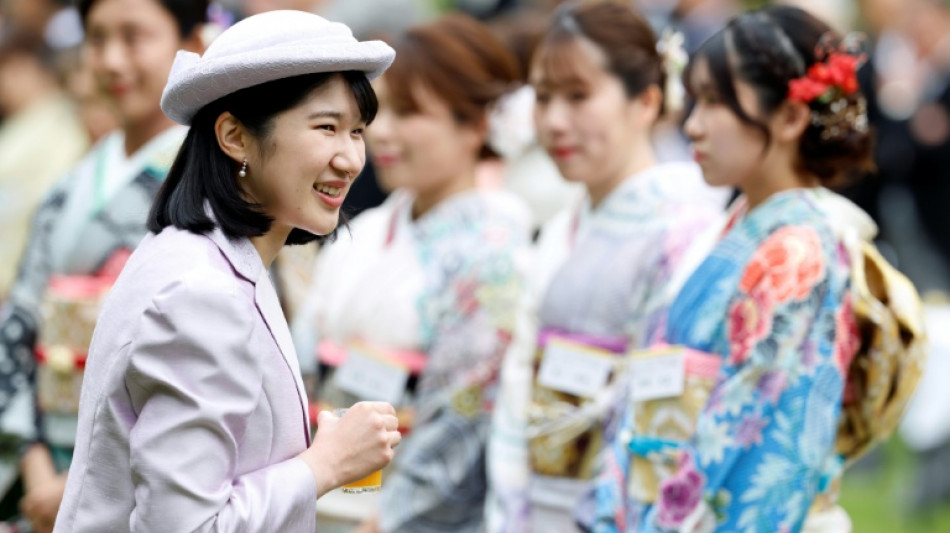
Japan imperial rules tweaked, but still no woman emperor / Photo: Franck ROBICHON - POOL/AFP

 Lights out in Laos as electricity exports surge

 Steven Strogatz weighs AI mathematics advances and their consequences for researchers

 Anthropic boss calls for AI slowdown, Altman and Musk agree

 French IT giant Capgemini sells subsidiary after row over ICE links

 Quebec Brokerage Qubit Insurance Announces New Data on Coverage Shortfalls as Rebuilding Costs Rise

 Lady Gaga welcomes first child with fiance: US media

 Bhutan business bets on hazelnuts for farming future

 'Widow's Bay' and 'The Pitt' are favorites for Emmys night

 Coastal erosion forces cancellation of California music festival

 Argentina's Dirty War rears its head in Venice film

 UK lawmakers throw out bill to legalise assisted dying

 US inflation steady in August, fueling Fed rate hike expectations

 New York marks 25th anniversary of 9/11 attacks

 Nepal flood reconstruction bill to be $4.78 bn: foreign ministry

 JUMO and Standard Bank launch Social Finance Framework to scale inclusive finance in Africa

 Doomsday tech: could AI really kill us all?

 French comedy show 'Call my agent' makes film comeback

 It's all coming back: Celine Dion fans gear up for Paris return

 Researchers eye AI revolution in natural disaster forecasts

 US braces for inflation report that may push Fed to hike rates

 Musk threatens legal action over documentary

 Latin America fact-check group asks Meta not to replace verification practice

 AI Risks to Enter 60–80% of Liability and Cyber Insurance Underwriting by 2028, ScienceSoft Predicts

 Tribal Launches Campfire, Letting Business and Technical Teams Build on Salesforce Together

 Stocks fall as fresh oil surge fans inflation fears

Japan's parliament tweaked the imperial succession law on Friday but maintained the bar on women emperors -- despite surveys suggesting wide public support for the idea.
The future of the imperial household -- mythically descended from the Shinto sun goddess Amaterasu -- hinges currently on Prince Hisahito, the 19-year-old nephew of Emperor Naruhito, 66.
If Hisahito -- a fan of dragonflies currently studying biology and who is not married -- has no son, then under the rules as they stand he will have no heir and the bloodline will end.
There have been eight female emperors on the Chrysanthemum Throne in Japan's imperial family, whose divine status was renounced after World War II.
But an 1889 imperial house law stipulated that only men could become emperor, and only through the paternal line. This was carried over in 1947 into the current Imperial Household Law.
This rules out the popular Princess Aiko, 24, daughter of Naruhito, or any other royal woman ever becoming emperor.
The bill, passed by the upper house on Friday, allows the adoption of male distant relatives aged over 15 back into the imperial family -- as long as they are single -- and for their future sons to become eligible to ascend the throne.
They are members of 11 families that left the imperial register after Japan's defeat in World War II.
Their common ancestor to the current emperor dates back to the 15th century and is "remote by 36 to 38 degrees of kinship", the Imperial Household Agency says.
The new rules also end the practice of women losing their royal status after marrying a commoner, although because of their gender their children still cannot become emperor.
In 2021, for example, former princess Mako Komuro, Naruhito's niece and one of Hisahito's two older sisters, officially left the family after marrying her university sweetheart.
- 'Utterly outrageous' -
The legislation passed after wrangling within the ruling Liberal Democratic Party (LDP) led by Japan's first woman prime minister, Sanae Takaichi, who opposes female succession.
Seiichiro Murakami, a veteran of the conservative LDP, said after the bill passed the lower house on July 10 that it was "utterly outrageous" to rule out Aiko becoming emperor.
Asahiro Kuni, 81, a member of one of the 11 imperial branches, has also said he would advise his grandchildren to refuse the opportunity of becoming royals.
"By the age of 15, a person has grown up breathing the air of freedom," Kuni told the Asahi Shimbun daily.
"There might be people who want to join the imperial family, but, if they understood the hardships of life as a royal member, they probably wouldn't say such a thing," Kuni added.
A poll conducted by the Mainichi Shimbun last month found only 23 percent of people in favour of the sons of re-adopted imperial family members becoming emperor, and 34 percent against.
By contrast, more than 70 percent supported a woman emperor, and 40 percent a matrilineal one.
An Asahi Shimbun poll in May also showed 72 percent of respondents in favour of changing the rules to allow women to ascend the throne.
The imperial family now has 16 members in total, including five men -- retired emperor Akihito, 92, his brother, 90, the 66-year-old emperor, his brother, and Hisahito.
Hideya Kawanishi, a professor at Nagoya University and expert in Japan's emperor system, told AFP that the new bill "fails to reflect public opinion".
"For the conservative camp of the ruling Liberal Democratic Party and the likes, the overriding goal is to preserve the male-line, male-only succession to the throne, and that is precisely why they do not want to listen to the voices of the people," he said.
"This is because the solid conservative base that supports them harbours attitudes akin to male chauvinism, and this measure was probably necessary in order to secure their votes in elections," he said.
"I believe these amendments carry the risk of undermining public support for the symbolic Emperor system."
X.Cheung--CPN