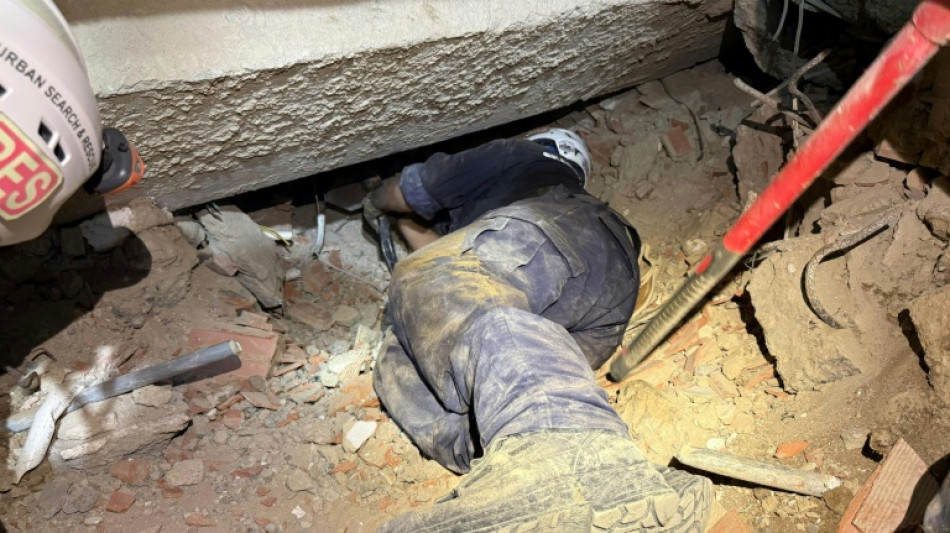
How rescuers carried out 180-hour 'miracle' amid Venzuela's ruins / Photo: Handout - City of Miami Fire-Rescue/AFP

 Lights out in Laos as electricity exports surge

 Steven Strogatz weighs AI mathematics advances and their consequences for researchers

 Anthropic boss calls for AI slowdown, Altman and Musk agree

 French IT giant Capgemini sells subsidiary after row over ICE links

 Quebec Brokerage Qubit Insurance Announces New Data on Coverage Shortfalls as Rebuilding Costs Rise

 Lady Gaga welcomes first child with fiance: US media

 Bhutan business bets on hazelnuts for farming future

 'Widow's Bay' and 'The Pitt' are favorites for Emmys night

 Coastal erosion forces cancellation of California music festival

 Argentina's Dirty War rears its head in Venice film

 UK lawmakers throw out bill to legalise assisted dying

 US inflation steady in August, fueling Fed rate hike expectations

 New York marks 25th anniversary of 9/11 attacks

 Nepal flood reconstruction bill to be $4.78 bn: foreign ministry

 JUMO and Standard Bank launch Social Finance Framework to scale inclusive finance in Africa

 Doomsday tech: could AI really kill us all?

 French comedy show 'Call my agent' makes film comeback

 It's all coming back: Celine Dion fans gear up for Paris return

 Researchers eye AI revolution in natural disaster forecasts

 US braces for inflation report that may push Fed to hike rates

 Musk threatens legal action over documentary

 Latin America fact-check group asks Meta not to replace verification practice

 AI Risks to Enter 60–80% of Liability and Cyber Insurance Underwriting by 2028, ScienceSoft Predicts

 Tribal Launches Campfire, Letting Business and Technical Teams Build on Salesforce Together

 Stocks fall as fresh oil surge fans inflation fears

In two decades as a rescuer, Kevin Meyers had never faced an operation as challenging as helping to free a man trapped under 160 tons of concrete and bricks after the double earthquake in Venezuela.
The rescue of Hernan Gil, who survived 183 hours buried after the June 24 disaster, became a symbol of hope to the South American nation now mourning at least 3,535 dead and thousands more missing.
But it also left a lasting mark on the dozens of rescuers who worked for nearly four days to extract Gil, a security guard, alive from the rubble of a building in La Guaira, a state neighboring Caracas and the one most affected by the earthquakes.
"One hundred percent the most challenging in my career," said Meyers, from the US team Florida Task Force 2, which joined dozens of international missions in Venezuela to search for survivors.
"There have been technical rescues that I've been on in my career that use a portion of the skills that were used today, but this one kind of put it all together."
"It was an extremely complex operation," agreed Víctor Torres of the Chilean Fire Department's USAR team, who described the operation as one of the most difficult in the unit's 175-year history.
Rescuers from the United States, Chile, Portugal, El Salvador, Mexico, Costa Rica, and Venezuela shared angst, and finally joy, when Gil emerged from his confinement around 9:00 a.m. on July 2nd.
- Signs of Life -
Gil was on duty in the basement of the Sol Marino Garden Residences in Catia La Mar, on the Venezuelan coast, when at 6:04 p.m. on that Wednesday, the earth shook and swallowed him.
While he cried out for help and tried to pray to stay calm as the aftershocks continued, rescuers outside were trying to locate him.
Two days after the earthquakes, Chilean rescuers inspected the area and returned with radar equipment after gathering the accounts of neighbors.
Three readings showed signs of life.
On June 29, when another tremor cornered Gil even further, teams from El Salvador and Costa Rica entered through a parking lot connected to the area where they believed Gil was. They started digging a first tunnel.
Through a second tunnel dug by the Chileans, in the early morning of June 30, they heard Gil's voice faintly.
"They were calling me and telling me to stay quiet, to listen for the knocking and tell them" where I heard it, Gil recounted.
With his responses, Torres pinpointed the location and was able to touch Gil's fingers. "It was a very emotional moment," the rescuer recalled.
Through that hole, they passed a hydration tube and a mini-camera to monitor him.
But the rescue would suffer another setback.
- "Sky's the limit" -
The Chilean plan became unfeasible due to the high risk of collapse if they continued digging. With the collaboration of teams from Los Angeles and Florida, they decided to try another approach.
The tension mounted as the rescuers dug tirelessly.
"I felt the pressure from the engineers: the more horizontally the tunnel advanced, the more unstable it became," recounted Torres, who participated in the rescue of 33 miners in Chile in 2010.
"It was a moment that in emergencies we call 'go or no go,' you either go or you stay," he said.
They stayed. And Gil's wife, Gusbimar Gonzalez, who had been watching over the rescue operation the whole time, was able to embrace her husband again. "Those were the longest eight days of my life," she told AFP.
But just when Gil's rescue seemed imminent, the rescuers hit yet another snag: the security guard's legs were stuck in a chair.
Torres and Eric DeArmas, from Florida Task Force 2, looked at each other. They knew Gil would have to make one last effort.
"He pushed a little bit. He turned toward us and we grabbed his arms, and we began to lift them up," DeArmas said.
Gil felt like he was going to faint.
DeArmas, usually so composed, couldn't hold back his tears.
"It was just overwhelming relief and happiness and joy for him, you know, and yeah, I broke down a little bit. I even gave him a kiss on his head," DeArmas recounted with a smile.
"I think we all learned a little bit of something in our own way," Meyers said. "Me, personally, I learned that the sky's the limit."
pr/lp/ad/pma/dw
X.Cheung--CPN