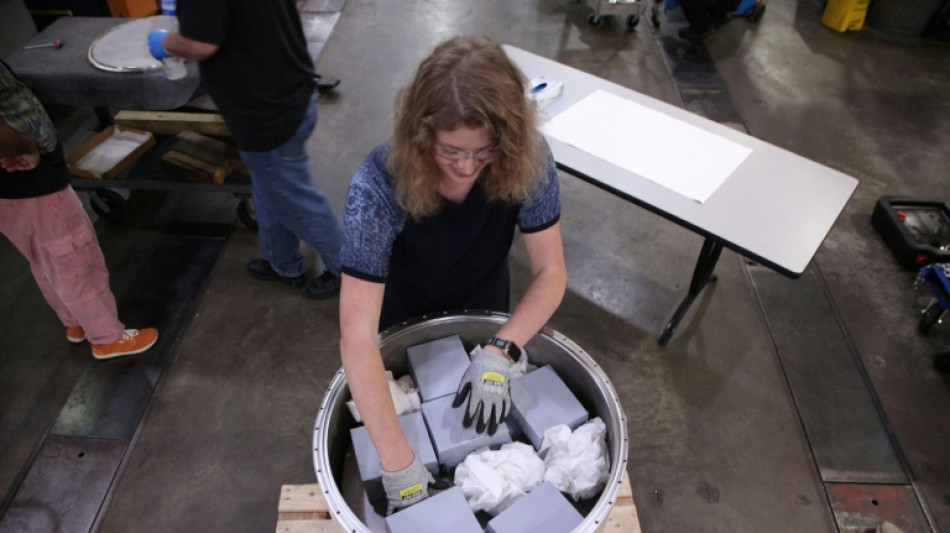
Do not open until 2276: US burying time capsule to mark July 4 / Photo: Rich PRESS - National Institute of Standards and Technology/AFP

 Lights out in Laos as electricity exports surge

 Steven Strogatz weighs AI mathematics advances and their consequences for researchers

 Anthropic boss calls for AI slowdown, Altman and Musk agree

 French IT giant Capgemini sells subsidiary after row over ICE links

 Quebec Brokerage Qubit Insurance Announces New Data on Coverage Shortfalls as Rebuilding Costs Rise

 Lady Gaga welcomes first child with fiance: US media

 Bhutan business bets on hazelnuts for farming future

 'Widow's Bay' and 'The Pitt' are favorites for Emmys night

 Coastal erosion forces cancellation of California music festival

 Argentina's Dirty War rears its head in Venice film

 UK lawmakers throw out bill to legalise assisted dying

 US inflation steady in August, fueling Fed rate hike expectations

 New York marks 25th anniversary of 9/11 attacks

 Nepal flood reconstruction bill to be $4.78 bn: foreign ministry

 JUMO and Standard Bank launch Social Finance Framework to scale inclusive finance in Africa

 Doomsday tech: could AI really kill us all?

 French comedy show 'Call my agent' makes film comeback

 It's all coming back: Celine Dion fans gear up for Paris return

 Researchers eye AI revolution in natural disaster forecasts

 US braces for inflation report that may push Fed to hike rates

 Musk threatens legal action over documentary

 Latin America fact-check group asks Meta not to replace verification practice

 AI Risks to Enter 60–80% of Liability and Cyber Insurance Underwriting by 2028, ScienceSoft Predicts

 Tribal Launches Campfire, Letting Business and Technical Teams Build on Salesforce Together

 Stocks fall as fresh oil surge fans inflation fears

Americans living in 2276 will get a taste of what their ancestors today think best represents the nation thanks to a time capsule to be buried this July 4.
The 900 pound (400 kilo) stainless steel cylinder will go into the ground Saturday, as the nation marks its 250th birthday, not far from where the Declaration of Independence was signed in Philadelphia.
It is not supposed to be opened for another 250 years, in 2276.
But it is not the only such gift for US people far off in the future. Another time capsule scheduled for opening when the United States turns 500 years old was unveiled a few days ago in Washington.
The contents of the Washington one are not widely known but the capsule due to be buried in Philadelphia near Independence Hall has spilled all its secrets.
All 50 states, five US territories such as Puerto Rico, plus an array of sporting and cultural organizations have made contributions to this collective national snapshot.
Together it all makes for "a representative record of the United States at 250 years," said Rosie Rios, chairwoman of America250, the official organization behind the national commemoration of the anniversary.
- Eagle feather and AI -
Wisconsin, for instance, has contributed a brown feather. It comes from a bald eagle known as "Old Abe" -- named for president Abraham Lincoln -- that served as a mascot to Union troops in over 30 battles in the US Civil War.
Ohio has offered a piece of fabric from the wings of the airplane built by Wilbur and Orville Wright, the pioneers who made aviation history in 1903 with the first powered, sustained flight.
From Maine comes a bone from the endangered North Atlantic right whale.
Other states opted for the stuff of modern life, such as California, which offers the response from the AI chatbot Claude to this prompt: "Write me a prediction of what California will be like 250 years from July 4, 2026."
America250 itself has chipped in a late-model orange iPhone.
Other pieces of Americana that made the cut: a bookmark made by the Wabanaki, a Native American tribe; a diamond from Arkansas; a recipe for anis-flavored cookies from New Mexico; and an Oklahoma City Thunder pin from when the team won the NBA basketball championship in 2025.
- Enduring underground -
Other ideas were discarded, like a leather American football, because of doubts it would endure 250 years underground.
Jay Nanninga, a National Institute of Standards and Technology mechanical engineer who designed the time capsule, had to address such storage issues. It was decided to bury the objects rather than insert them in a statue.
He considered different shapes for the container -- like a square or even a star -- but thought it best to avoid having seams and joints, so a stainless steel cylinder won the day.
The cylinder will be placed inside a metallic bell that leaves an air pocket that is supposed to keep moisture out of the inner chamber.
The cylinder itself is sealed with a thin protective layer of a soft, malleable metal called indium.
Papers destined to be read in 250 years are stored in a separate compartment inside the cylinder and sealed, while the other objects were placed in cardboard boxes.
Nanninga said engineers have watched how stainless steel aged over the 100 years it has been in use, and he thinks the material will hold up well in this national exercise of self-storage.
"I do think in 250 years all the stainless will be in really good shape," he said.
America has done this kind of thing before.
A time capsule buried in 1876 was opened in 1976.
Another capsule, created for that year's bicentennial, is stored at the National Archives, to be opened in 2076, said Rios.
She said when the new capsule buried in Philadelphia is finally opened in 2276, "we want future generations to have a clear, authentic window into who we were at 250."
"What we valued, what we built, and how we saw ourselves as a nation," she added.
es/llb/dw/msp
A.Levy--CPN