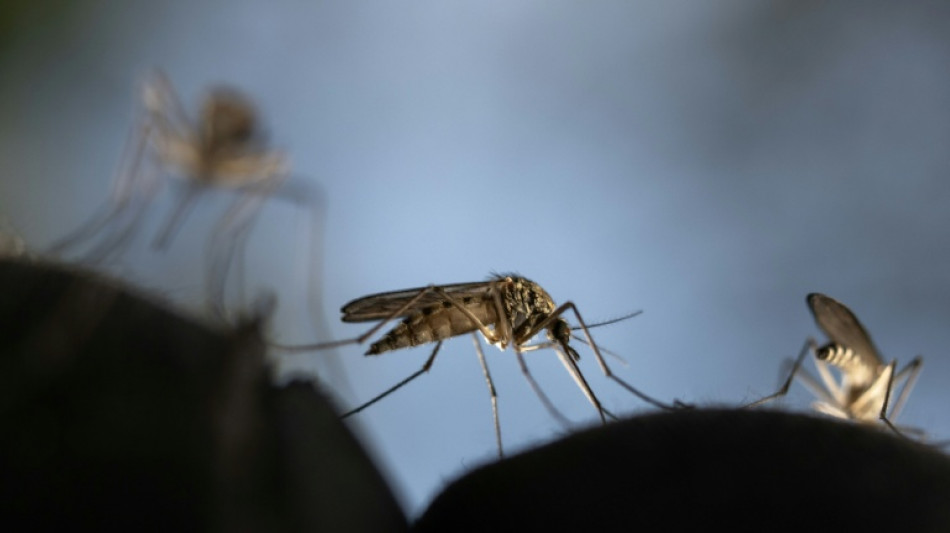
Mosquitoes can learn to love common repellent, scientists find / Photo: Olivier MORIN - AFP/File

 Lights out in Laos as electricity exports surge

 Steven Strogatz weighs AI mathematics advances and their consequences for researchers

 Anthropic boss calls for AI slowdown, Altman and Musk agree

 French IT giant Capgemini sells subsidiary after row over ICE links

 Quebec Brokerage Qubit Insurance Announces New Data on Coverage Shortfalls as Rebuilding Costs Rise

 Lady Gaga welcomes first child with fiance: US media

 Bhutan business bets on hazelnuts for farming future

 'Widow's Bay' and 'The Pitt' are favorites for Emmys night

 Coastal erosion forces cancellation of California music festival

 Argentina's Dirty War rears its head in Venice film

 UK lawmakers throw out bill to legalise assisted dying

 US inflation steady in August, fueling Fed rate hike expectations

 New York marks 25th anniversary of 9/11 attacks

 Nepal flood reconstruction bill to be $4.78 bn: foreign ministry

 JUMO and Standard Bank launch Social Finance Framework to scale inclusive finance in Africa

 Doomsday tech: could AI really kill us all?

 French comedy show 'Call my agent' makes film comeback

 It's all coming back: Celine Dion fans gear up for Paris return

 Researchers eye AI revolution in natural disaster forecasts

 US braces for inflation report that may push Fed to hike rates

 Musk threatens legal action over documentary

 Latin America fact-check group asks Meta not to replace verification practice

 AI Risks to Enter 60–80% of Liability and Cyber Insurance Underwriting by 2028, ScienceSoft Predicts

 Tribal Launches Campfire, Letting Business and Technical Teams Build on Salesforce Together

 Stocks fall as fresh oil surge fans inflation fears

Mosquitoes can learn to associate the smell of the world's most common insect repellent with a tasty meal -- and after training can even prefer to bite people who have been sprayed with it, an experimental study said Thursday.
The surprising results, which were conducted "under very specific conditions" in the lab, do not "call into question the effectiveness" of the repellent DEET, lead study author Claudio Lazzari told AFP.
Since being developed in the 1940s in the United States, the chemical compound has saved many lives from the scourge of insect bites.
"It is the absolute gold standard for repellents, used by the World Health Organization to combat the transmission of mosquito-borne diseases," emphasised Lazzari, professor emeritus at the Insect Biology Research Institute at France's University of Tours.
However the world also needs to find new, more effective, environmentally friendly repellents that cause fewer allergies, he added.
That means figuring out exactly why insects are so turned off by the repellents that we do have.
"We don't know why" compounds like DEET deter mosquitoes, Lazzari admitted. Are they toxic for the little blood-suckers? Do they stop mosquitoes from tracking down our scent? Or do they just smell bad?
To find out more, the international team of scientists used a form of conditioning made famous by Pavlov's dog, which learned to associate the arrival of food with the sound of a ball.
- 'Paradigm shift' -
For the experiment, the mosquitoes were put in a fabric mesh enclosure, then presented with a bag of warm sheep's blood to observe how eagerly they fed on it.
Unsurprisingly, the Aedes aegypti mosquitoes -- which spread deadly diseases such as dengue fever, Zika, yellow fever, and chikungunya -- leapt at the chance.
When the smell of DEET was introduced, the mosquitoes moved away, which was also expected.
Next, the scientists fed the insects warm blood for 20 seconds, releasing DEET during the last 10 seconds.
That part was repeated three times before the mosquitoes were exposed to solely the scent of the repellent.
This time, more than 60 percent of the insects tried to bite the fabric -- even though there was no blood.
Then, one of the scientists offered up their hands -- one clean, the other coated with DEET -- to the trained mosquitoes to see which one they would bite.
The result was beyond doubt: the insects preferred the hand covered in repellent.
The scientists had similar results when they repeated the experiment using sugar instead of blood, because mosquitoes mostly feed on plant nectar in the wild.
"The common assumption has always been that repellents work because of their chemistry," study co-author Clement Vinauger of Virginia Tech in the United States said in a statement.
But this study shows "that it's not the chemistry of the molecule itself that is toxic" to the mosquito, instead they are repelled by how they "interpret this chemical information," Lazzari added.
"What we are showing is that the mosquito's brain can rewrite that response based on experience," Vinauger explained.
"What the insect has learned matters just as much as what the chemical does. That, I think, is a paradigm shift."
While the mosquitoes were trained relatively quickly during the experiment, in nature "very specific conditions would be needed for things to happen the same way," Lazzari emphasised.
He advised everyone to follow the instructions on their repellent, because DEET can come in a variety of concentrations.
The study was published in the Journal of Experimental Biology.
Y.Jeong--CPN