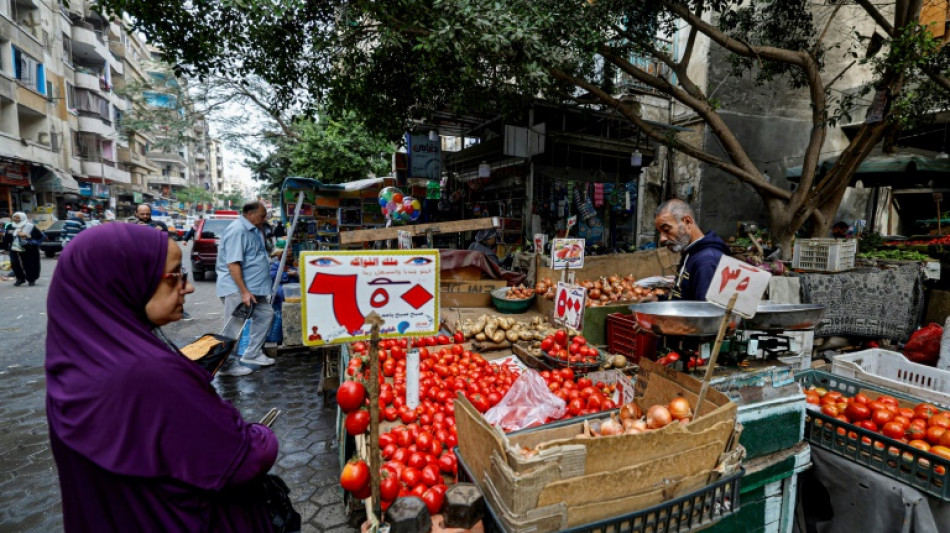
Egypt's middle class cuts costs as IMF-backed reforms take hold / Photo: Khaled DESOUKI - AFP/File

 Kenya's economy faces climate change risks: World Bank
 Anthropic's models gained unauthorized 'real-world' access during testing

 Apple tops estimates in CEO Cook's final quarter, but shares fall

 Milei demands expulsion of foreigners expressing 'hate' against Argentina

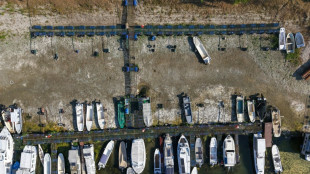
 Italy's Po River valley on drought alert

 Prada profits pinched as growth hard to chase
 Stocks climb on earnings and rates, oil retreats

 US economic growth slows in second quarter, missing expectations

 Russia adds Telegram founder Durov to 'terrorist' blacklist

 Stocks diverge on earnings, as oil steadies

 Eurozone economy grows despite Middle East war
 Singapore group will develop 'most promising' Ebola vaccine

 Shell profit surges as Mideast war fuels oil prices
 Car maker Stellantis says back in profit in second quarter

 Samsung quarterly operating profit up 1,800% on AI boom

 South Korean stocks bounce after rout, oil holds gains on Mideast woes

 South Korea's women web sleuths fight AI deepfake porn

 Anything but programmable: New cost-efficient EC-power-supply-series for the DIN rail by CAMTEC PS
 Meta misses profit expectations, sticks to massive AI spending

 Campari - king of the spritz - hopes to conquer American heartland
 Air France-KLM and Lufthansa bid for Portugal's TAP airline

 Profits soar at Airbus as it delivers more planes

 Rheinmetall shares surge after armsmaker reports record profit

 FIFA hit by furious backlash over plans to sell stake in competitions

 MEXC Integrates World-Check to Fortify Institutional Grade Compliance Architecture

Egypt's economy has been in crisis for years, but as the latest round of International Monetary Fund-backed reforms bites, much of the country's middle class has found itself struggling to afford goods once considered basics.
The world lender has long backed measures in Egypt including a liberal currency exchange market and weaning the public away from subsidies.
On the ground, that has translated into an eroding middle class with depleted purchasing power, turning into luxuries what were once considered necessities.
Nourhan Khaled, a 27-year-old private sector employee, has given up "perfumes and chocolates".
"All my salary goes to transport and food," she said as she perused items at a west Cairo supermarket, deciding what could stay and what needed to go.
For some, this has extended to cutting back on even the most basic goods -- such as milk.
"We do not buy sweets anymore and we've cut down on milk," said Zeinab Gamal, a 28-year-old housewife.
Most recently, Egypt hiked fuel prices by 17.5 percent last month, marking the third increase just this year.
The measures are among the conditions for an $8 billion IMF loan programme, expanded this year from an initial $3 billion to address a severe economic crisis in the North African country.
- Mounting pressures -
"The lifestyle I grew up with has completely changed," said Manar, a 38-year-old mother of two, who did not wish to give her full name.
She has taken on a part-time teaching job to increase her family's income to 15,000 Egyptian pounds ($304), just so she can "afford luxuries like sports activities for their children".
Her family has even trimmed their budget for meat, reducing their consumption from four times to "only two times per week".
Egypt, the Arab world's most populous country, is facing one of its worst economic crises ever.
Foreign debt quadrupled since 2015 to register $160.6 billion in the first quarter of 2024. Much of the debt is the result of financing for large-scale projects, including a new capital east of Cairo.
The war in Gaza has also worsened the country's economic situation.
Repeated attacks on Red Sea shipping by Yemen's Huthi rebels in solidarity with Palestinians in Gaza have resulted in Egypt's vital Suez Canal -- a key source of foreign currency -- losing over 70 percent of its revenue this year.
Amid growing public frustration, officials have recently signalled a potential re-evaluation of the IMF programme.
"If these challenges will make us put unbearable pressure on public opinion, then the situation must be reviewed with the IMF," President Abdel Fattah al-Sisi said last month.
Prime Minister Mostafa Madbouly also ruled out any new financial burdens on Egyptians "in the coming period", without specifying a timeframe.
Economists, however, say the reforms are already taking a toll.
Wael Gamal, director of the social justice unit at the Egyptian Initiative for Personal Rights, said they led to "a significant erosion in people's living conditions" as prices of medicine, services and transportation soared.
He believes the IMF programme could be implemented "over a longer period and in a more gradual manner".
- 'Bitter pill to swallow' -
Egypt has been here before. In 2016, a three-year $12-billion loan programme brought sweeping reforms, kicking off the first of a series of currency devaluations that have decimated the Egyptian pound's value over the years.
Egypt's poverty rate stood at 29.7 percent in 2020, down slightly from 32.5 percent the previous year in 2019, according to the latest statistics by the country's CAPMAS agency.
But Gamal said the current IMF-backed reforms have had a "more intense" effect on people.
"Two years ago, we had no trouble affording basics," said Manar.
"Now, I think twice before buying essentials like food and clothing," she added.
Earlier this month, the IMF's managing director Kristalina Georgieva touted the programme's long-term impact, saying Egyptians "will see the benefits of these reforms in a more dynamic, more prosperous Egyptian economy".
Her remarks came as the IMF began a delayed review of its loan programme, which could unlock $1.2 billion in new financing for Egypt.
Economist and capital market specialist Wael El-Nahas described the loan as a "bitter pill to swallow", but called it "a crucial tool" forcing the government to make "systematic" decisions.
Still, many remain sceptical.
"The government's promises have never proven true," Manar said.
Egyptian expatriates send about $30 billion in remittances per year, a major source of foreign currency.
Manar relies on her brother abroad for essentials, including instant coffee which now costs 400 Egyptian pounds (about $8) per jar.
"All I can think about now is what we will do if there are more price increases in the future," she said.
U.Ndiaye--CPN