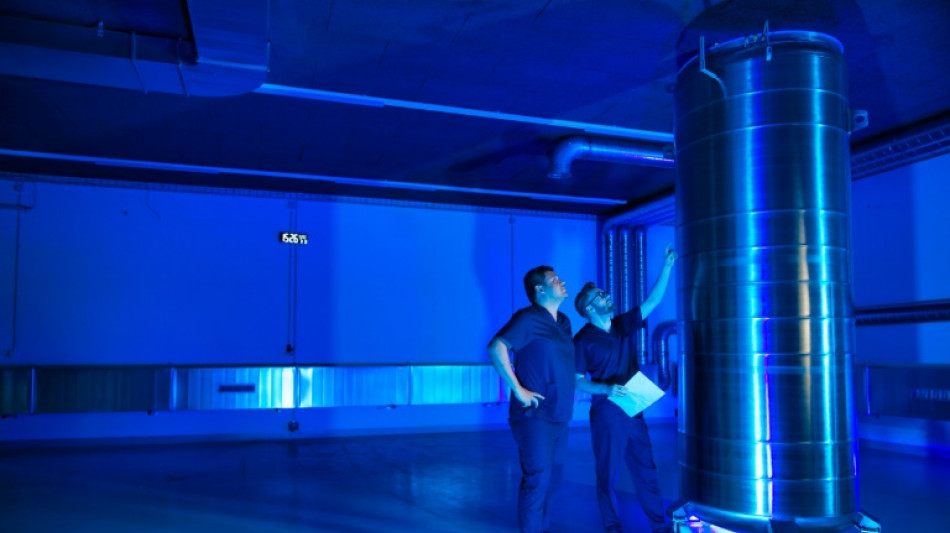
Stiff business: Berlin startup will freeze your corpse for monthly fee / Photo: Handout - TOMORRROW BIOSTASIS/AFP

 Kenya's economy faces climate change risks: World Bank

 Anthropic's models gained unauthorized 'real-world' access during testing

 Apple tops estimates in CEO Cook's final quarter, but shares fall

 Milei demands expulsion of foreigners expressing 'hate' against Argentina

 Italy's Po River valley on drought alert

 Prada profits pinched as growth hard to chase

 Stocks climb on earnings and rates, oil retreats

 US economic growth slows in second quarter, missing expectations

 Russia adds Telegram founder Durov to 'terrorist' blacklist

 Stocks diverge on earnings, as oil steadies

 Eurozone economy grows despite Middle East war

 Singapore group will develop 'most promising' Ebola vaccine

 Shell profit surges as Mideast war fuels oil prices

 Car maker Stellantis says back in profit in second quarter

 Samsung quarterly operating profit up 1,800% on AI boom

 South Korean stocks bounce after rout, oil holds gains on Mideast woes

 South Korea's women web sleuths fight AI deepfake porn

 Anything but programmable: New cost-efficient EC-power-supply-series for the DIN rail by CAMTEC PS

 Meta misses profit expectations, sticks to massive AI spending

 Campari - king of the spritz - hopes to conquer American heartland

 Air France-KLM and Lufthansa bid for Portugal's TAP airline

 Profits soar at Airbus as it delivers more planes

 Rheinmetall shares surge after armsmaker reports record profit

 FIFA hit by furious backlash over plans to sell stake in competitions

 MEXC Integrates World-Check to Fortify Institutional Grade Compliance Architecture

Becca Ziegler is only 24, but she already has her death planned out: her corpse will be deep-frozen to minus 200 degrees Celsius (minus 328 degrees Fahrenheit) with liquid nitrogen.
Ziegler, a US tech firm worker based in Berlin, has signed up with Tomorrow Biostasis, a startup in the German capital that offers to cryogenically freeze a person's body after they die.
When the time comes, a team of medics will pump her full of a chemical solution to stop ice crystals from forming in her body and then transport her mortal remains to a storage facility in Switzerland.
The hope is that one day, medical technology might be advanced enough to bring her back to life. Many experts dismiss this gamble on the future as far-fetched, but Ziegler has decided to give it a shot.
"I'm kind of curious to see what the future would be like and, in general, I like life," said the Californian, who works in educational technology.
"So if I could buy myself more time, that sounds really appealing."
Once a fringe pursuit reserved for eccentric billionaires, cryogenic freezing -- also known as cryonics -- has become more accessible in recent years.
Several companies offering cryopreservation have sprung up in the United States and elsewhere, with around 500 people worldwide thought to have been frozen so far.
A persistent myth has it that Walt Disney, the creator of Mickey Mouse, is one of them, but this has been debunked, with BBC reporting in 2019 there is "zero evidence" for this.
Tomorrow Biostasis, founded in 2020, is thought to be the first such company offering the service in Europe. It offers to freeze your body after you die and store it for a membership fee of 50 euros a month.
A lump-sum payment of 200,000 euros ($216,000) -- or 75,000 euros if you opt to have just your brain frozen -- is also due at the time of death, a cost that can be covered by a life insurance payout.
- Liquid nitrogen -
"One of the main goals of this company is to bring the cost down... so that cryopreservation becomes available to whoever chooses to do it," said Emil Kendziorra, one of the co-founders of Tomorrow Biostasis.
Kendziorra, 38, from the western German city of Darmstadt, studied medicine and originally worked in cancer research but said he became frustrated with the slow pace of developments in the field.
"The one big advantage of cryopreservation is that it is something that you can do right now," he said.
When a client dies, Tomorrow Biostasis promises to dispatch a specially equipped ambulance and a medical team that starts cooling the body using ice and water as soon as possible.
The body is then infused with a "cryoprotectant" and transported to the facility in Switzerland where it is stored in a pod surrounded by liquid nitrogen and cooled to around minus 200 degrees Celsius.
Tomorrow Biostasis says it currently has around 700 paying members, and by the end of last year had cryopreserved four people.
The typical customer is aged 30 to 40, healthy, works in technology and is more likely to be male than female, said Kendziorra.
- No guarantees -
No one has ever been brought back to life after being cryopreserved, but proponents say recent advances in technology have made the prospect more plausible.
In an experiment almost a decade ago, scientists said they were able to cryopreserve the brain of a rabbit and recover it in near-perfect condition.
And this year, researchers at China's Fudan University reported using a new technique to freeze human brain tissue so that it regained normal function after thawing.
Nonetheless, some scientists voice deep scepticism about the bet on a future return to life.
Holger Reinsch, head of the Cryo Competence Center at the ILK Dresden research institute for refrigeration technologies, said bringing a person back to life is still a remote prospect.
"We are rather critical of the concept of cryonics... I personally would advise you against such an endeavour," he said.
"The magic limit for the life-sustaining cryopreservation of tissue structures is a frog's heart the size of a fingernail, and this has not changed since the 1970s."
Even Kendziorra admitted that there are no guarantees.
"I think there's a good chance for it, but do I know for sure? Absolutely not."
But whatever happens in the future, Ziegler is confident she will not regret her decision.
"In some ways it's weird," she conceded. "But on the other hand the alternative is to be put in a box in the ground and get eaten by worms."
D.Goldberg--CPN