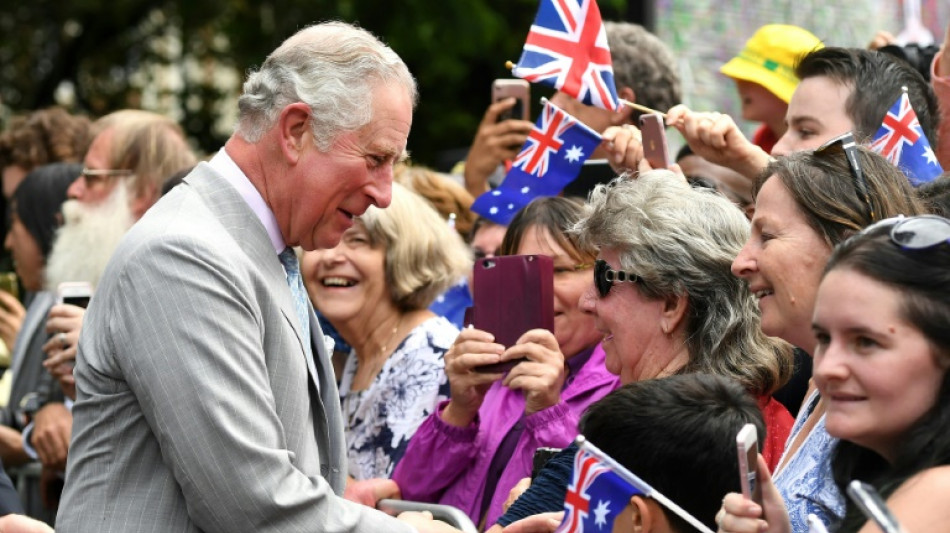
King Charles heads to Australia, a nation shrugs / Photo: DAN PELED - POOL/AFP

 Kenya's economy faces climate change risks: World Bank

 Cables and cooling bring AI windfall to Indian suppliers

 Anthropic's models gained unauthorized 'real-world' access during testing

 Apple tops estimates in CEO Cook's final quarter, but shares fall

 Milei demands expulsion of foreigners expressing 'hate' against Argentina

 Italy's Po River valley on drought alert

 Prada profits pinched as growth hard to chase

 Stocks climb on earnings and rates, oil retreats

 US economic growth slows in second quarter, missing expectations

 Russia adds Telegram founder Durov to 'terrorist' blacklist

 Stocks diverge on earnings, as oil steadies

 Eurozone economy grows despite Middle East war

 Singapore group will develop 'most promising' Ebola vaccine

 Shell profit surges as Mideast war fuels oil prices

 Car maker Stellantis says back in profit in second quarter

 Samsung quarterly operating profit up 1,800% on AI boom

 South Korean stocks bounce after rout, oil holds gains on Mideast woes

 South Korea's women web sleuths fight AI deepfake porn

 Anything but programmable: New cost-efficient EC-power-supply-series for the DIN rail by CAMTEC PS
 Meta misses profit expectations, sticks to massive AI spending
 Campari - king of the spritz - hopes to conquer American heartland
 Air France-KLM and Lufthansa bid for Portugal's TAP airline

 Profits soar at Airbus as it delivers more planes

 Rheinmetall shares surge after armsmaker reports record profit
 FIFA hit by furious backlash over plans to sell stake in competitions

On the eve of King Charles III's landmark tour Down Under, many of his antipodean subjects are unaware or uninterested -- a sign, experts say, of a more diverse and less Anglo-centric Australia.
There is no red-white-and-blue bunting around Sydney Harbour, no posters on the city's streets and aside from cries from ardent monarchists and republicans, little chatter about the first visit of a sitting Australian monarch in 13 years.
"I'd forgotten they were even coming," said 73-year-old Sydneysider Trevor Reeves summing up the mood in Australia's largest city.
This six-day royal visit to Sydney and Canberra will undoubtedly bring pomp, ceremony and plenty of media coverage.
Even with the schedule skimmed back because of Charles' cancer diagnosis, there will be extravagant mass gatherings, including an event in front of the Opera House and a sprawling community barbecue.
But few expect Charles and Camilla's visit to match the buzz of nation-stopping royal visits past -- including Charles and his first wife Diana's trip in 1983.
Today Aussies appear more preoccupied with war in the Middle East, the US election, or another group of British visitors -- rock group Oasis -- who will tour next year.
"I'm not excited, but I don't begrudge them coming out," said 72-year-old Susanne Lowire. "They don't have much impact over here."
"Some people just love it as they love movie stars" said Lowire, likening the royals to musical brothers Liam and Noel Gallagher.
"Are they going to fight again? Do they sound terrible? It's the same with the king and the queen coming over," she said.
University of Sydney historian Cindy McCreery believes the lack of attention being paid to the royal visit is understandable amid worries about war, climate change and the cost of living.
"We live in a complex moment with all the global issues," she said. It is "natural to expect a more varied response to the monarchy".
However, decades-long demographic trends are also shaping perceptions.
- A changing nation -
About 36 percent of Australians still identify as "English", the country's largest ancestry, according to a 2021 census.
That figure was 10 points higher when the census first asked that question in 1986.
About a third of Australians today were born overseas, and the population is steadily becoming more Italian, Greek, Lebanese, Indian or Chinese.
"That impacts how Australians connect or do not connect," McCreery said.
"In previous royal visits, people may have had a stronger connection to Britain, but a growing number of people may not necessarily have that immediate connection."
Polls show about a third of Australians would like to ditch the monarchy, a third would keep it, and a third are ambivalent.
So no sweeping constitutional change is on the cards, and the issue is political dead rubber.
While Australia voted against becoming a republic in 1999, the movement remains active, but in political purgatory.
Australia's Prime Minister Anthony Albanese is a lifelong republican and even created a minister for the republic when he came to office.
The post was quietly scrapped earlier this year and Albanese, having heavily lost a referendum on Indigenous rights, has ruled out going back to the voters about the royals.
- Royal collectors -
The royals are not without Australian fans.
Still, even Jan Hugo, one of the largest royal memorabilia collectors in the Southern Hemisphere, will not travel two hours to Sydney to see the king and queen, when they visit.
Her home in rural New South Wales could be mistaken for a museum. Every corner is bursting with more than 10,000 pieces of royal memorabilia.
Hugo admits she has given up counting how many items she has.
"It's probably worth a fortune to me and nothing to somebody else," she said.
It all started 40 years ago when she was given a commemorative coin for the engagement of Charles and Diana.
Now, most of Hugo's home is dedicated to the royal family, with unusual trinkets lining the walls.
A large statue of Queen Elizabeth II sits on a throne surrounded by her beloved corgis.
Hugo said the republic debate rears its head every time the royals visit, but whatever Australia decides she just hopes to get her hands on some memorabilia.
Ch.Lefebvre--CPN