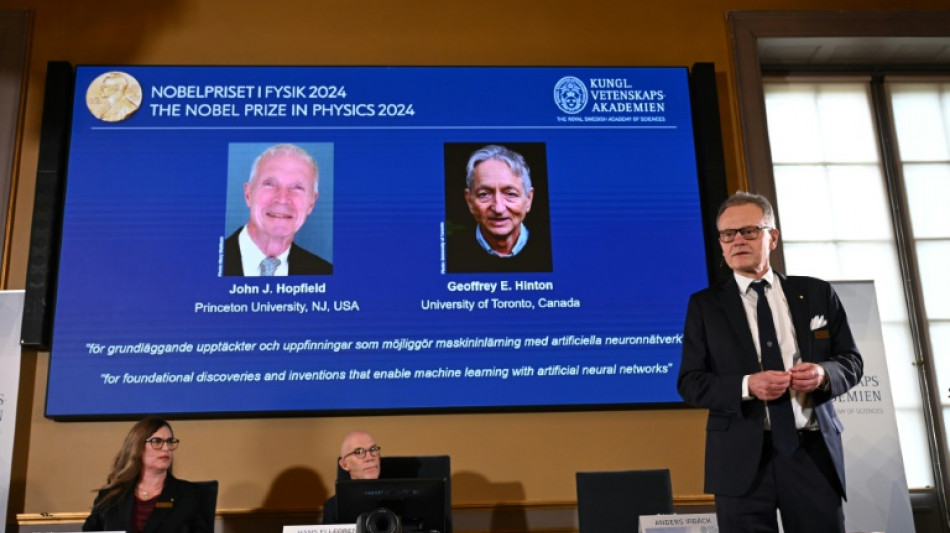
Duo wins Physics Nobel for key breakthroughs in AI / Photo: Jonathan NACKSTRAND - AFP

 Kenya's economy faces climate change risks: World Bank
 Tech rebound fuels record-breaking rally in South Korean stocks
 Cables and cooling bring AI windfall to Indian suppliers
 Anthropic's models gained unauthorized 'real-world' access during testing
 Apple tops estimates in CEO Cook's final quarter, but shares fall

 Milei demands expulsion of foreigners expressing 'hate' against Argentina

 Italy's Po River valley on drought alert

 Prada profits pinched as growth hard to chase

 Stocks climb on earnings and rates, oil retreats

 US economic growth slows in second quarter, missing expectations

 Russia adds Telegram founder Durov to 'terrorist' blacklist

 Stocks diverge on earnings, as oil steadies

 Eurozone economy grows despite Middle East war

 Singapore group will develop 'most promising' Ebola vaccine

 Shell profit surges as Mideast war fuels oil prices

 Car maker Stellantis says back in profit in second quarter

 Samsung quarterly operating profit up 1,800% on AI boom

 South Korean stocks bounce after rout, oil holds gains on Mideast woes

 South Korea's women web sleuths fight AI deepfake porn

 Anything but programmable: New cost-efficient EC-power-supply-series for the DIN rail by CAMTEC PS

 Meta misses profit expectations, sticks to massive AI spending

 Campari - king of the spritz - hopes to conquer American heartland

 Air France-KLM and Lufthansa bid for Portugal's TAP airline

 Profits soar at Airbus as it delivers more planes
 Rheinmetall shares surge after armsmaker reports record profit

American John Hopfield and British-Canadian Geoffrey Hinton won the Nobel Prize in Physics on Tuesday for pioneering work in the development of artificial intelligence.
The pair were honoured "for foundational discoveries and inventions that enable machine learning with artificial neural networks," the jury said.
"These artificial neural networks have been used to advance research across physics topics as diverse as particle physics, material science and astrophysics," Ellen Moons, chair of the Nobel Committee for Physics, told a press conference.
Moons also noted that these tools have also become part of our daily lives, including in facial recognition and language translation.
"Humans carry the responsibility for using this new technology in a safe and ethical way," she said.
Hopfield, a 91-year-old professor at Princeton University, was spotlighted for having created "an associative memory that can store and reconstruct images and other types of patterns in data."
- 'Flabbergasted' -
The jury said Hinton, a 76-year-old professor at the University of Toronto, "invented a method that can autonomously find properties in data, and so perform tasks such as identifying specific elements in pictures."
"I'm flabbergasted, I had no idea this would happen," Hinton told reporters via a phone interview as the laureates were announced in Stockholm.
Hinton said he was an avid user of AI tools such as ChatGPT, but also conceded that he had concerns about the potential impact of the technology he helped spawn.
"In the same circumstances, I would do the same again, but I am worried that the overall consequence of this might be systems more intelligent than us that eventually take control," the researcher added.
The Nobel Prize in Physics is the second Nobel of the season after the Medicine Prize on Monday was awarded to American scientists Victor Ambros and Gary Ruvkun.
The US duo were honoured for their discovery of microRNA and its role in how genes are regulated.
Awarded since 1901, the Nobel Prizes honour those who have, in the words of prize creator and scientist Alfred Nobel, "conferred the greatest benefit on humankind".
Last year, the Nobel Prize in Physics went to France's Pierre Agostini, Hungarian-Austrian Ferenc Krausz and Franco-Swede Anne L'Huillier for research using ultra quick light flashes that enable the study of electrons inside atoms and molecules.
The physics prize will be followed by the chemistry prize on Wednesday, with the highly watched literature and peace prizes to be announced on Thursday and Friday respectively.
The economics prize wraps up the 2024 Nobel season on October 14.
The winners will receive their prize, consisting of a diploma, a gold medal and a $1 million cheque, from King Carl XVI Gustaf at a formal ceremony in Stockholm on December 10, the anniversary of the 1896 death of scientist Alfred Nobel who created the prizes in his last will and testament.
H.Müller--CPN