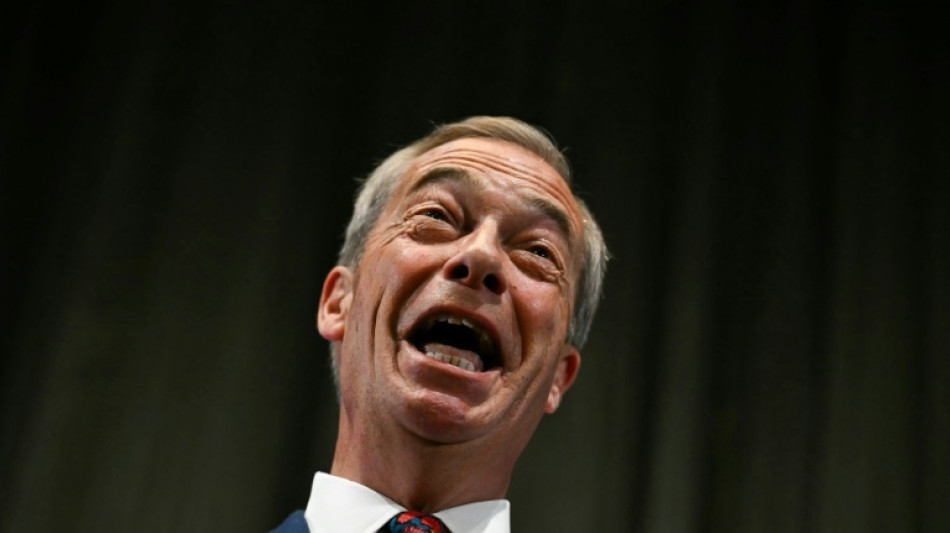
Nigel Farage: eighth time lucky for Brexit figurehead? / Photo: Ben Stansall - AFP

 Kenya's economy faces climate change risks: World Bank
 Chipmaker Kioxia reports AI-driven 45-fold surge in quarterly net profit

 Far right and far left battle for power in polarised Berlin

 The last trio: S.Africa's zoo elephants await their fate

 Oil industry sees war windfall but girds for political blowback

 Amazon beats expectations with cloud and AI growth

 Blowout Microsoft results lift US stocks as oil retreats

 'Beginning of the end': Relief but no party as French wildfire winds down

 Southern Europe 'becoming more flammable' in hotter climate, experts say

 Mammoth bones found on parched bed of Danube in Bulgaria

 MEXC Lists Grvt (GRVT) with $60,000 Worth of GRVT and 10,000 USDT in Airdrop+ Rewards

 George and Amal Clooney flee French home due to wildfire

 MEXC Ventures Supports Alpha Arena's APAC Debut at Coinfest Bali

 AI data centre supplier Zhongji InnoLight slips on Hong Kong debut

 May, June heatwaves caused 2,877 extra deaths in England: govt

 BMW profit down a third as carmaker plans job cuts

 Seoul extends losses as most Asian markets drop, oil rises again

 Gambling.com Group Is Now Grandstand

 Meet the astronomer digging into the Milky Way's 'fossils'

 AI data centre supplier Zhongji InnoLight falls on Hong Kong debut

 Samsung operating profit up 1,800% in second quarter on AI boom

 Japanese population below 120 million for first time in decades
 US actor Jared Leto denies latest accusations of sexual assault
 Danube drops to 'historic lows' as fresh heatwave hits
 BTS pulls out of Grammys after Asian pop category introduction
Nigel Farage, who announced on Monday an eighth bid to become a British MP, has risen from fringe eurosceptic rabble-rouser to an attention-grabbing figurehead who wants to "reshape" right-wing UK politics.
The 60-year-old former Member of the European Parliament (MEP) was a driving force behind Britain's 2016 Brexit vote, before forging a career more recently as a presenter on the upstart right-wing TV channel GB News.
A vocal Donald Trump advocate nicknamed "Mr Brexit" by the former US president, Farage is a similarly divisive figure in the UK, loved and loathed in apparent equal measure by supporters and detractors.
Seen as one of Britain's most effective communicators and campaigners, his decision to stand in a eurosceptic seat in Clacton, southeast England, in the general election on July 4 poses particular peril for the embattled ruling Conservatives.
It is also a dramatic U-turn, after he initially said he would not try again to become an MP.
This is the eighth of his so far unsuccessful attempts to become a member of the UK parliament.
Farage's candidacy will be seen as a huge boost for the populist Reform UK, which is campaigning on a pro-Brexit, anti-immigration, anti-net zero platform that threatens to draw right-wing support away from the Tories.
That could help the main Labour opposition, which polls show is on course to win the election, and leave Farage in a powerful position in its aftermath.
Alternatively, if Labour underperforms expectations, he could become a potential kingmaker in horse-trading for a coalition government.
Farage told the Sunday Times that, in the long term, he aims to stage a "takeover" of the Conservatives, likening his bid to 1990s-era efforts to remould Canada's Conservative Party.
"I want to reshape the centre-right," he told the newspaper, adding he did not have "any trust" in the Tories, who have been in power since 2010.
- 'Everyman' -
Nigel Paul Farage, a beer-loving divorced father-of-four whose father was a stockbroker, is on paper an unlikely populist, appearing to embody much of what he rails against.
The privately educated former commodities trader was an MEP in Brussels for 20 years, yet he railed against the European Union that paid his salary and regularly lambasts both "career politicians" and "the global elite".
Cheered by his supporters as a straight-talking, pint-swilling "everyman", opponents accuse him of being a hypocrite who plays to racists and far-right ideologues.
But Farage has an uncanny ability to capture media attention, capitalising on right-wing voters' frustrations over how Brexit has been handled.
In 1985 he had a cancerous testicle removed, and was hit by a car after a night out in 1987, suffering serious head and leg injuries.
Once recovered, he married his nurse, and the couple had two sons.
- Profile -
Following their divorce in 1997, Farage married second wife Kirsten Mehr, a German, with whom he has two daughters. They separated in 2017.
On general election day in May 2010, a light aircraft he was in crashed after a campaign banner got caught in a propeller.
He escaped relatively unscathed with just broken bones and a punctured lung.
Farage's political ascent began in 1993 when Britain, under the ruling Conservatives, joined in a process of deeper European integration.
He quit the Tories in disgust to co-found the eurosceptic UK Independence Party (UKIP) and six years later won election to the European Parliament aged 35.
Farage had two stints leading UKIP, pulling off an unprecedented win in the 2014 European Parliament elections, while also making seven failed bids to become a British MP over the years.
The 2014 results heaped pressure on then-prime minister David Cameron to call the European Union membership referendum that would eventually seal his demise.
Farage was kept out of the official Leave campaign in the run-up to the Brexit referendum. Leave feared his brand was too divisive.
But he maintained a high profile, hammering away at the immigration issue -- and sparking enduring criticism by unveiling a poster of refugees under the slogan "breaking point".
In the afterglow of victory, Farage stepped down as UKIP leader, claiming his mission was complete.
But he soon returned to frontline politics, founding the Brexit Party in response to the political paralysis around leaving the EU and then helping rebrand it as Reform following the UK's eventual withdrawal in 2020.
M.Mendoza--CPN