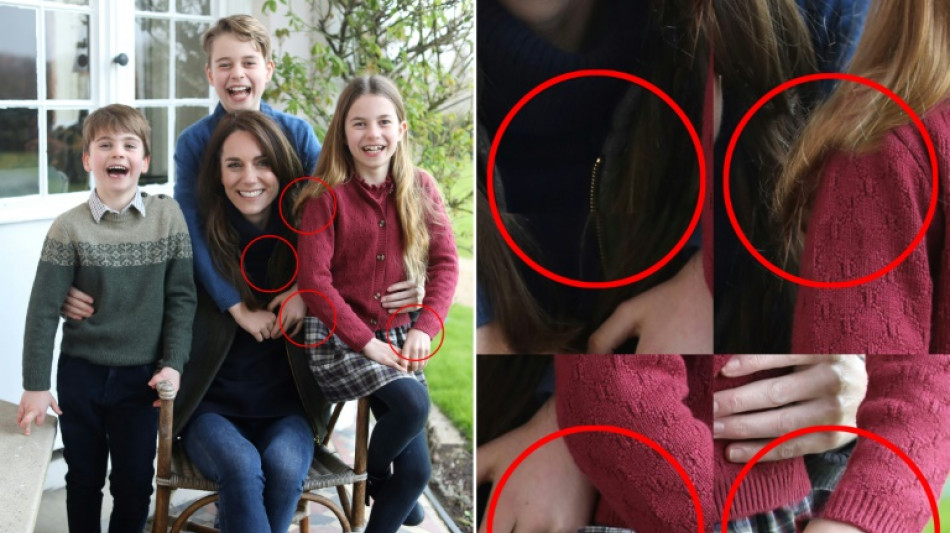
'Katespiracy' explodes after UK royal photo gaffe / Photo: Prince of Wales - KENSINGTON PALACE/AFP

 Kenya's economy faces climate change risks: World Bank

 Japan probe made closest-ever asteroid flyby: space agency
 British oil giant BP aims to sell North Sea business

 China factory activity slides as leaders seek spending boost

 Tech rebound fuels record-breaking rally in South Korean stocks

 Cables and cooling bring AI windfall to Indian suppliers

 Anthropic's models gained unauthorized 'real-world' access during testing

 Apple tops estimates in CEO Cook's final quarter, but shares fall

 Milei demands expulsion of foreigners expressing 'hate' against Argentina

 Italy's Po River valley on drought alert

 Prada profits pinched as growth hard to chase

 Stocks climb on earnings and rates, oil retreats

 US economic growth slows in second quarter, missing expectations

 Russia adds Telegram founder Durov to 'terrorist' blacklist

 Stocks diverge on earnings, as oil steadies

 Eurozone economy grows despite Middle East war

 Singapore group will develop 'most promising' Ebola vaccine

 Shell profit surges as Mideast war fuels oil prices

 Car maker Stellantis says back in profit in second quarter

 Samsung quarterly operating profit up 1,800% on AI boom

 South Korean stocks bounce after rout, oil holds gains on Mideast woes

 South Korea's women web sleuths fight AI deepfake porn

 Anything but programmable: New cost-efficient EC-power-supply-series for the DIN rail by CAMTEC PS

 Meta misses profit expectations, sticks to massive AI spending

 Campari - king of the spritz - hopes to conquer American heartland

The picture was meant to douse speculation about the whereabouts and health of Britain's Catherine, Princess of Wales, but instead her manipulated image unleashed a torrent of internet-breaking rumors and conspiracy theories.
The storm in the royal tea pot erupted after Kate, 42, on Monday apologized and admitted to editing a palace-issued photograph of herself with her three children after the altered image was withdrawn by news agencies including AFP.
The fiasco gave way to a fresh swirl of speculation about the British royal -- dubbed online as "Katespiracy" -- laying bare the fragility of the digital landscape in the age of rampant disinformation that has eroded trust and turned social media users into amateur sleuths.
The internet guessing game had already begun after the princess was not seen in public since attending a Christmas Day church service and underwent abdominal surgery in January.
Amid a vacuum of information, online posts speculated whether her marriage to William, heir to the British throne, was on the rocks. Others pondered whether Kate was recovering from an eating disorder or the cosmetic procedure known as a Brazilian butt lift -- while some wondered whether she were even alive.
Proof of life landed on Sunday, when the palace released a photograph they said was recently snapped by William, but eagle-eyed social media users began tearing it apart for inconsistencies, such as a misaligned zipper on Kate's jacket.
The inconsistencies were so clear that several global news agencies, including AFP, pulled the picture from publication.
Then the rumor mill began spinning even faster after the princess declared in a statement that, whoops, she had edited the photograph -- without disclosing the reasons for doing so or what she had edited out.
"The moral of the editing of the royal picture is simple. Tell all," wrote Guardian newspaper columnist Simon Jenkins.
"At this stage, privacy does not work. It breeds rumour, gossip and fabrication."
- Internet rabbit holes -
That is exactly what happened. Social media exploded with memes exploring what the palace was hiding.
Kensington Palace declined to release an unedited copy of the photograph, prompting social media detectives to go down new rabbit holes.
Some observers called it the Streisand effect, royal edition -- the palace secrecy and botched PR had made the speculation about Kate worse, leaving even those who typically steer clear of such gossip hooked.
There were questions about whether or not it was actually Kate who had edited the image.
Some turned to horticulturists, demanding to know the plant in the background of the altered photograph, as it looked suspiciously leafy for this time of the year in England.
A breed of self-declared Kate Middleton Truthers demanded to know her whereabouts, while some speculated –- with a dash of humor -- whether she had ditched her family to do an intensive Photoshop course.
An entreaty from royal sympathizers seemingly went ignored as they insisted Kate was entitled to her privacy and should to be left alone.
- 'Transparency' -
The manipulated image dropped at a time when concerns around false or misleading visual information are at an all-time high, particularly following the rapid advances in generative artificial intelligence.
"People now feel a pervasive, low-grade disorientation, suspicion, and distrust," US writer Charlie Warzel wrote in the Atlantic Monthly.
"As the royal photo fiasco shows, the deepfake age doesn't need to be powered by generative AI -- a hasty Photoshop will do."
The furore also prompted many to ask whether British royals had altered images before, with media outlets such as CNN saying they were reviewing all handout photos previously provided by Kensington Palace.
The climate of online distrust has spurred new calls for transparency, even among British royal family members with a long tradition of secrecy.
Last month, King Charles III, Kate's father-in-law, won plaudits for publicly announcing his cancer diagnosis.
But many health experts faulted him for not declaring the type of cancer, a move that would have encouraged members of the British public to emulate him and get themselves examined.
"If the royals really want to model important values to the nation, they should start by overhauling their approach to media in favour of transparency (and) scrupulous honesty," Catherine Mayer, author of the book "Charles: The Heart of a King," wrote on X.
"They should stand against disinformation, not contribute to it."
L.K.Baumgartner--CPN