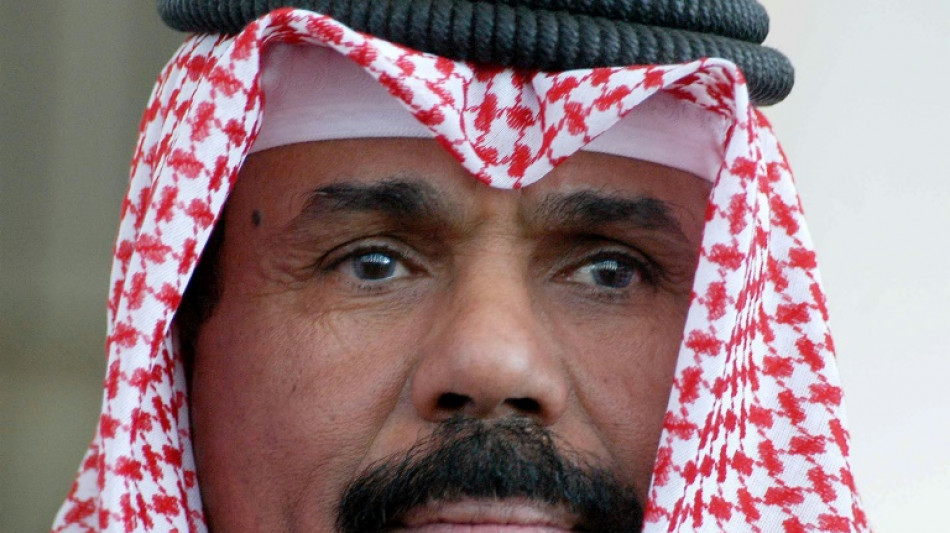
Kuwait's Sheikh Nawaf: a short but tumultuous reign / Photo: YASSER AL-ZAYYAT - AFP/File

 Kenya's economy faces climate change risks: World Bank

 US Fed dissenters call for rate hikes over sustained inflation
 New York sues online prediction markets giant Kalshi

 Profits surge at US oil giant amid Iran war supply shock
 Stock markets rally on tech rebound
 France, Spain assess scorched terrain as new wildfires threaten other regions

 Chipmaker Kioxia reports AI-driven 45-fold surge in quarterly net profit

 Far right and far left battle for power in polarised Berlin

 The last trio: S.Africa's zoo elephants await their fate
 Oil industry sees war windfall but girds for political blowback

 Amazon beats expectations with cloud and AI growth

 Blowout Microsoft results lift US stocks as oil retreats

 'Beginning of the end': Relief but no party as French wildfire winds down

 Southern Europe 'becoming more flammable' in hotter climate, experts say

 Mammoth bones found on parched bed of Danube in Bulgaria

 MEXC Lists Grvt (GRVT) with $60,000 Worth of GRVT and 10,000 USDT in Airdrop+ Rewards

 George and Amal Clooney flee French home due to wildfire

 MEXC Ventures Supports Alpha Arena's APAC Debut at Coinfest Bali
 AI data centre supplier Zhongji InnoLight slips on Hong Kong debut

 May, June heatwaves caused 2,877 extra deaths in England: govt

 BMW profit down a third as carmaker plans job cuts

 Seoul extends losses as most Asian markets drop, oil rises again

 Gambling.com Group Is Now Grandstand

 Meet the astronomer digging into the Milky Way's 'fossils'
 AI data centre supplier Zhongji InnoLight falls on Hong Kong debut

Sheikh Nawaf al-Ahmad Al-Sabah served as Kuwait's emir for just three years but spent decades in top posts through the House of Sabah's tumultuous rule of the oil-rich state.
Sheikh Nawaf, who died on Saturday aged 86, was defence minister when Iraq invaded in 1990, setting off a war that drew in armies from around the world to end the occupation.
He was interior minister when Kuwaiti security forces battled Islamist militants in January 2005.
Despite the episodes that have deeply marked Kuwait's history, Sheikh Nawaf's low-key style never saw him fall out of favour.
He was named crown prince in 2006 by his half-brother Sheikh Sabah al-Ahmad Al-Sabah and took over as emir when he died in September 2020 at the age of 91.
The current crown prince, Sheikh Mishal al-Ahmad al-Sabah, another half-brother, is 83 and much attention will now be focused on whether a younger ruler is brought in by the family.
Sheikh Nawaf showed a rare sign of public emotion when he was formally sworn in by the Gulf state's Gulf state's national assembly in 2020.
Born in 1937, Sheikh Nawaf was the fifth son of Kuwait's late ruler from 1921 to 1950 Sheikh Ahmad al-Jaber Al-Sabah.
He received secondary schooling in Kuwait but did not go on to higher education.
He started his political career at 25 as governor of Hawalli province, where he remained until 1978, before taking on the role of interior minister for a decade.
- Battered economy -
Sheikh Nawaf became defence minister two years before the start of the seven-month Iraqi occupation in 1991.
After the liberation by a US-led international force, he was named minister for social affairs and excluded from the government formed after the first post-war election in 1992.
Sheikh Nawaf returned as deputy commander of the national guard in 1994 and in 2003 became interior minister again.
This period was marked by a series of deadly clashes between Kuwaiti security forces and Islamic militants in January 2005.
On becoming emir, Sheikh Nawaf had to steer the economy through a crisis caused by a fall in oil prices that saw Kuwait's credit rating cut by international agencies in 2020.
He acknowledged the "serious" challenges in his inauguration speech and the government spent heavily -- doubling public debt in 18 months -- to guide the state through the Covid-19 pandemic.
He made few dramatic changes, however.
Kuwait has maintained its hardline stance on Israel even as Bahrain and the United Arab Emirates have established relations. It remains a diplomatic rarity in maintaining close relations with both Saudi Arabia and its regional rival Iran.
Mohammed al-Faily, an expert in constitutional law at Kuwait University, said Sheikh Nawaf was generally considered "a calm person who, when it calls for it, can take firm decisions".
The future for the royal family remains uncertain.
There are bitter divisions within the Sabah family, with lurid accusations of corruption and political conspiracies lodged by some members against rivals.
Kuwait's constitution stipulates only that the ruler should be a descendant of the nation's founder, Mubarak Al-Sabah. By tradition, the throne had alternated between the Salem and Jaber branches of the family.
But that pattern has been broken this decade, with Sheik Sabah, Sheikh Nawaf and the heir-apparent Sheikh Mishal all from the Jaber clan.
H.Meyer--CPN